
Stained glass is coloured glass as a material or works created from it. Throughout its thousand-year history, the term has been applied almost exclusively to the windows of churches and other significant religious buildings. Although traditionally made in flat panels and used as windows, the creations of modern stained glass artists also include three-dimensional structures and sculpture. Modern vernacular usage has often extended the term "stained glass" to include domestic lead light and objets d'art created from foil glasswork exemplified in the famous lamps of Louis Comfort Tiffany.

Murano is a series of islands linked by bridges in the Venetian Lagoon, northern Italy. It lies about 1.5 km (1 mi) north of Venice and measures about 1.5 km (1 mi) across with a population of just over 5,000. It is famous for its glass making. It was once an independent comune, but is now a frazione of the comune of Venice.
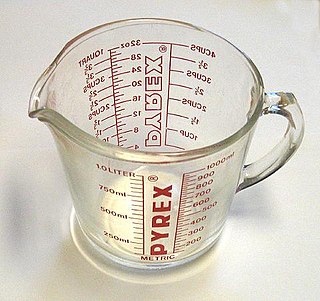
Pyrex is a brand introduced by Corning Inc. in 1915 for a line of clear, low-thermal-expansion borosilicate glass used for laboratory glassware and kitchenware. It was later expanded in the 1930s to include kitchenware products made of soda–lime glass and other materials.

Venetian glass is glassware made in Venice, typically on the island of Murano near the city. Traditionally it is made with a soda–lime "metal" and is typically elaborately decorated, with various "hot" glass-forming techniques, as well as gilding, enamel, or engraving. Production has been concentrated on the Venetian island of Murano since the 13th century. Today Murano is known for its art glass, but it has a long history of innovations in glassmaking in addition to its artistic fame—and was Europe's major center for luxury glass from the High Middle Ages to the Italian Renaissance. During the 15th century, Murano glassmakers created cristallo—which was almost transparent and considered the finest glass in the world. Murano glassmakers also developed a white-colored glass that looked like porcelain. They later became Europe's finest makers of mirrors.
Bakewell Glass is nineteenth-century glassware from Pittsburgh, Pennsylvania, produced by a company founded by Benjamin Bakewell. Bakewell's company can be found under the names ThePittsburgh Glass Manufactory, Bakewell & Page and, Bakewell, Pears & Co. Bakewell glass built a reputation of being both luxurious and utilitarian during the 80 years it was in business.

Murrine are colored patterns or images made in a glass cane that are revealed when the cane is cut into thin cross-sections. Murrine can be made in infinite designs from simple circular or square patterns to complex detailed designs to even portraits of people. One familiar style is the flower or star shape which, when used together in large numbers from a number of different canes, is called millefiori.

Altare is a comune (municipality) in the Province of Savona in the Italian region Liguria, located about 45 km (28 mi) west of Genoa and about 11 km (6.8 mi) northwest of Savona. As of 1 January 2009, it had a population of 2,160 and an area of 11.7 km2 (4.5 sq mi).
The firm of James Powell and Sons, also known as Whitefriars Glass, were London-based English glassmakers, leadlighters and stained-glass window manufacturers. As Whitefriars Glass, the company existed from the 17th century, but became well known as a result of the 19th-century Gothic Revival and the demand for stained glass windows.

The Corning Museum of Glass is a museum in Corning, New York in the United States, dedicated to the art, history, and science of glass. It was founded in 1951 by Corning Glass Works and currently has a collection of more than 50,000 glass objects, some over 3,500 years old.
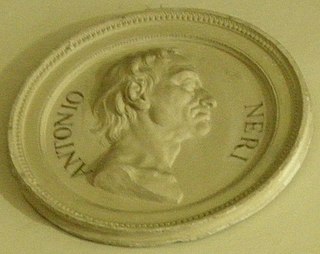
Antonio Neri was a Florentine priest who published the book L’Arte Vetraria or The Art of Glass in 1612. This book was the first general treatise on the systematics of glassmaking.

Engraved glass is a type of decorated glass that involves shallowly engraving the surface of a glass object, either by holding it against a rotating wheel, or manipulating a "diamond point" in the style of an engraving burin. It is a subgroup of glass art, which refers to all artistic glass, much of it made by "hot" techniques such as moulding and blowing melting glass, and with other "cold" techniques such as glass etching which uses acidic, caustic, or abrasive substances to achieve artistic effects, and cut glass, which is cut with an abrasive wheel, but more deeply than in engraved glass, where the engraving normally only cuts deeply enough into the surface to leave a mark. Usually the engraved surface is left "frosted" so a difference is visible, while in cut glass the cut surface is polished to restore transparency. Some pieces may combine two or more techniques.
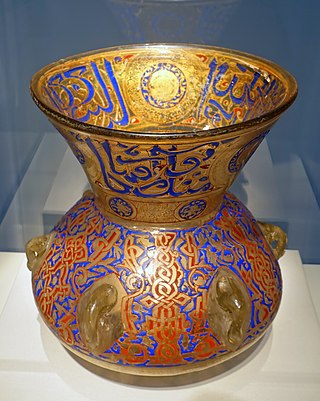
The influence of the Islamic world to the history of glass is reflected by its distribution around the world, from Europe to China, and from Russia to East Africa. Islamic glass developed a unique expression that was characterized by the introduction of new techniques and the reinterpreting of old traditions.

Variety Unit is an exhibit building at Shelburne Museum in Shelburne, Vermont.

The history of glass-making dates back to at least 3,600 years ago in Mesopotamia. However, some writers claim that they may have been producing copies of glass objects from Egypt. Other archaeological evidence suggests that the first true glass was made in coastal north Syria, Mesopotamia or Egypt. The earliest known glass objects, of the mid 2,000 BCE, were beads, perhaps initially created as the accidental by-products of metal-working (slags) or during the production of faience, a pre-glass vitreous material made by a process similar to glazing. Glass products remained a luxury until the disasters that overtook the late Bronze Age civilizations seemingly brought glass-making to a halt.
Factory glass is a term used by collectors of art glass to distinguish relevant items, mostly of decorative rather than utilitarian glass, from the more individual or unique studio glass and by studio glass artists to distinguish their work from the more standardised items which are generally made in larger glassworks. It can be an equivalent for the 20th century of the term art glass, which is largely applied to 19th-century or early 20th-century pieces.
J. H. Hobbs, Brockunier and Company was one of the largest and best known manufacturers of glass in the United States during the 19th century. Its products were distributed world–wide. The company is responsible for one of the greatest innovations in American glassmaking—an improved formula for lime glass that enabled American glass makers to produce high-quality glass at a lower cost. The firm also developed talented glassmakers that started glass factories in Ohio and Indiana.

The Church of St John the Baptist is a Christian church located in the city center of Kerch, Crimea. Built in the Byzantine architectural style, it is noted for the candy-striping in its façade. Dating to 717 AD, it is said to be one of the oldest churches in Eastern Europe.

The Seguso family has been dedicated to the art of Murano glass in Venice since May 3, 1397. Seguso is one of the most esteemed, historical and respected glass manufacturers on the island, and among the largest glass furnaces in Murano, which has a few, homonymous furnaces. Glass made by the Seguso furnace can be found in over 75 museums worldwide, such as MOMA in New York and the Victoria and Albert Museum in London. Today, Seguso is known for its high end Venetian glass objects, lighting, accessories and custom installations. Seguso glass has been made for the Pope, Royalty and numerous luxury interiors throughout the world.

Enamelled glass or painted glass is glass which has been decorated with vitreous enamel and then fired to fuse the glasses. It can produce brilliant and long-lasting colours, and be translucent or opaque. Unlike most methods of decorating glass, it allows painting using several colours, and along with glass engraving, has historically been the main technique used to create the full range of image types on glass.
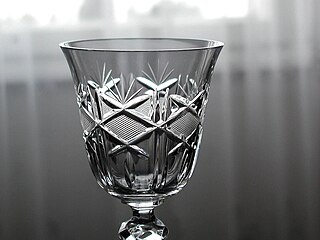
Cut glass or cut-glass is a technique and a style of decorating glass. For some time the style has often been produced by other techniques such as the use of moulding, but the original technique of cutting glass on an abrasive wheel is still used in luxury products. On glassware vessels, the style typically consists of furrowed faces at angles to each other in complicated patterns, while for lighting fixtures, the style consists of flat or curved facets on small hanging pieces, often all over. Historically, cut glass was shaped using "coldwork" techniques of grinding or drilling, applied as a secondary stage to a piece of glass made by conventional processes such as glassblowing.
