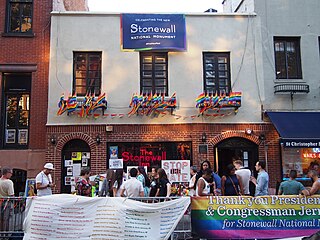
The LGBT community is a loosely defined grouping of lesbian, gay, bisexual, and transgender individuals united by a common culture and social movements. These communities generally celebrate pride, diversity, individuality, and sexuality. LGBT activists and sociologists see LGBT community-building as a counterweight to heterosexism, homophobia, biphobia, transphobia, sexualism, and conformist pressures that exist in the larger society. The term pride or sometimes gay pride expresses the LGBT community's identity and collective strength; pride parades provide both a prime example of the use and a demonstration of the general meaning of the term. The LGBT community is diverse in political affiliation. Not all people who are lesbian, gay, bisexual, or transgender consider themselves part of the LGBT community.
Verification or verify may refer to:
Identity politics is politics based on a particular identity, such as ethnicity, race, nationality, religion, denomination, gender, sexual orientation, social background, caste, and social class. The term could also encompass other social phenomena which are not commonly understood as exemplifying identity politics, such as governmental migration policy that regulates mobility based on identities, or far-right nationalist agendas of exclusion of national or ethnic others. For this reason, Kurzwelly, Pérez and Spiegel, who discuss several possible definitions of the term, argue that it is an analytically imprecise concept.
Whiteness studies is the study of the structures that produce white privilege, the examination of what whiteness is when analyzed as a race, a culture, and a source of systemic racism, and the exploration of other social phenomena generated by the societal compositions, perceptions and group behaviors of white people. It is an interdisciplinary arena of inquiry that has developed beginning in the United States from white trash studies and critical race studies, particularly since the late 20th century. It is focused on what proponents describe as the cultural, historical and sociological aspects of people identified as white, and the social construction of "whiteness" as an ideology tied to social status.

Intersectionality is a sociological analytical framework for understanding how groups' and individuals' social and political identities result in unique combinations of discrimination and privilege. Examples of these factors include gender, caste, sex, race, ethnicity, class, sexuality, religion, disability, height, age, and weight. These intersecting and overlapping social identities may be both empowering and oppressing. However, little good-quality quantitative research has been done to support or undermine the practical uses of intersectionality.
Transracial may refer to:
In the United States, acting white is a pejorative term, usually applied to Black people, which refers to a person's perceived betrayal of their culture by assuming the social expectations of white society. The term is controversial, and its precise meaning is hard to define; some usage focuses on success in education. It is theorized that some students in racial minority groups are discouraged from achieving in school by the negative prejudices of ethnic peers; such a view has been expressed in articles in The New York Times, Time magazine, and The Wall Street Journal—and by public figures and academics across the political spectrum.
Racial passing occurs when a person who is classified as a member of a racial group is accepted or perceived ("passes") as a member of another racial group. Historically, the term has been used primarily in the United States to describe a black or brown person or of multiracial ancestry who assimilated into the white majority to escape the legal and social conventions of racial segregation and discrimination. In the Antebellum South, passing as white was a temporary disguise used as a means of escaping slavery. Other instances include cases of Jews in Nazi Germany attempting to pass as "Aryan" and non-Jewish to escape persecution.
Whitewash is a paint-like covering of hydrated lime or a cheap white paint.

Redneck is a derogatory term mainly, but not exclusively, applied to white Americans perceived to be crass and unsophisticated, closely associated with rural whites of the Southern United States.

Since 1922, the United Kingdom has been made up of four countries: England, Scotland, Wales and Northern Ireland. The UK Prime Minister's website has used the phrase "countries within a country" to describe the United Kingdom.

White Irish is an ethnicity classification used in the census in the United Kingdom for England, Scotland and Wales. In the 2021 census, the White Irish population was 564,342 or 0.9% of Great Britain's total population. This was a slight fall from the 2011 census which recorded 585,177 or 1% of the total population.
Social privilege is an advantage or entitlement that benefits individuals belonging to certain groups, often to the detriment of others. Privileged groups can be advantaged based on social class, wealth, education, caste, age, height, skin color, physical fitness, nationality, geographic location, cultural differences, ethnic or racial category, gender, gender identity, neurodiversity, physical disability, sexual orientation, religion, and other differentiating factors. Individuals can be privileged in one area, such as education, and not privileged in another area, such as health. The amount of privilege any individual has may change over time, such as when a person becomes disabled, or when a child becomes a young adult.
According to some scholars, a national identity of the English as the people or ethnic group dominant in England can be traced to the Anglo-Saxon period.

The Identitarian movement or Identitarianism is a pan-European nationalist, ethno-nationalist, far-right political ideology asserting the right of the European ethnic groups and white peoples to Western culture and territories exclusively. Originating in France as Les Identitaires, with its youth wing Generation Identity (GI), the movement expanded to other European countries during the early 21st century. Its ideology was formulated from the 1960s onward by essayists such as Alain de Benoist, Dominique Venner, Guillaume Faye and Renaud Camus, who are considered the main ideological sources of the movement.

Nkechi Amare Diallo is an American former college instructor and activist known for presenting herself as a black woman despite being born to white parents. She is also a former National Association for the Advancement of Colored People (NAACP) chapter president.

Identity Evropa was an American far-right, neo-Nazi, neo-Fascist, and white supremacist organization established in March 2016. It was rebranded as the American Identity Movement in March 2019. In November 2020, the group disbanded. Leaders and members of Identity Evropa, such as former leader Elliot Kline, praised Nazi Germany and pushed for what they described as the "Nazification of America".
Cherokee descent, "being of Cherokee descent", or "being a Cherokee descendant" are all terms for individuals with some degree of documented Cherokee ancestry but do not meet the criteria for tribal citizenship. The terms are also used by non-Native individuals who self-identify as Cherokee despite lacking documentation or community recognition.

