Feminist theology is a movement found in several religions, including Buddhism, Hinduism, Zoroastrianism, Sikhism, Jainism,Neopaganism, Baháʼí Faith, Judaism, Islam, Christianity, and New Thought, to reconsider the traditions, practices, scriptures, and theologies of those religions from a feminist perspective. Some of the goals of feminist theology include increasing the role of women among clergy and religious authorities, reinterpreting patriarchal (male-dominated) imagery and language about God, determining women's place in relation to career and motherhood, studying images of women in the religions' sacred texts, and matriarchal religion.

A goddess is a female deity. In many known cultures, goddesses are often linked with literal or metaphorical pregnancy or imagined feminine roles associated with how women and girls are perceived or expected to behave. This includes themes of spinning, weaving, beauty, love, sexuality, motherhood, domesticity, creativity, and fertility. Many major goddesses are also associated with magic, war, strategy, hunting, farming, wisdom, fate, earth, sky, power, laws, justice, and more. Some themes, such as discord or disease, which are considered negative within their cultural contexts also are found associated with some goddesses. There are as many differently described and understood goddesses as there are male, shapeshifting, or neuter gods.

A solar deity or sun deity is a deity who represents the Sun or an aspect thereof. Such deities are usually associated with power and strength. Solar deities and Sun worship can be found throughout most of recorded history in various forms. The Sun is sometimes referred to by its Latin name Sol or by its Greek name Helios. The English word sun derives from Proto-Germanic *sunnǭ.

A mother goddess is a major goddess characterized as a mother or progenitor, either as an embodiment of motherhood and fertility or fulfilling the cosmological role of a creator- and/or destroyer-figure, typically associated the Earth, sky, and/or the life-giving bounties thereof in a maternal relation with humanity or other gods. When equated in this lattermost function with the earth or the natural world, such goddesses are sometimes referred to as the Mother Earth or Earth Mother, deity in various animistic or pantheistic religions. The earth goddess is archetypally the wife or feminine counterpart of the Sky Father or Father Heaven, particularly in theologies derived from the Proto-Indo-European sphere. In some polytheistic cultures, such as the Ancient Egyptian religion which narrates the cosmic egg myth, the sky is instead seen as the Heavenly Mother or Sky Mother as in Nut and Hathor, and the earth god is regarded as the male, paternal, and terrestrial partner, as in Osiris or Geb who hatched out of the maternal cosmic egg.

Apotheosis, also called divinization or deification, is the glorification of a subject to divine levels and, commonly, the treatment of a human being, any other living thing, or an abstract idea in the likeness of a deity.
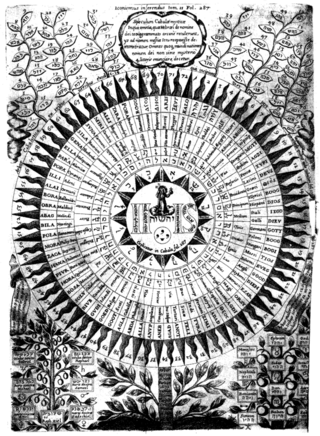
There are various names of God, many of which enumerate the various qualities of a Supreme Being. The English word god is used by multiple religions as a noun to refer to different deities, or specifically to the Supreme Being, as denoted in English by the capitalized and uncapitalized terms God and god. Ancient cognate equivalents for the biblical Hebrew Elohim, one of the most common names of God in the Bible, include proto-Semitic El, biblical Aramaic Elah, and Arabic ilah. The personal or proper name for God in many of these languages may either be distinguished from such attributes, or homonymic. For example, in Judaism the tetragrammaton is sometimes related to the ancient Hebrew ehyeh. It is connected to the passage in Exodus 3:14 in which God gives his name as אֶהְיֶה אֲשֶׁר אֶהְיֶה, where the verb, translated most basically as "I am that I am" or "I shall be what I shall be", "I shall be what I am" In the Hebrew Bible, YHWH, the personal name of God, is revealed directly to Moses. Correlation between various theories and interpretation of the name of "the one God", used to signify a monotheistic or ultimate Supreme Being from which all other divine attributes derive, has been a subject of ecumenical discourse between Eastern and Western scholars for over two centuries. In Christian theology the word is considered a personal and a proper name of God. On the other hand, the names of God in a different tradition are sometimes referred to by symbols. The question whether divine names used by different religions are equivalent has been raised and analyzed.
Soter derives from the Greek epithet σωτήρ (sōtēr), meaning a saviour, a deliverer; initial capitalised Σωτήρ; fully capitalised ΣΩΤΗΡ; feminine Soteira (Σώτειρα) or sometimes Soteria (Σωτηρία).
A supreme deity, supreme god or supreme being is the conception of the sole deity of monotheistic religions or, in polytheistic or henotheistic religions, the paramount deity or supernatural entity which is above all others.

Anput is a goddess in ancient Egyptian religion. Her name is written in hieroglyphs as jnpwt. In English, her name also is rendered as Anupet, Input, Inpewt, and Yineput. As the female counterpart of her husband, Anubis, who was known as jnpw to the Egyptians, Anput's name ends in a feminine "t" suffix when seen as jnpwt.
Women as theological figures have played a significant role in the development of various religions and religious hierarchies.
The gender of God can be viewed as a literal or as an allegorical aspect of a deity.
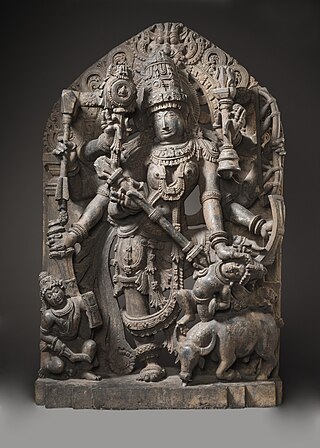
In Hinduism, there are diverse approaches to conceptualizing God and gender. Many Hindus focus upon impersonal Absolute (Brahman) which is genderless. Other Hindu traditions conceive God as bigender, alternatively as either male or female, while cherishing gender henotheism, that is without denying the existence of other gods in either gender.

Despoina or Despoena was the epithet of a goddess worshipped by the Eleusinian Mysteries in Ancient Greece as the daughter of Demeter and Poseidon and the sister of Arion. Surviving sources refer to her exclusively under the title Despoina alongside her mother Demeter, as her real name could not be revealed to anyone except those initiated into her mysteries and was consequently lost with the extinction of the Eleusinian religion. Writing during the second century A.D., Pausanias spoke of Demeter as having two daughters; Kore being born first, before Despoina was born, with Zeus being the father of Kore and Poseidon as the father of Despoina. Pausanias made it clear that Kore is Persephone, although he did not reveal Despoina's proper name.

The Mari religion, also known as Mari paganism, is the ethnic religion of the Mari people, a Volga Finnic ethnic group based in the republic of Mari El, in Russia. The religion has undergone changes over time, particularly under the influence of neighbouring monotheisms. In the last few decades, while keeping its traditional features in the countryside, an organised Neopagan-kind revival has taken place.
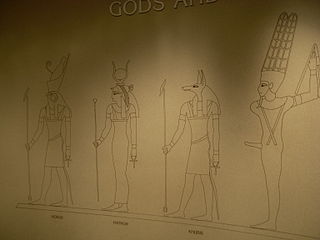
Polytheism is the belief in or worship of more than one god. According to Oxford Reference, it is not easy to count gods, and so not always obvious whether an apparently polytheistic religion, such as Chinese Folk Religions, is really so, or whether the apparent different objects of worship are to be thought of as manifestations of a singular divinity. Polytheistic belief is usually assembled into a pantheon of gods and goddesses, along with their own religious sects and rituals. Polytheism is a type of theism. Within theism, it contrasts with monotheism, the belief in a singular God who is, in most cases, transcendent.

Dǒumǔ, also known as Dǒumǔ Yuánjūn, Dòulǎo Yuánjūn and Tàiyī Yuánjūn, is a goddess in Chinese religion and Taoism. She is also named through the honorific Tiānhòu, shared with other Chinese goddesses, especially Mazu, who are perhaps conceived as her aspects. Other names of her are Dàomǔ and Tiānmǔ.

Heqet, sometimes spelled Heket, is an Egyptian goddess of fertility, identified with Hathor, represented in the form of a frog.

Chinese gods and immortals are beings in various Chinese religions seen in a variety of ways and mythological contexts.
