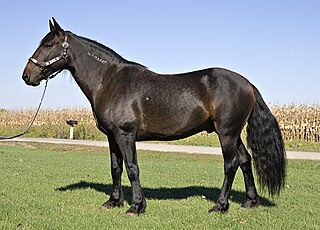
Wild Horse Inmate Rehabilitation Programs

Last updated
An inmate at Northern Nevada Correctional Center stands for a picture with a gentled wild horse. My Public Lands Roadtrip- Northern Nevada Correctional Center-Stewart Conservation Camp Saddle Horse and Burro Training Program in Carson City, Nevada (19532503682).jpg
An inmate at Northern Nevada Correctional Center stands for a picture with a gentled wild horse.

Beginning in 1988 at Southern New Mexico Correctional Facility, Wild Horse Inmate Rehabilitation Programs provide animal therapy and work experience opportunities for inmates. [1] Correctional facilities work directly with the Bureau of Land Management (BLM) to provide rehabilitation opportunities through working with wild mustangs that have been rounded up due to overgrazing or overpopulation for inmates who fit the qualifications to be a part of the program. [2] Inmates not only work at the equine facilities where the mustangs are held but also participate in training, commonly referred to as gentling, the mustangs to improve their chances of adoption. Tasks include feeding, watering, and grooming the mustangs, as well as mucking paddocks and/or stalls. [1] Inmates who participate in the training of wild mustangs will often be the first person to touch the wild horse and will gentle them to varying degrees, including halter-training, saddle-training, and training them in ridden work. After they have been gentled, most of the mustangs are adopted to various people, including the inmates who gentled them after they have completed their sentence.

Contents

Wild Horse Inmate Rehabilitation Programs, when implemented, have shown an increase in an inmate's sense of responsibility and accomplishment while giving them a challenge that makes their sentence meaningful. [3] Working with horses also provides an aspect of animal therapy for the inmates involved. Most programs notice a decrease in disciplinary reports, both minor and major, and recidivism. [4] These programs also often increase the rates at which wild mustangs are being adopted.

Participating Facilities

Southern New Mexico Correctional Facility

The Southern New Mexico Correctional Facility made an agreement with the BLM in 1988 which began their well-known but short-lived Wild Horse Inmate Rehabilitation Program. At first, only older horses were sent to the program so they would be easier to adopt, but it eventually turned into a much larger program, inspiring similar programs to start at prisons in Los Lunas and Santa Fe. The BLM paid $1.85 per horse per day to fulfill a boarding fee and $56 per horse once they were trained. [5] Due to federal budget cuts, the Southern New Mexico Correctional Facility Wild Horse Inmate Rehabilitation Program shut down in 1992. [5] However, in the short time the program was open, 20-30 inmates were employed at all times and nearly 2,400 horses, 600 per year, were gentled. [5] Although this program did not last long, it sparked a new generation of rehabilitation programs for inmates. After most rehabilitation programs were written off in the mid-1970s, Southern New Mexico Correctional Facility's Wild Horse Inmate Rehabilitation Program showed that inmate rehabilitation was possible and inspired the development of similar programs that are still successful today [1]

Northern Nevada Correctional Center/Stewart Conservation Camp Saddle Horse and Burro Training Program

Participants in an adoption event at Rio Cosumnes Correctional Center in California meet the mustangs up for adoption and their trainers. WHB R3C Adoption (37365589890).jpg
Participants in an adoption event at Rio Cosumnes Correctional Center in California meet the mustangs up for adoption and their trainers.

Made famous by the movie The Mustang, the Northern Nevada Correctional Center (NNCC) contains a facility next to the correctional facility that can hold up to 2,000 animals and provides areas for gentling wild horses and adoption events. [6] Approximately 60-80 wild horses and burros are gentled and adopted through the NNCC rehabilitation program a year. Each horse or burro is paired with an inmate and trained for 120 days. [6] Then, the facility is opened to the public for an adoption event. About 3-4 adoption events are held annually. They are conducted as competitive-bids run by an auctioneer where the highest bidder will be given a year with the adopted animal before applying for a title which will transfer the ownership of the wild horse or burro to the adopter. [6] Bidding starts at $150 but often exceeds that. [7] Before the adoption event starts, participants are given time to meet the horses and their trainers. [6] The NNCC program is self-sustaining and relies on training fees from the BLM, which are around $1,000 per horse. There are similar programs in Arizona, Wyoming, Kansas, Colorado, and California [2]

Recidivism, Disciplinary Reports, and Job Offers

Wild Horse Inmate Rehabilitation Programs often teach inmates how to respect and be patient with another being. [8] They also develop their communication skills and their abilities to work in groups and follow instructions due to working with fellow inmates and alongside horsemen. [3] During the first four years of the Wild Horse Inmate Rehabilitation Program at Southern New Mexico Correctional Facility, violent offenders and property offenders who were a part of the program both showed a decrease in major disciplinary reports while violent offenders also showed a decrease in minor disciplinary reports. [1] Similarly, inmates who participate in Wild Horse Inmate Rehabilitation Programs show a decrease in recidivism. Across the country, only 15% of inmates who participate in these programs return to prison after their release. The inmates who participate in the rehabilitation program at Northern Nevada Correctional Center are half as likely to return to prison after they are released compared to their fellow inmates who are not a part of the program. [3] Many inmates have also received job opportunities working with horses upon their release.

Related Research Articles

<span class="mw-page-title-main">Mustang</span> Free-roaming horse of the Western US

The mustang is a free-roaming horse of the Western United States, descended from horses brought to the Americas by the Spanish conquistadors. Mustangs are often referred to as wild horses, but because they are descended from once-domesticated animals, they are actually feral horses. The original mustangs were Colonial Spanish horses, but many other breeds and types of horses contributed to the modern mustang, now resulting in varying phenotypes. Some free-roaming horses are relatively unchanged from the original Spanish stock, most strongly represented in the most isolated populations.

<span class="mw-page-title-main">Recidivism</span> Person repeating an undesirable behavior following punishment

Recidivism is the act of a person repeating an undesirable behavior after they have experienced negative consequences of that behavior, or have been trained to extinguish it. Recidivism is also used to refer to the percentage of former prisoners who are rearrested for a similar offense.

<span class="mw-page-title-main">Prison education</span> Educational activities inside prisons

Prison education is any educational activity that occurs inside prison. Courses can include basic literacy programmes, secondary school equivalency programmes, vocational education, and tertiary education. Other activities such as rehabilitation programs, physical education, and arts and crafts programmes may also be considered a form of prison education. Programmes are typically provided, managed, and funded by the prison system, though inmates may be required to pay for distance education programmes. The history of and current practices in prison education vary greatly among countries.

A prison nursery is a section of a prison that houses incarcerated mothers and their very young children. Prison nurseries are not common in correctional facilities in the United States, although prior to the 1950s many states had them and they are widespread throughout the rest of the world.

Hutchinson Correctional Facility (HCF) is a state prison operated by the Kansas Department of Corrections located in Hutchinson, Kansas.

<span class="mw-page-title-main">Utah Department of Corrections</span> Law enforcement agency

The Utah Department of Corrections (UDC) is a government agency dedicated to the management and supervision of convicted felons in the U.S. state of Utah. It is currently led by the Executive Director Brian Nielson. It has its headquarters in the Utah Department of Corrections Administration Building in Draper.
<span class="mw-page-title-main">California Correctional Center</span>

California Correctional Center (CCC) was a state prison in the city of Susanville in Northern California. It was a minimum-security facility.

<span class="mw-page-title-main">Ironwood State Prison</span> State prison in Blythe, California

Ironwood State Prison (ISP) is a state prison located south of Interstate 10, in a detached section of Blythe, California, that lies west of the main portion of the city. It is located in eastern Riverside County, California, adjacent to Chuckawalla Valley State Prison.

<span class="mw-page-title-main">Northern Nevada Correctional Center</span> Prison complex in Nevada, United States

Northern Nevada Correctional Center (NNCC) and Stewart Conservation Camp (SCC) are part of a prison complex located in Carson City. The correctional center was established in 1964 and is managed by the Nevada Department of Corrections. The medium security center housed 1,444 male and 9 female inmates as of September 2010. It is designed with a capacity for 1,619 inmates and employs a staff of 373 as of 2008.

The Pryor Mountains Wild Horse Range is a refuge for a historically significant herd of free-roaming mustangs, the Pryor Mountain mustang, feral horses colloquially called "wild horses", located in the Pryor Mountains of Montana and Wyoming in the United States. The range has an area of 39,650 acres (160.5 km2) and was established in 1968 along the Montana–Wyoming border as the first protected refuge dedicated exclusively for mustangs. It was the second feral horse refuge in the United States. About a quarter of the refuge lies within the Bighorn Canyon National Recreation Area. A group of federal agencies, led by the Bureau of Land Management, administers the range.
<span class="mw-page-title-main">Wild and Free-Roaming Horses and Burros Act of 1971</span> 1971 Act of Congress

The Wild and Free-Roaming Horses and Burros Act of 1971 (WFRHBA), is an Act of Congress, signed into law by President Richard M. Nixon on December 18, 1971. The act covered the management, protection and study of "unbranded and unclaimed horses and burros on public lands in the United States."

The Youthful Offender System (YOS) is a medium security prison in Pueblo, Colorado. YOS houses male and female offenders between ages 14–19. Inmates at YOS have all been convicted of a violent felony, except Class 1 felonies, and sentenced as adults through the state's Department of Corrections (DOC) system. They are not sentenced as juveniles or sentenced through the Department of Youth Services system. Offenders can only be sent to YOS if their sentencing judge recommends them for the YOS program. The judge makes this determination based on the offender's age and perceived amenability for rehabilitation. The maximum sentence a YOS inmate can serve is 7 years, no matter what their original charge was, and the minimum sentence a YOS inmate can serve is 2 years. YOS sentencing is in lieu of jail sentences and if the offender fails the YOS program they will have to serve the jail sentence that has been suspended.

<span class="mw-page-title-main">Free-roaming horse management in North America</span>

Management of free-roaming feral and semi-feral horses, on various public or tribal lands in North America is accomplished under the authority of law, either by the government of jurisdiction or efforts of private groups. In western Canada, management is a provincial matter, with several associations and societies helping to manage wild horses in British Columbia and Alberta. In Nova Scotia, and various locations in the United States, management is under the jurisdiction of various federal agencies. The largest population of free-roaming horses is found in the Western United States. Here, most of them are protected under the Wild and Free-Roaming Horses and Burros Act of 1971 (WFRH&BA), and their management is primarily undertaken by the Bureau of Land Management (BLM), but also by the U. S. Forest Service (USFS)
<span class="mw-page-title-main">Relationships for incarcerated individuals</span> Familial and romantic relations of individuals in prisons or jails

Relationships of incarcerated individuals are the familial and romantic relations of individuals in prisons or jails. Although the population of incarcerated men and women is considered quite high in many countries, there is relatively little research on the effects of incarceration on the inmates' social worlds. However, it has been demonstrated that inmate relationships play a seminal role in their well-being both during and after incarceration, making such research important in improving their overall health, and lowering rates of recidivism.

Prisoner reentry is the process by which prisoners who have been released return to the community. Many types of programs have been implemented with the goal of reducing recidivism and have been found to be effective for this purpose. Consideration for the conditions of the communities formerly incarcerated individuals are re-entering, which are often disadvantaged, is a fundamental part of successful re-entry.

<span class="mw-page-title-main">Incarceration in Norway</span> Overview of incarceration in Norway

Norway's criminal justice system focuses on the principles of restorative justice and the rehabilitation of prisoners. Correctional facilities in Norway focus on maintaining custody of the offender and attempting to make them functioning members of society. Norway's prison system is renowned as one of the most effective and humane in the world.

Mzuzu Central Prison is a prison in Mzuzu City in Mzimba District, Malawi. The prison was built to address the growing need for a secure facility to hold criminals and political dissidents in the Northern Region of Malawi.

Lilongwe Central Prison is a prison in Malawi located in Lilongwe District established during the colonial era. Lilongwe Central Prison has a maximum capacity of approximately 2,500 inmates, although it often holds more due to overcrowding. The prison population consists of male and female inmates, including those on remand and convicted prisoners.

References

  1. 1 2 3 4 "Wild Mustang Program: A Case Study in Facilitated Inmate Therapy | Office of Justice Programs". www.ojp.gov. Retrieved 2023-03-04.
  2. 1 2 Kurutz, Steven (2017-10-05). "Wild Horses and the Inmates Who 'Gentle' Them". The New York Times. ISSN   0362-4331 . Retrieved 2023-03-04.
  3. 1 2 3 "The Inmate-Trained Mustangs Working for the Forest Service". Outside Online. 17 May 2022. Retrieved 2023-03-04.
  4. Miller, Laurel (2012). "Wild Horses in the Big House". American Cowboy. pp. 69–86. Retrieved March 4, 2023.
  5. 1 2 3 "LACK OF FUNDS ENDS PRISON HORSE PROGRAM". Deseret News. 1992-08-23. Retrieved 2023-03-04.
  6. 1 2 3 4 "Northern Nevada Correctional Center Wild Horse Training Facility". Bureau of Land Management. Retrieved March 4, 2023.
  7. Nowicki, Katherine (2022-10-11). "Fifteen wild horses adopted at Northern Nevada Correctional Center event". KRNV. Retrieved 2023-03-04.
  8. "Wild horse training program gives inmates a chance at rehabilitation". FOX40. 2022-07-14. Retrieved 2023-03-04.