
Juliana was Queen of the Netherlands from 1948 until her abdication in 1980.
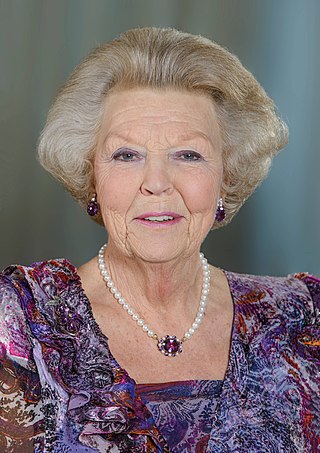
Beatrix is a member of the Dutch royal house who reigned as Queen of the Netherlands from 1980 until her abdication in 2013.

Wilhelmina was Queen of the Netherlands from 1890 until her abdication in 1948. She reigned for nearly 58 years, making her the longest-reigning monarch in Dutch history, as well as the longest-reigning female monarch outside the United Kingdom. Her reign saw World War I, the Dutch economic crisis of 1933 and World War II.

Vilhelmina Municipality is a municipality in Västerbotten County in northern Sweden. Its seat is located in Vilhelmina.

Duke Henry of Mecklenburg-Schwerin was Prince of the Netherlands from 7 February 1901 until his death in 1934 as the husband of Queen Wilhelmina. He remains the longest-serving Dutch consort.

Adolphe was Grand Duke of Luxembourg from 23 November 1890 to his death on 17 November 1905. The first grand duke from the House of Nassau-Weilburg, he succeeded King William III of the Netherlands, ending the personal union between the Netherlands and Luxembourg. Adolphe was Duke of Nassau from 20 August 1839 to 20 September 1866, when the Duchy was annexed to the Kingdom of Prussia.

Louise of the Netherlands, also called Lovisa, was Queen of Sweden and Norway from 8 July 1859 until her death in 1871 as the wife of King Charles XV & IV.

Frederica Louisa of Hesse-Darmstadt was Queen of Prussia and Electress of Brandenburg as the second wife of King Frederick William II.
Wilhelmine of Prussia, Wilhelmine von Preußen in German, may refer to:
Princess Margaret (1930–2002) was the daughter of King George VI of the United Kingdom and Elizabeth Bowes-Lyon; sister of Queen Elizabeth II of the United Kingdom.

Wilhelmine of Prussia was the first Queen consort of the Netherlands as the first wife of King William I of the Netherlands. She had a modest public role but acted as a patron of the arts.

Princess Louise of Prussia was a princess of the Netherlands as the wife of Prince Frederick. She was born the penultimate child of King Frederick William III of Prussia and Queen Louise. Although Princess Louise played a minor role in royal society, she helped establish the Luisestiftelsen—a charity organisation built for orphans—and pitched ideas for the construction of a residential home in Passow.
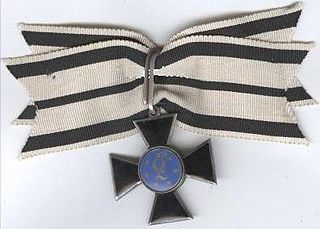
The Order of Louise was founded on 3 August 1814 by Frederick William III of Prussia to honor his late wife, the much beloved Queen Louise. This order was chivalric in nature, but was intended strictly for women whose service to Prussia was worthy of such high national recognition. Its dame companion members were limited to 100 in number, and were intended to be drawn from all classes.

Wilhelmina is a feminine given name, the Dutch, German and Yiddish form of Wilhelm or William, which is derived from the Germanic wil, meaning "will, desire" and helm, meaning "helmet, protection". Wilhelmina was ranked in the top 1000 most popular names for girls in the United States between 1900 and 1940 but is rarely used today. In many European countries, this name is once again very popular. Nicknames for Wilhelmina include, but are not restricted to, Minna, Mina, Mineke, Minnie, Willie, Willy, Willa, and Billie.

Princess Wilhelmina Frederika Louise Pauline Charlotte of Orange-Nassau was the third child and elder daughter of King William I of the Netherlands and his queen consort, Wilhelmine of Prussia.

Daniel de Superville was a Dutch physician who in 1742 founded the University of Erlangen in Germany. He served as chancellor of the university until 1748. De Superville also wrote several treatises on anatomy.

Koningsdag or King's Day is a national holiday in the Kingdom of the Netherlands. Celebrated on 27 April, the date marks the birth of King Willem-Alexander. When the Dutch monarch is female, the holiday is known as Koninginnedag or Queen's Day and, under Queen Beatrix until 2013, was celebrated on 30 April. She prolonged the tradition that was born under her mother’s reign: Queen Juliana’s birthday was on April 30th.

Princess Marie Alexandrine of Saxe-Weimar-Eisenach was the eldest daughter and second child of Charles Alexander, Grand Duke of Saxe-Weimar-Eisenach and his wife Princess Sophie of the Netherlands.
Court Mistress or Chief Court Mistress is or was the title of the senior lady-in-waiting in the courts of Austria, Denmark, Norway, the Netherlands, Sweden, Imperial Russia, and the German princely and royal courts.

Crown Jewels of the Netherlands is the jewellery used by the Dutch royal family, which is sometimes dubbed "crown jewels". In the past, the terms "House-diamonds", "House-jewels" and "family jewels" have been used. In 1790 the term "Bijoux de la Couronne" was used by Luise of Brunswick -Wolfenbüttel to refer to a large diamond from Borneo. In 1896 the Firm of van Kempen & Begeer wrote about resetting the jewels of the Crown. Queen Juliana gave a selection of her formal jewelry to the new Foundation Regalia of the House of Orange-Nassau, instituted on 27 July 1963. In 1968 a Foundation "Kroongoederen van het Huis van Oranje-Nassau" was instituted. It owns the regalia and the House-jewels.
