
KStars is a freely licensed planetarium program using the KDE Platform. It is available for Linux, BSD, macOS, and Microsoft Windows. A light version of KStars is available for Android devices. It provides an accurate graphical representation of the night sky, from any location on Earth, at any date and time. The display includes up to 100 million stars, 13,000 deep sky objects, constellations from different cultures, all 8 planets, the Sun and Moon, and thousands of comets, asteroids, satellites, and supernovae. It has features to appeal to users of all levels, from informative hypertext articles about astronomy, to robust control of telescopes and CCD cameras, and logging of observations of specific objects.

StarOffice, known briefly as Oracle Open Office before being discontinued in 2011, is a proprietary office suite. It originated in 1985 as StarWriter by Star Division, which was acquired by Sun Microsystems in 1999. Sun Microsystems, in turn, was acquired by Oracle Corporation in 2010.

Celestia is a 3D astronomy software program created by Chris Laurel. The program allows users to virtually travel through a simulated version of our universe. Celestia can display objects of various scales using OpenGL.
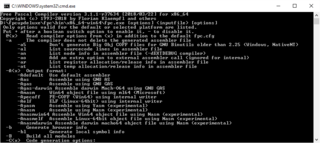
Free Pascal Compiler (FPC) is a compiler for the closely related programming-language dialects Pascal and Object Pascal. It is free software released under the GNU General Public License, with exception clauses that allow static linking against its runtime libraries and packages for any purpose in combination with any other software license.

The Sloan Digital Sky Survey or SDSS is a major multi-spectral imaging and spectroscopic redshift survey using a dedicated 2.5-m wide-angle optical telescope at Apache Point Observatory in New Mexico, United States. The project was named after the Alfred P. Sloan Foundation, which contributed significant funding.

A deep-sky object (DSO) is any astronomical object that is not an individual star or Solar System object. The classification is used for the most part by amateur astronomers to denote visually observed faint naked eye and telescopic objects such as star clusters, nebulae and galaxies. This distinction is practical and technical, implying a variety of instruments and techniques appropriate to observation, and does not distinguish the nature of the object itself.

A robotic telescope is an astronomical telescope and detector system that makes observations without the intervention of a human. In astronomical disciplines, a telescope qualifies as robotic if it makes those observations without being operated by a human, even if a human has to initiate the observations at the beginning of the night, or end them in the morning. It may have software agent(s) using Artificial Intelligence that assist in various ways such as automatic scheduling. A robotic telescope is distinct from a remote telescope, though an instrument can be both robotic and remote.

HNSKY or Hallo Northern Sky is a popular free and open-source planetarium program for Linux, Microsoft Windows, and Raspberry Pi to simulate the night sky. It is provided with several non-English language modules, numerous astronomical catalogues, conversion utilities and tools, as well as several stellar databases.

Cartes du Ciel is a free and open source planetarium program for Linux, macOS, and Windows. With the change to version 3, Linux has been added as a target platform, licensing has changed from freeware to GPLv2 and the project moved to a new website.
GNATS is the GNU project's issue-tracking software.

PMB is a fully featured open source integrated library system. It is continuously developed and maintained by the French company PMB Services.

Celestial cartography, uranography, astrography or star cartography is the fringe of astronomy and branch of cartography concerned with mapping stars, galaxies, and other astronomical objects on the celestial sphere. Measuring the position and light of charted objects requires a variety of instruments and techniques. These techniques have developed from angle measurements with quadrants and the unaided eye, through sextants combined with lenses for light magnification, up to current methods which include computer-automated space telescopes. Uranographers have historically produced planetary position tables, star tables, and star maps for use by both amateur and professional astronomers. More recently computerized star maps have been compiled, and automated positioning of telescopes is accomplished using databases of stars and other astronomical objects.

XEphem is a Motif based ephemeris and planetarium program for Unix-like operating systems developed by Elwood C. Downey.
Planetarium software is application software that allows a user to simulate the celestial sphere at any time of day, especially at night, on a computer. Such applications can be as rudimentary as displaying a star chart or sky map for a specific time and location, or as complex as rendering photorealistic views of the sky.

WorldWide Telescope (WWT) is an open-source set of applications, data and cloud services, originally created by Microsoft Research but now an open source project hosted on GitHub. The .NET Foundation holds the copyright and the project is managed by the American Astronomical Society and has been supported by grants from the Moore Foundation and National Science Foundation. WWT displays astronomical, earth and planetary data allowing visual navigation through the 3-dimensional (3D) Universe. Users are able to navigate the sky by panning and zooming, or explore the 3D universe from the surface of Earth to past the Cosmic microwave background (CMB), viewing both visual imagery and scientific data about that area and the objects in it. Data is curated from hundreds of different data sources, but its open data nature allows users to explore any third party data that conforms to a WWT supported format. With the rich source of multi-spectral all-sky images it is possible to view the sky in many wavelengths of light. The software utilizes Microsoft's Visual Experience Engine technologies to function. WWT can also be used to visualize arbitrary or abstract data sets and time series data.

Drizzle is an abandoned free software/open-source relational database management system (DBMS) that was forked from the now-defunct 6.0 development branch of the MySQL DBMS.
Digital Universe Atlas is a free open source software planetarium application, available under the terms of the Illinois Open Source License, and running on Linux, Windows, macOS, AmigaOS 4, and IRIX.

Apache Drill is an open-source software framework that supports data-intensive distributed applications for interactive analysis of large-scale datasets. Drill is the open source version of Google's Dremel system which is available as an infrastructure service called Google BigQuery. One explicitly stated design goal is that Drill is able to scale to 10,000 servers or more and to be able to process petabytes of data and trillions of records in seconds. Drill is an Apache top-level project.
SpaceEngine is a 3D astronomy program and game engine developed by Russian astronomer and programmer Vladimir Romanyuk. It creates a three-dimensional planetarium representing the entire universe from a combination of real astronomical data and scientifically-accurate procedural generation algorithms. Users can travel through space in any direction or speed, and forwards or backwards in time. SpaceEngine is in beta status and is currently freeware for Microsoft Windows. SpaceEngine's latest release, version 0.990 beta, is the first paid edition.


