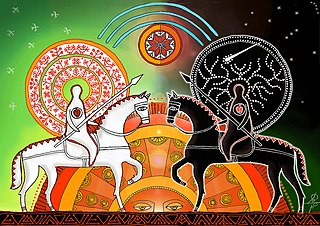
Chernobog and Belobog are an alleged pair of Polabian deities. Chernobog appears in the Helmold's Chronicle as a god of misfortune worshipped by the Wagri and Obodrites, while Belobog is not mentioned – he was reconstructed in opposition to Chernobog. Both gods also appear in later sources, but they are not considered reliable. Researchers do not agree on the status of Chernobog and Belobog: many scholars recognize the authenticity of these theonyms and explain them, for example, as gods of good and evil; on the other hand, many scholars believe that they are pseudo-deities, and Chernobog may have originally meant "bad fate", and later associated with the Christian devil.

Slavic mythology or Slavic religion is the religious beliefs, myths, and ritual practices of the Slavs before Christianisation, which occurred at various stages between the 8th and the 13th century. The South Slavs, who likely settled in the Balkan Peninsula during the 6th–7th centuries AD, bordering with the Byzantine Empire to the south, came under the sphere of influence of Eastern Christianity, beginning with the creation of writing systems for Slavic languages in 855 by the brothers Saints Cyril and Methodius and the adoption of Christianity in Bulgaria in 864 and 863 in Great Moravia. The East Slavs followed with the official adoption in 988 by Vladimir the Great of Kievan Rus'.

Svarog is a Slavic god of fire and blacksmithing, who was once interpreted as a sky god on the basis of an etymology rejected by modern scholarship. He is mentioned in only one source, the Primary Chronicle, which is problematic in interpretation. He is presented there as the Slavic equivalent of the Greek god Hephaestus. The meaning of his name is associated with fire. He is the father of Dazhbog and Svarozhits.

Svetovit, Sventovit, Svantovit is the god of abundance and war, and the chief god of the Slavic tribe of the Rani, and later of all the Polabian Slavs. His organized cult was located on the island of Rügen, at Cape Arkona, where his main temple was also located. According to the descriptions of medieval chroniclers, the statue representing this god had four heads, a horn and a sword, and to the deity himself were dedicated a white horse, a saddle, a bit, a flag, and eagles. Once a year, after the harvest, a large festival was held in his honor. With the help of a horn and a horse belonging to the god, the priests carried out divinations, and at night the god himself rode a horse to fight his enemies. His name can be translated as "Strong Lord" or "Holy Lord". In the past it was often mistakenly believed that the cult of Svetovit originated from St. Vitus. Among scholars of Slavic mythology, Svetovit is often regarded as a Polabian hypostasis of Pan-Slavic god Perun. His cult collapsed in 1168.

Triglav is the god of the Pomeranians and probably some of the Polabian Slavs, worshipped in Szczecin, Wolin and probably Brenna. His cult is confirmed in the biographies of St. Otto of Bamberg. His cult has been confirmed since 1124, officially collapsed in 1127.

In the pre-Christian religion of Eastern and Southern Slavs, Rod is the god of the family, ancestors and fate, perhaps as the supreme god. Among Southern Slavs, he is also known as Sud. He is usually mentioned together with Rozhanitsy deities. One's first haircut (postriziny) was dedicated to him, in a celebration in which he and the rozhanitsy were given a meal and the cut hair. His cult lost its importance through time, and in the ninth or tenth century he was replaced by Perun, Svarog and/or Svetevid, which explains his absence in the pantheon of Vladimir the Great.

Khors is a Slavic god of uncertain functions mentioned since the 12th century. Generally interpreted as a sun god, sometimes as a moon god. The meaning of the theonym is also unknown: most often his name has been combined with the Iranian word for sun, such as the Persian xoršid, or the Ossetian xor, but modern linguists strongly criticize such an etymology, and other native etymologies are proposed instead.
Iriy, Vyrai, Vyriy, or Irij is a mythical place in Slavic mythology where "birds fly for the winter and souls go after death" that is sometimes identified with paradise. Spring is believed to have arrived on Earth from Vyrai.

The Zbruch Idol, Sviatovid is a 9th-century sculpture, more precisely an example of a bałwan, and one of the few monuments of pre-Christian Slavic beliefs. The pillar was commonly incorrectly associated with the Slavic deity Sviatovid, although current opinions on the exact meaning of all the bas-reliefs and their symbols differ. It is thought that the three tiers of bas-relief represent the three levels of the world, from the bottom underworld, to the middle mortal world and the uppermost, largest, world of heavenly gods.

Native Polish Church or The Native Church of Poland, Rodzimy Kościół Polski (RKP) – a West Slavic pagan religious association that refers to ethnic, pre-Christian beliefs of the Slavic people. The religion has its seat in Warsaw. Temples gathering local believers are spread throughout the country, The RKP was registered with the Polish Ministry of the Interior's registry of denominations and churches in March 1995.

Poland has historically been one of the most religious countries in Europe. Though varied religious communities exist in Poland, most Poles adhere to Christianity. Within this, the largest grouping is the Roman Catholic Church: 91.9% of the population identified themselves with that denomination in 2018 and, according to the Institute for Catholic Church Statistics, 36.7% of Polish Catholic believers attended Sunday Mass in 2015. Poland has historically been one of the most Catholic countries in the world; Neal Pease describes Poland as "Rome's Most Faithful Daughter."
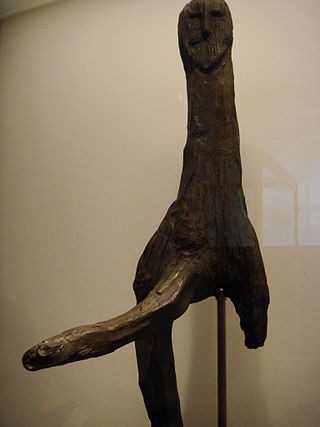
Anthropomorphic wooden cult figurines, sometimes called pole gods, have been found at many archaeological sites in Central and Northern Europe. They are generally interpreted as cult images, in some cases presumably depicting deities, sometimes with either a votive or an apotropaic (protective) function. Many have been preserved in peat bogs. The majority are more or less crudely worked poles or forked sticks; some take the form of carved planks. They have been dated to periods from the Mesolithic to the Early Middle Ages, including the Roman Era and the Migration Age. The majority have been found in areas of Germanic settlement, but some are from areas of Celtic settlement and from the later part of the date range, Slavic settlement. A typology has been developed based on the large number found at Oberdorla, Thuringia, at a sacrificial bog which is now the Opfermoor Vogtei open-air museum.

Yarovit, Iarovit is a Polabian god of war, worshipped in Vologošč (Circipanians) and Hobolin. Sources give only a brief description of his cult, his main temple was located in Vologošč, where there was a golden shield belonging to Yarovit. By one Christian monk he was identified with the Roman Mars.

In Slavic paganism there are a variety of female tutelary spirits associated with water. They have been compared to the Greek Nymphs, and they may be either white (beneficent) or black (maleficent). They may be called Boginki, Navki, Rusalki, and Vily.
Chernoglav or Chernoglov is the god of victory and war worshipped in Rügen, probably in the town of Jasmund, mentioned together with Svetovit, Rugievit, Turupid, Puruvit and Pizamar in the Knýtlinga saga.
The fifth god was called Pizamar from a place called Jasmund, and was destroyed by fire, There was also Tjarnaglófi, their god of victory who went with them on military campaigns. He had a moustache of silver and resisted longer than the others but they managed to get him there years later. Altogether, they christened five thousand on this expedition.

A zhrets is a priest in the Slavic religion whose name literally means "one who makes sacrifices". The name appears mainly in the East and South Slavic vocabulary, while in the West Slavs it is attested only in Polish. Most information about the Slavic priesthood comes from Latin texts about the paganism of the Polabian Slavs. The descriptions show that they were engaged in offering sacrifices to the gods, divination and determining the dates of festivals. They possessed cosmological knowledge and were a major source of resistance against Christianity.
Pizamar is a Slavic deity worshipped on Rügen. His statue was overthrown by the Danes in 1168 together with statues of other gods on Rügen. He is mentioned only in Knýtlinga saga, which, however, does not give the functions of the god or his image. Nowadays his name may be transcribed into English as Pachomir, Pachemir.

The Arkonian Forest Park, also simply known as the Arkonian Forest, or Arkonian Woods, and until 1945, Eckerberg Forrest, is a forest in the city of Szczecin, Poland, that is a part of the Szczecin Forests, which by themselves, are a part of the Ueckermünde Heath. It is located in the Warszewo Hills, in the north-western part of the city, in the municipal neighbourhoods of Arkońskie-Niemierzyn, Głębokie-Pilchowo, and Osów. It covers an area of 976,9 ha.

