
Gender equality, also known as sexual equality or equality of the sexes, is the state of equal ease of access to resources and opportunities regardless of gender, including economic participation and decision-making; and the state of valuing different behaviors, aspirations and needs equally, regardless of gender.
United Nations Security Council Resolution 1325 (S/RES/1325), on women, peace, and security, was adopted unanimously by the UN Security Council on 31 October 2000, after recalling resolutions 1261 (1999), 1265 (1999), 1296 (2000), and 1314 (2000). The resolution acknowledged the disproportionate and unique impact of armed conflict on women and girls. It calls for the adoption of a gender perspective to consider the special needs of women and girls during conflict, repatriation and resettlement, rehabilitation, reintegration, and post-conflict reconstruction.
Gender mainstreaming is the public policy concept of assessing the different implications for people of different genders of any planned policy action, including legislation and programmes, in all areas and levels. Mainstreaming essentially offers a pluralistic approach that values the diversity among people of different genders.

The General Union of Syrian Women (GUSW) was founded in 1967 with Saud al Abdallah serving as the original president. It aimed to mobilize women while developing their education, political activism, and skills that helped women become more effective members in socio-economic settings. While Syrian women have historically held more rights when compared to the rest of the Arab world, the GUSW is working to put an end the isolation and marginalization of Syrian women as well as involve women to become more of an effective population in society. This movement was born out of the unification of various welfare associations, volunteer organizations, and welfare groups caused by various political shifts in Syria.

Since 1979, the United Nations International Research and Training Institute for the Advancement of Women has been the leading United Nations body of the research, knowledge management and capacity development of gender equality and women's empowerment. The Institute's participatory and innovative approaches to research have produced gender disaggregated data and research results that have served to better inform the design of training and capacity-building programmes and to strengthen stakeholder capacity to address and effectively integrate gender perspectives in all policies, programmes and projects. UN-INSTRAW works in partnership with governments, the United Nations System, civil society and academia.
The International Knowledge Network of Women in Politics is an online workspace designed to serve the needs of elected officials, candidates, political party leaders and members, researchers, students and other practitioners interested in advancing women in politics.
Gender inequality acknowledges that men and women are not equal and that gender affects an individual's lived experience. These differences arise from distinctions in biology, psychology, and cultural norms. Some of these distinctions are empirically grounded while others appear to be socially constructed. Studies show the different lived experience of genders across many domains including education, life expectancy, personality, interests, family life, careers, and political affiliations. Gender inequality is experienced differently across different cultures.

As sexual violence affects all parts of society, the responses that arise to combat it are comprehensive, taking place on the individual, administrative, legal, and social levels. These responses can be categorized as:
The World Institute for Nuclear Security (WINS) is an international non-governmental membership organisation located in Vienna, Austria. Its mission is to be the leader in knowledge exchange, professional development and certification for nuclear security management. In this capacity, WINS focuses on the operational level of licensees, regulators and other similar stakeholders rather than on the State level.

Hivos is a development aid organization, headquartered in The Netherlands. Hivos provides financial support to organizations working in Africa, Latin America and Asia, it provides advocacy and it supports knowledge sharing in particular in the field of social change, digital activism and rural innovations.

Veronica Cecilia de Klerk is a Namibian women's rights activist. Veronica Cecilia De Klerk is a former television news presenter and actuality radio programme presenter with the Namibian Broadcasting Corporation in Namibia, and was educated in Germany in the "Promotion of Women's Self-help programmes in developing countries".
Although the Constitution of Bolivia guarantees equal rights for women and men, women in Bolivia face struggles and discrimination in several aspects of their lives. According to the Human Development Report published by the Office of the United Nations Development Programme, in Bolivia "men receive more and better education than women, receive increased and better health assistance than women, and have the possibility to generate greater income while working less...if we consider that women, as opposed to men, also have...the almost exclusive responsibility for domestic work". According to a study by the Pan American Health Organization conducted in twelve Latin American countries, Bolivia has the highest prevalence of domestic violence against women among these countries. Bolivian women are also exposed to excessive machismo, being utilized as promotional tools in popular advertising which solidifies stereotypes and assumptions about women.
Gender and security sector reform is an emerging subfield of security sector reform (SSR) that is both practical and conceptual. SSR generally is a comprehensive framework within which all or part of a state's security sector undergoes a process of transformation in order to bring it more into line with principles such as democratic oversight, good governance and the rule of law. The overall objectives of SSR programmes – as defined both by the state in question and any international donors supporting the process – tend to include improving service delivery, enhancing local ownership and ensuring the sustainability of security sector institutions. As gender-specific approaches take into account the specific needs of men, women, boys and girls through gender mainstreaming and by promoting the equal participation of people of all genders in decision-making processes, states and international organisations increasingly consider them to be a necessary component of SSR programmes.
The Expert Group Meeting (EGM): prevention of violence against women and girls was convened as part of the United Nations Commission on the Status of Women's multi-year programme of work for 2010-2014. The "Elimination and prevention of all forms of violence against women and girls" forms a priority theme for its fifty-seventh session in 2013 (CSW57).
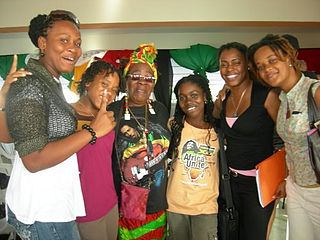
Women in Trinidad and Tobago are women who were born in, who live in, or are from Trinidad and Tobago. Depending from which island the women came, they may also be called Trinidadian women or Tobagonian women respectively. Women in Trinidad and Tobago excel in various industries and occupations, including micro-enterprise owners, "lawyers, judges, politicians, civil servants, journalists, and calypsonians." Women still dominate the fields of "domestic service, sales, and some light manufacturing."
The term 'political participation' has a very wide meaning. It is not only related to 'Right to Vote', but simultaneously relates to participation in: decision-making process, political activism, political consciousness, etc. Women in India participate in voting, run for public offices and political parties at lower levels more than men. Political activism and voting are the strongest areas of women's political participation. To combat gender inequality in politics, the Indian Government has instituted reservations for seats in local governments.

The Uganda Women's Network (UWONET) is a Ugandan non-governmental organization (NGO) working to advance public policy regarding women's rights. It is an umbrella organisation of national women's NGOs and individuals operating in East Africa. The executive director is Rita H. Aciro-Lakor.

Women's empowerment is the process in which women elaborate and recreate what it is that they can be, do, and accomplish in a circumstance that they previously were denied. Empowerment can be defined in many ways, however, when talking about women's empowerment, empowerment means accepting and allowing people (women) who are on the outside of the decision-making process into it. “This puts a strong emphasis on participation in political structures and formal decision-making and, in the economic sphere, on the ability to obtain an income that enables participation in economic decision-making.” Empowerment is the process that creates power in individuals over their own lives, society, and in their communities. People are empowered when they are able to access the opportunities available to them without limitations and restrictions such as in education, profession and lifestyle. Feeling entitled to make your own decisions creates a sense of empowerment. Empowerment includes the action of raising the status of women through education, raising awareness, literacy, and training. Women's empowerment is all about equipping and allowing women to make life-determining decisions through the different problems in society.
Foreign aid for gender equality in Jordan includes programs funded by governments or non-governmental organizations (NGOs) that aim to empower women, close gender based gaps in opportunity and experience, and promote equal access to education, economic empowerment, and political representation in the Hashemite Kingdom of Jordan.
ABANTU for Development is an international women's non-governmental organisation. It seeks to empower African women in the fields of politics and the economy on the local, national, regional and international levels. It pursues these goals by educating through workshops, research, publishing and consultations. ABANTU attracts international attention through its offices in London, where it was founded in 1991 by African women. Its other offices are in Kenya, Tanzania, Ghana, and Nigeria. ABANTU has a special consultative status with the United Nations Economic and Social Council (ECOSOC).
