
Chandra, also known as Soma, is the Hindu god of the Moon, and is associated with the night, plants and vegetation. He is one of the Navagraha and Dikpala.
Ritu means "season" in different ancient Indian calendars used in India, Bangladesh, Nepal and Sri Lanka. There are six ritus or seasons. Seasons are different times of the year and there are 12 months in the year. Every month has its own special season. The word is derived from the Vedic Sanskrit word Ṛtú, a fixed or appointed time, especially the proper time for sacrifice (yajna) or ritual in Vedic religion; this in turn comes from the word Ṛta (ऋत), as used in Vedic Sanskrit literally means the "order or course of things". This word is used in nearly all Indian languages.
Śruti or shruti in Sanskrit means "that which is heard" and refers to the body of most authoritative, ancient religious texts comprising the central canon of Hinduism. Manusmriti states: Śrutistu vedo vijñeyaḥ meaning, "Know that Vedas are Śruti". Thus, it includes the four Vedas including its four types of embedded texts—the Samhitas, the Upanishads, the Brahmanas and the Aranyakas.

Rangoli is an art form that originates from the Indian subcontinent, in which patterns are created on the floor or a tabletop using materials such as powdered lime stone, red ochre, dry rice flour, coloured sand, quartz powder, flower petals, and coloured rocks. It is an everyday practice in many Hindu households, however making it is mostly reserved for festivals and other important celebrations as it is time-consuming. Rangolis are usually made during Diwali or Tihar, Onam, Pongal, and other Hindu festivals in the Indian subcontinent, and are most often made during Diwali. Designs are passed from one generation to the next, keeping both the art form and the tradition alive.
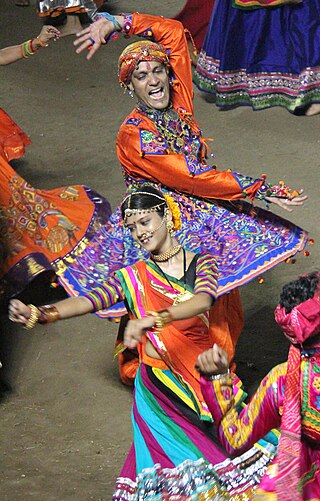
Garba is a form of Gujarati dance which originates from the state of Gujarat, India. The name is derived from the Sanskrit term Garbha. Many traditional garbas are performed around a centrally lit lamp or a picture or statue of the Hindu goddess Durga. Traditionally, it is performed during the nine-day Hindu festival Navaratri. Either the lamp or an image of the Goddess, Durga is placed in the middle of concentric rings as an object of veneration.

Namaste, sometimes called namaskār and namaskāram, is a customary Hindu manner of respectfully greeting and honouring a person or group, used at any time of day. It is used in the Indian subcontinent, and among the Indian and Nepalese diaspora. Namaste is usually spoken with a slight bow and hands pressed together, palms touching and fingers pointing upwards, thumbs close to the chest. This gesture is called añjali mudrā; the standing posture incorporating it is pranāmāsana.
Stotra is a Sanskrit word that means "ode, eulogy or a hymn of praise." It is a literary genre of Indian religious texts designed to be melodically sung, in contrast to a shastra which is composed to be recited.
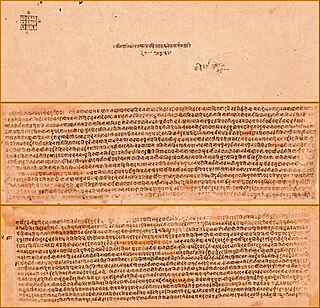
Nirukta is one of the six ancient Vedangas, or ancillary science connected with the Vedas – the scriptures of Hinduism. Nirukta covers etymology, and is the study concerned with correct interpretation of Sanskrit words in the Vedas.
The following list consists of notable concepts that are derived from Hindu culture and associated cultures’ traditions, which are expressed as words in Sanskrit or other Indic languages and Dravidian languages. The main purpose of this list is to disambiguate multiple spellings, to make note of spellings no longer in use for these concepts, to define the concept in one or two lines, to make it easy for one to find and pin down specific concepts, and to provide a guide to unique concepts of Hinduism all in one place.

Samskara are sacraments in Hinduism and other Indian religions, described in ancient Sanskrit texts, as well as a concept in the karma theory of Indian philosophies. The word literally means "putting together, making perfect, getting ready, to prepare", or "a sacred or sanctifying ceremony" in ancient Sanskrit and Pali texts of India.
Pramana literally means "proof" and "means of knowledge". In Indian philosophies, pramana are the means which can lead to knowledge, and serve as one of the core concepts in Indian epistemology. It has been one of the key, much debated fields of study in Hinduism, Buddhism and Jainism since ancient times. It is a theory of knowledge, and encompasses one or more reliable and valid means by which human beings gain accurate, true knowledge. The focus of pramana is how correct knowledge can be acquired, how one knows, how one does not know, and to what extent knowledge pertinent about someone or something can be acquired.
Dikshit is traditionally a Hindu family name.
A Balinese name is part of a system of identification used by the Balinese people and in the western parts of the neighboring island of Lombok, Indonesia. A Balinese name will have three parts: a title, a birth order name and a personal name. Balinese people do not use a family name.

A salabhanjika or shalabhanjika is a term found in Indian art and literature with a variety of meanings. In Buddhist art, it means an image of a woman or yakshi next to, often holding, a tree, or a reference to Maya under the sala tree giving birth to Siddhartha (Buddha). In Hindu and Jain art, the meaning is less specific, and it is any statue or statuette, usually female, that breaks the monotony of a plain wall or space and thus enlivens it.

Akhara or Akhada is an Indian word for a place of practice with facilities for boarding, lodging and training, both in the context of Indian martial artists or a sampradaya monastery for religious renunciates in Guru–shishya tradition. For example, in the context of the Dashanami Sampradaya sect, the word denotes both martial arts and religious monastic aspects of the trident-wielding martial regiment of the renunciating sadhus.
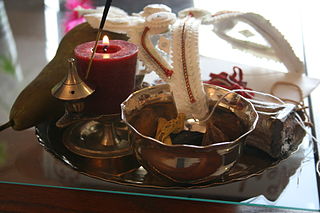
The annaprashana, also known as annaprashana vidhi or annaprashanam, is a Hindu rite of passage (Saṃskāra) that marks an infant's first intake of food other than milk. The term annaprashana means 'eating of cooked rice'. In Vedic Hindu culture, the child cannot eat rice until the annaprashana has occurred. Importance is given to rice because of its symbolism as a life-sustaining food and a sacred food in the form of kheer. The annaprashana remains an important milestone and the ceremony is celebrated in Bangladesh, Nepal and India. It is also known as mukhēbhāt in West Bengal, cōṟūṇŭ in Kerala, and bhāt khulai in Himachal Pradesh. In Nepal, it is also called pasni.
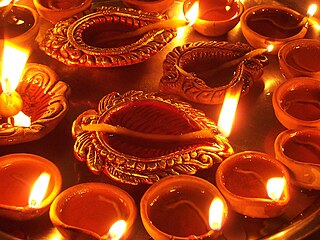
Worship in Hinduism is an act of religious devotion usually directed to one or more Hindu deities, invoking a sense of Bhakti or devotional love. This term is probably a central one in Hinduism, but a direct translation from the Sanskrit to English is difficult. Worship in Hinduism takes many forms, and its expression vary depending on geographical, linguistic, and cultural factors. Hindu worship is not limited to a particular place and Hindus perform worship in temples and within the home. It often incorporates personal reflection, music, dance, poetry, rituals, and ceremonies. Worship in Hinduism serves various purposes, including seeking blessings, guidance, or specific outcomes, as well as fostering a sense of inner peace and spiritual growth. It can also be an expression of devotion (bhakti) to the deity. The aim is to lead a pure life in order to progress spiritually and eventually attain liberation (moksha) from the cycle of rebirth.
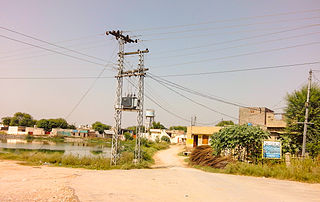
Dhab Kalan is a small village of Har Char Dhab Union council, Chakwal District in the Punjab Province of Pakistan.
In Hinduism, Śāstra pramāṇam refers to the authority of the scriptures with regard to puruṣārtha, the objects of human pursuit, namely dharma, artha, kāma (pleasure) and mokṣa (liberation). Together with smṛti, ācāra, and ātmatuṣṭi, it provides pramana and sources of dharma, as expressed in Classical Hindu law, philosophy, rituals and customs.
Swami in Hinduism is an honorific title given to an ascetic who has chosen the path of renunciation (sanyāsa), or has been initiated into a religious monastic order of Vaishnavas. It is used either before or after the subject's name. An alternative form, swamini, is sometimes used by female renunciates.
