Related Research Articles
In telecommunications, a customer-premises equipment or customer-provided equipment (CPE) is any terminal and associated equipment located at a subscriber's premises and connected with a carrier's telecommunication circuit at the demarcation point ("demarc"). The demarc is a point established in a building or complex to separate customer equipment from the equipment located in either the distribution infrastructure or central office of the communications service provider.
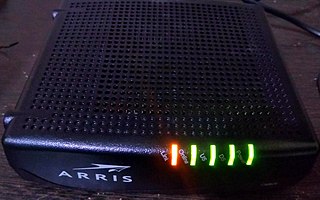
A cable modem is a type of network bridge that provides bi-directional data communication via radio frequency channels on a hybrid fibre-coaxial (HFC), radio frequency over glass (RFoG) and coaxial cable infrastructure. Cable modems are primarily used to deliver broadband Internet access in the form of cable Internet, taking advantage of the high bandwidth of a HFC and RFoG network. They are commonly deployed in the Americas, Asia, Australia, and Europe.
Voice over Internet Protocol (VoIP), also called IP telephony, is a method and group of technologies for the delivery of voice communications and multimedia sessions over Internet Protocol (IP) networks, such as the Internet. The terms Internet telephony, broadband telephony, and broadband phone service specifically refer to the provisioning of communications services over the Internet, rather than via the public switched telephone network (PSTN), also known as plain old telephone service (POTS).

An Internet service provider (ISP) is an organization that provides services for accessing, using, or participating in the Internet. ISPs can be organized in various forms, such as commercial, community-owned, non-profit, or otherwise privately owned.

NTL Incorporated, branded as ntl:, was a United States-listed British company founded in 1992, which provided cable television, cable internet and fixed-line cable telephone services. While NTL had its headquarters in New York City, the company's activities focused heavily on the United Kingdom, with operational headquarters in Hook, Hampshire.

A digital subscriber line access multiplexer is a network device, often located in telephone exchanges, that connects multiple customer digital subscriber line (DSL) interfaces to a high-speed digital communications channel using multiplexing techniques. Its cable internet (DOCSIS) counterpart is the Cable modem termination system.

Internet access is the ability of individuals and organizations to connect to the Internet using computer terminals, computers, and other devices; and to access services such as email and the World Wide Web. Internet access is sold by Internet service providers (ISPs) delivering connectivity at a wide range of data transfer rates via various networking technologies. Many organizations, including a growing number of municipal entities, also provide cost-free wireless access and landlines.
Satellite Internet access is Internet access provided through communication satellites. Modern consumer grade satellite Internet service is typically provided to individual users through geostationary satellites that can offer relatively high data speeds, with newer satellites using Ku band to achieve downstream data speeds up to 506 Mbit/s. In addition, new satellite internet constellations are being developed in low-earth orbit to enable low-latency internet access from space.
Telkom SA SOC Limited is a South African wireline and wireless telecommunications provider, operating in more than 38 countries across the African continent. Telkom is majority state-owned (55.3%) with the South African government owning 40.5% of Telkom, while another 14.8% is owned by another state-owned company - the Public Investment Corporation (PIC), which is closely linked to the South African government.

A cable modem termination system (CMTS) is a piece of equipment, typically located in a cable company's headend or hubsite, which is used to provide high speed data services, such as cable Internet or Voice over Internet Protocol, to cable subscribers. A CMTS provides many of the same functions provided by the DSLAM in a DSL system.

Internet Protocol television (IPTV) is the delivery of television content over Internet Protocol (IP) networks. This is in contrast to delivery through traditional terrestrial, satellite, and cable television formats. Unlike downloaded media, IPTV offers the ability to stream the source media continuously. As a result, a client media player can begin playing the content almost immediately. This is known as streaming media.

A broadband remote access server routes traffic to and from broadband remote access devices such as digital subscriber line access multiplexers (DSLAM) on an Internet service provider's (ISP) network. BRAS can also be referred to as a broadband network gateway or border network gateway (BNG).
Eastlink Inc. is a Canadian cable television and telecommunications company. The privately held company was founded in Nova Scotia in 1969 by the Bragg family, and has grown since through the amalgamation of several telecommunications companies.

In telecommunications, triple play service is a marketing term for the provisioning, over a single broadband connection, of two bandwidth-intensive services, broadband Internet access and television, and the latency-sensitive telephone. Triple play focuses on a supplier convergence rather than solving technical issues or a common standard. However, standards like G.hn might deliver all these services on a common technology.
Access Communications is a Canadian telecommunications service provider operating in over 235 communities in Saskatchewan. Headquartered in Regina, the co-operative provides internet, cable television, telephone and security services to residential and business customers. Its primary competitor is Saskatchewan's government-owned SaskTel.

Lamit Company is an independent satellite operator company in Europe, operating worldwide. The company provides satellite internet and telephony to primary schools and high schools, universities, government institutions etc. Areas of the world covered by the company are: Africa (whole), Europe (whole), Middle East (whole), Russia, Australia, Americas, India, Indonesia, etc.

Virgin Media is a British 2007 telecommunications company which provides telephone, television and internet services in the United Kingdom. Its headquarters are at Green Park in Reading, England. A range of videos advertising the company remain available on YouTube. It is owned by Virgin Media O2, a 50:50 joint venture between Liberty Global and Telefónica.
The prevalent means of connecting to the Internet in Germany is DSL, introduced by Deutsche Telekom in 1999. Other technologies such as Cable, FTTH and FTTB (fiber), Satellite, UMTS/HSDPA (mobile) and LTE are available as alternatives.
EarthLink is an American Internet service provider.
Net bias is the counter-principle to net neutrality, which indicates differentiation or discrimination of price and the quality of content or applications on the Internet by ISPs. Similar terms include data discrimination, digital redlining, and network management.