
Yu Luojin (born 1946 in Beijing) is a Chinese novelist. [1]
Yu Luojin (born 1946 in Beijing) is a Chinese novelist. [1]
She graduated from Beijing Arts and Crafts School in 1966. She was a toy designer.
During the Cultural Revolution, she was sentenced to forced labor, for diary entries. Her brother, Yu Luoke, was tortured, and executed for working as the author of On Class Origins . She married Wang Shijing, divorced, then Cai Zhongpai, and divorced. She was a member of the Chinese Woman's Association.
Her novel was criticized by the Chinese Youth Daily. In 1985, she requested political asylum in Germany. In 1993, she became a German citizen. [2]
Shu Qingchun, known by his pen name Lao She, was a Chinese novelist and dramatist. He was a writer of 20th-century Chinese literature, known for his novel Rickshaw Boy and the play Teahouse (茶馆). He was of Manchu ethnicity, and his works are known for their vivid use of the Beijing dialect.
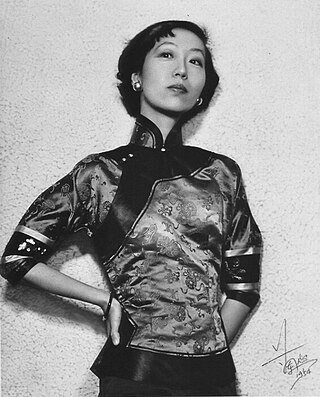
Eileen Chang (traditional Chinese: 張愛玲; simplified Chinese: 张爱玲; pinyin: Zhāng Àilíng; Wade–Giles: Chang1 Ai4-ling2;September 30, 1920 – September 8, 1995), also known as Chang Ai-ling or Zhang Ailing, or by her pen name Liang Jing (梁京), was a Chinese-born American essayist, novelist, and screenwriter.

Gao Xingjian is a Chinese émigré and later French naturalized novelist, playwright, critic, painter, photographer, film director, and translator who in 2000 was awarded the Nobel Prize in Literature "for an oeuvre of universal validity, bitter insights and linguistic ingenuity." He is also a noted translator, screenwriter, stage director, and a celebrated painter.

Wen Wei Po is a pro-Beijing state-owned newspaper based in Hong Kong. The newspaper was established in Hong Kong on 9 September 1948, 10 years after the launch of its Shanghai counterpart in 1938.
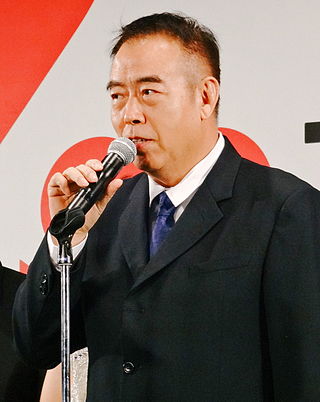
Chen Kaige is a Chinese filmmaker and a leading figure of the fifth generation of Chinese cinema. His films are known for their visual flair and epic storytelling. Chen won the Palme d'Or at 1993 Cannes Film Festival and the International Federation of Film Critics (FIPRESCI) Award in 1993 for directing Farewell My Concubine.
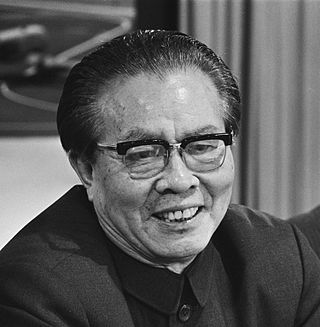
Huang Hua was a senior Chinese Communist revolutionary, politician, and diplomat. He served as Foreign Minister of China from 1976 to 1982, and concurrently as Vice Premier from 1980 to 1982. He was instrumental in establishing diplomatic links of the People's Republic of China with the United States and Japan, and was intensely involved in the negotiations with the United Kingdom over the status of Hong Kong.

Edith Marion Grossman was an American literary translator. Known for her work translating Latin American and Spanish literature to English, she translated the works of Nobel laureate Mario Vargas Llosa, Nobel laureate Gabriel García Márquez, Mayra Montero, Augusto Monterroso, Jaime Manrique, Julián Ríos, Álvaro Mutis, and Miguel de Cervantes. She was a recipient of the PEN/Ralph Manheim Medal for Translation and the 2022 Thornton Wilder Prize for Translation.
Lau Kar-leung was a Chinese actor, filmmaker, choreographer, and martial artist from Hong Kong. Lau is best known for the films he made in the 1970s and 1980s for the Shaw Brothers Studio. His most famous works include The 36th Chamber of Shaolin starring Gordon Liu as well as Drunken Master II starring Jackie Chan.

Shek Wing-cheung, better known by his stage name Shih Kien, Sek Kin, Sek Gin or Shek Kin, was a Hong Kong actor and martial artist. Shih is best known for playing antagonists and villains in several early Hong Kong wuxia and martial arts films that dated back to the black-and-white period, and is most familiar to Western audiences for his portrayal of the primary villain, Han, in the 1973 martial arts film Enter the Dragon, which starred Bruce Lee.

Sanmao was the pen name of Echo Chen Ping, a Taiwanese writer and translator. Her works range from autobiographical writing, travel writing and reflective novels, to translations of Spanish-language comic strips. She studied philosophy and taught German before becoming a career writer. Her pen name was adopted from the main character of Zhang Leping's most famous work, Sanmao. In English, she was also known as Echo or Echo Chan, the first name she used in Latin script, after the eponymous Greek nymph. Since childhood, she was said to have avoided writing the character "Mao" (懋) as it was too complex; later in life, she legally changed her name to Chen Ping.

Sylvia Chang is a Taiwanese actress, singer, director, screenwriter and producer. In 1992, she served as a jury member at the 42nd Berlin International Film Festival. In June 2018, she was invited to become a member of the Academy of Motion Picture Arts and Sciences. In the same year, she served as a jury member at the 75th Venice International Film Festival.

Walter Tso Tat-Wah was a film actor of Hong Kong, most famous for the roles he played in a number of Wuxia films in the 1950s and 1960s.
Siqin Gaowa, born Duan Anlin, is a Chinese-born Swiss actress. She was born in Guangzhou to a Han Chinese father and a Mongol Chinese mother. Her father died when she was 4, she was raised by her mother in Inner Mongolia. She has been married to musician Chen Liangsheng (陈亮声) since 1986 and currently holds Swiss citizenship together with her husband.

George Kao was a Chinese American author, translator, and journalist. He is best known for translating English-language classics into Chinese and for his efforts to bring Chinese classics to English-speaking audiences.

Howard Goldblatt is a literary translator of numerous works of contemporary Chinese fiction, including The Taste of Apples by Huang Chunming and The Execution of Mayor Yin by Chen Ruoxi. Goldblatt also translated works of Chinese novelist and 2012 Nobel Prize in Literature winner Mo Yan, including six of Mo Yan's novels and collections of stories. He was a Research Professor of Chinese at the University of Notre Dame from 2002 to 2011.

Zeng Xueming, known in Vietnamese as Tăng Tuyết Minh, was a Chinese midwife. She was a Catholic from Guangzhou and it was claimed that she married Nguyễn Ái Quốc in October 1926. They lived together until April 1927, when Hồ fled China following an anti-communist coup. Despite several attempts to renew contact by both Zeng and Hồ, the couple never reunited. Zeng and Hồ were never legally divorced, nor was their marriage ever annulled. There is uncertainty of true happenings as some say it was a marriage of convenience to avoid Hồ's political persecution during his time in Kuomintang-ruled China, whilst others say the story was never true to begin with, and was only a hypothesis.

Dong Yingjie was a leading master of tai chi, and a top disciple of Yang Chengfu. Born in Ren County, Hebei, China, his given name was Wenke (文科). Famous in his time for defeating a foreign boxer in a public challenge match, he dedicated his life to the martial arts, training intensively in multiple styles, serving as chief assistant instructor for Yang Chengfu, and going on to found his own thriving tai chi legacy.
Yu Qiangsheng is a former high-ranking Chinese intelligence officer who defected to the United States in 1985. During a career which saw him rise to head of the North America Bureau of China's Ministry of State Security (MSS), Yu passed information to the Central Intelligence Agency (CIA) which most famously exposed CIA officer Larry Wu-Tai Chin as having been a mole for Chinese intelligence for more than 40 years.
Wong Bik-wan or Huang Biyun is a Hong Kong writer. She has received multiple literary awards in Hong Kong, and is cited in The Cambridge History of Chinese Literature as a major contemporary writer.

Huang Zongying was a Chinese actress and writer. She starred in many black-and-white films such as Rhapsody of Happiness (1947), Crows and Sparrows (1949), Women Side by Side (1949), and The Life of Wu Xun (1950), all co-starring her third husband Zhao Dan.
| International | |
|---|---|
| National | |
| Other | |
