Related Research Articles

Douglas, on the South Side of Chicago, Illinois, is one of Chicago's 77 community areas. The neighborhood is named for Stephen A. Douglas, Illinois politician and Abraham Lincoln's political foe, whose estate included a tract of land given to the federal government. This tract later was developed for use as the Civil War Union training and prison camp, Camp Douglas, located in what is now the eastern portion of the Douglas neighborhood. Douglas gave that part of his estate at Cottage Grove and 35th to the Old University of Chicago. The Chicago 2016 Olympic bid planned for the Olympic Village to be constructed on a 37-acre (15 ha) truck parking lot, south of McCormick Place, that is mostly in the Douglas community area and partly in the Near South Side.

State Street is a large south-north street, also one of the main streets, in Chicago, Illinois, USA and its south suburbs. Its intersection with Madison Street has marked the base point for Chicago's address system since 1909. State begins in the north at North Avenue, the south end of Lincoln Park, runs south through the heart of the Chicago Loop, and ends at the southern city limits, intersecting 127th Street along the bank of the Little Calumet River. It resumes north of 137th Street in Riverdale and runs south intermittently through Chicago's south suburbs until terminating at New Monee Road in Crete, Illinois.

John Augur Holabird (1886–1945) was an American architect based in Chicago.
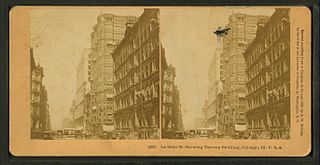
The architectural firm now known as Holabird & Root was founded in Chicago in 1880. Over the years, the firm has changed its name several times and adapted to the architectural style then current — from Chicago School to Art Deco to Modern Architecture to Sustainable Architecture.

Ernest Harold Cluett was an American businessman and politician from Troy, New York. A Republican, he was most notable for his service as a United States representative from 1937 to 1943.

The Chicago Board of Trade Building is a 44-story, 604-foot (184 m) Art Deco skyscraper located in the Chicago Loop, standing at the foot of the LaSalle Street canyon. Built in 1930 for the Chicago Board of Trade (CBOT), it has served as the primary trading venue of the CBOT and later the CME Group, formed in 2007 by the merger of the CBOT and the Chicago Mercantile Exchange. In 2012, the CME Group sold the CBOT Building to a consortium of real estate investors, including GlenStar Properties LLC and USAA Real Estate Company.

The Black Metropolis–Bronzeville District is a historic African American district in the Bronzeville neighborhood of the Douglas community area on the South Side of Chicago, Illinois.

The Chicago Bee Building is a historic building on Chicago's South Side. It originally housed the Chicago Bee, a newspaper serving the African Americans of Chicago. The building now houses the Chicago Bee Branch of the Chicago Public Library. The building was named a Chicago Landmark on September 9, 1998. It is located in the Black Metropolis-Bronzeville District in the Douglas community area of Chicago, Illinois.

Hygienic Manufacturing Company, also known as Overton Hygienic Company, was a cosmetics company established by Anthony Overton. It was one of the nation's largest producers of African-American cosmetics. Anthony Overton also ran other businesses from the building, including the Victory Life Insurance Company and Douglass National Bank, the first nationally chartered, African-American-owned bank. The Overton Hygienic Building is a Chicago Landmark and part of the Black Metropolis-Bronzeville District in the Douglas community area of Chicago, Illinois. It is located at 3619-3627 South State Street.

Frank Arthur Vanderlip Sr. was an American banker and journalist. He was president of the National City Bank of New York from 1909 to 1919, and Assistant Secretary of the Treasury from 1897 to 1901. Vanderlip is known for his part in founding the Federal Reserve System and for founding the first Montessori school in the United States, the Scarborough School and the group of communities in Palos Verdes, California.
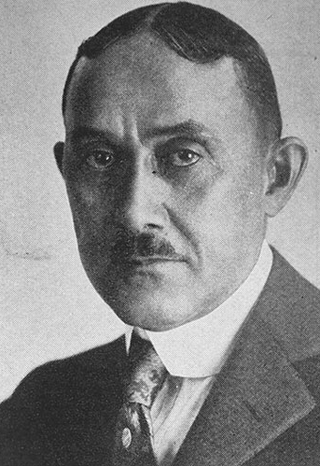
Anthony Overton Jr., was an American banker and manufacturer. He was the first African American to lead a major business conglomerate.
Herbert Wallace Tullgren was an American architect active from the 1910s-1944. He was centered in Milwaukee, Wisconsin, but his work can be seen in different locations throughout Wisconsin, such as Whitefish Bay, Waukesha, Shorewood, and Fond du Lac. His designs made use of Art Deco and Art Moderne, which were popular during the time. Tullgren was the foremost Milwaukee architect practicing in the Art Deco and Art Moderne styles of the early twentieth century.

The W. W. Orr Building is an 11-story landmark building at 478 Peachtree Street NE in SoNo, Atlanta.

The William–Oliver Building is a 1930 Art Deco landmark building at 32 Peachtree Street NW at Five Points, Downtown Atlanta. It currently consists of 115 apartments. Its architect was Francis Palmer Smith of Pringle and Smith and was Atlanta's first completed Art Deco skyscraper. It was named after developer Thomas G. Healey's grandsons William and Oliver.

The Chicago Bee or Chicago Sunday Bee was a Chicago-based weekly newspaper founded by Anthony Overton, an African American, in 1925. Its readership was primarily African American and the paper was committed to covering "wholesome and authentic news", and adopted a middle-class, conservative tone. Politically, it was aligned with the Republican Party. Overton established Half-Century Magazine in 1916 and it was published until 1925.
P.W. Chavers (1876–1933) born Pearl William Chavers, was a banker, entrepreneur, industrialist, philanthropist, African-American journalist, and real estate developer in Chicago, Illinois. He devoted his life to the establishment of a black economy in Chicago, Illinois and in Columbus, Ohio.
Ermelindo Eduardo Ardolino, known as Edward Ardolino was an Italian-born American stone carver and architectural sculptor of the early twentieth century. He was the most prominent member of the Ardolino family of stone carvers. He worked with leading architects and sculptors, including architect Bertram Grosvenor Goodhue and sculptor Lee Lawrie. Ardolino participated in at least nine Goodhue-Lawrie collaborations including the Los Angeles Public Library and the Nebraska State Capitol. His carvings adorn a significant number of important public and private buildings and monuments, including four buildings in the Federal Triangle of Washington, D.C.
Weary and Alford Company was an American architectural firm with partners Edwin Delos Weary and Willam Headley Alford. The firm was known for its design of office buildings and bank buildings and was headquartered in Chicago. The firm also employed Oscar Wenderoth, E. F. Weary, and R. D. Weary. Several buildings designed by the firm are listed on the National Register of Historic Places (NRHP).
Ascher Brothers was a theater business in Chicago and Wisconsin. It was owned by brothers including Max Ascher, Nathan Ascher, and Harry Ascher who established it in 1909. The business owned more than two dozen theaters and was one of the city's largest owners of theaters along with Balaban and Katz and Lubliner and Trinz. The brothers exited the theater business in 1929.
Henry L. Newhouse (1874–1929) was an architect in Chicago, Illinois. His work includes the Milford Theatre (Chicago), Blackstone-State Theater, and Sutherland Hotel. He also designed Elam House (1903) and Chicago Defender Building.
References
- ↑ "Smith". Chicago Tribune. September 30, 1964. p. 57. Retrieved December 16, 2023.
- 1 2 Bruegmann, Robert (October 2, 2018). Art Deco Chicago: Designing Modern America. Yale University Press. ISBN 9780300229936 – via Google Books.
- 1 2 "Z EROL SMITH, 78". Chicago Tribune. February 17, 2004.
- ↑ Bruegmann, Robert (October 2, 2018). Art Deco Chicago: Designing Modern America. Yale University Press. ISBN 9780300229936.
- 1 2 "Domestic Engineering". Domestic Engineering Company. December 27, 1919. p. 78 – via Google Books.
- ↑ "The American Contractor". 1925.
- ↑ "The Lumber Manufacturer and Dealer". 1919.
- ↑ "The Economist: A Weekly Financial, Commercial and Real-estate Newspaper". Economist Publishing Company. January 8, 1919 – via Google Books.
- ↑ "Overton Hygienic Building". Choose Chicago.
- ↑ West, E. James (April 26, 2022). A House for the Struggle: The Black Press and the Built Environment in Chicago. University of Illinois Press. ISBN 978-0-252-05331-3.
- ↑ "Chicago Landmarks - Landmark Details". webapps1.chicago.gov.
- ↑ List of Chicago's outlying banks, 1893-1933 Archived 19 June 2013 at the Wayback Machine
- ↑ "The Economist: A Weekly Financial, Commercial, and Real-estate Newspaper". Economist Publishing Company. December 27, 1921 – via Google Books.
- ↑ "The Iron Age". Chilton Company. December 27, 1926 – via Google Books.
- ↑ "Shore Theatre in Chicago, IL - Cinema Treasures". cinematreasures.org.
- ↑ "Iron Trade Review". December 27, 1926 – via Google Books.
- ↑ "The Economist: A Weekly Financial, Commercial, and Real-estate Newspaper". Economist Publishing Company. December 27, 1916 – via Google Books.