
Absolute zero is the lowest limit of the thermodynamic temperature scale, a state at which the enthalpy and entropy of a cooled ideal gas reach their minimum value, taken as zero kelvins. The fundamental particles of nature have minimum vibrational motion, retaining only quantum mechanical, zero-point energy-induced particle motion. The theoretical temperature is determined by extrapolating the ideal gas law; by international agreement, absolute zero is taken as −273.15 degrees on the Celsius scale, which equals −459.67 degrees on the Fahrenheit scale. The corresponding Kelvin and Rankine temperature scales set their zero points at absolute zero by definition.

Thermodynamic temperature is the measure of absolute temperature and is one of the principal parameters of thermodynamics. A thermodynamic temperature reading of zero denotes the point at which the fundamental physical property that imbues matter with a temperature, transferable kinetic energy due to atomic motion, begins. In science, thermodynamic temperature is measured on the Kelvin scale and the unit of measure is the kelvin. For comparison, a temperature of 295 K is a comfortable one, equal to 21.85 °C and 71.33 °F.
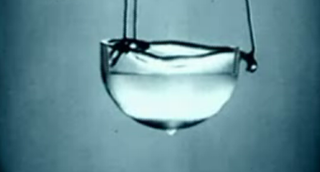
Zero-point energy (ZPE) is the lowest possible energy that a quantum mechanical system may have. Unlike in classical mechanics, quantum systems constantly fluctuate in their lowest energy state as described by the Heisenberg uncertainty principle. As well as atoms and molecules, the empty space of the vacuum has these properties. According to quantum field theory, the universe can be thought of not as isolated particles but continuous fluctuating fields: matter fields, whose quanta are fermions, and force fields, whose quanta are bosons. All these fields have zero-point energy. These fluctuating zero-point fields lead to a kind of reintroduction of an aether in physics, since some systems can detect the existence of this energy; however, this aether cannot be thought of as a physical medium if it is to be Lorentz invariant such that there is no contradiction with Einstein's theory of special relativity.

The invariant mass, rest mass, intrinsic mass, proper mass, or in the case of bound systems simply mass, is the portion of the total mass of an object or system of objects that is independent of the overall motion of the system. More precisely, it is a characteristic of the system's total energy and momentum that is the same in all frames of reference related by Lorentz transformations. If a center-of-momentum frame exists for the system, then the invariant mass of a system is equal to its total mass in that "rest frame". In other reference frames, where the system's momentum is nonzero, the total mass of the system is greater than the invariant mass, but the invariant mass remains unchanged.

F-Zero X is a futuristic racing video game for the Nintendo 64 (N64) console. Developed by Nintendo's EAD division, it was released in Japan, North America, and Europe in 1998. In 2000, an expansion pack was released in Japan providing numerous extra features not in the original game. F-Zero X was ported in 2004 to the iQue Player in China. The game was re-released on the Wii Virtual Console in Japan, Europe and in North America, in 2007. To honor the 100th Virtual Console release in Europe, it became available on June 15.

A zero-emissions vehicle, or ZEV, is a vehicle that never emits exhaust gas from the onboard source of power.

The laws of thermodynamics define a group of physical quantities, such as temperature, energy, and entropy, that characterize thermodynamic systems in thermodynamic equilibrium. The laws also use various parameters for thermodynamic processes, such as thermodynamic work and heat, and establish relationships between them. They state empirical facts that form a basis of precluding the possibility of certain phenomena, such as perpetual motion. In addition to their use in thermodynamics, they are important fundamental laws of physics in general, and are applicable in other natural sciences.
Powerade is a sports drink created, manufactured and marketed by The Coca-Cola Company. Its primary competitor is Gatorade, made by PepsiCo.

The California Public Utilities Commission is a regulatory agency that regulates privately owned public utilities in the state of California, including electric power, telecommunications, natural gas and water companies. In addition, the CPUC regulates common carriers, including household goods movers, passenger transportation companies such as limousine services, and rail crossing safety. The CPUC has headquarters in the Civic Center district of San Francisco, and field offices in Los Angeles and Sacramento.

A Zero Energy Building (ZEB), also known as a Net Zero Energy (NZE) building, or a Zero Net Energy (ZNE) building, is a building with net zero energy consumption, meaning the total amount of energy used by the building on an annual basis is equal to the amount of renewable energy created on the site or in other definitions by renewable energy sources offsite, using technology such as heat pumps, high efficiency windows and insulation, and solar panels. The goal is that these buildings contribute less overall greenhouse gas to the atmosphere during operations than similar non-ZNE buildings. They do at times consume non-renewable energy and produce greenhouse gases, but at other times reduce energy consumption and greenhouse gas production elsewhere by the same amount. Zero-energy buildings are not only driven by a want to have less of an impact on the environment, but they are also driven by money. Tax breaks as well as savings on energy costs make Zero-energy buildings financially viable. A similar concept approved and implemented by the European Union and other agreeing countries is nearly Zero Energy Building (nZEB), with the goal of having all buildings in the region under nZEB standards by 2020. Terminology tends to vary between countries, agencies, cities, towns and reports, so a general knowledge of this concept and its various employments is essential for a versatile understanding of clean energy and renewables. The IEA and European Union most commonly use Net Zero Energy, with "zero net" mainly used in the USA.
Domestic housing in the United Kingdom presents a possible opportunity for achieving the 20% overall cut in UK carbon dioxide emissions targeted by the Government for 2010. However, the process of achieving that drop is proving problematic given the very wide range of age and condition of the UK housing stock.
Zero energy may refer to:
In the UK, an electricity supplier is a retailer of electricity. For each supply point the supplier has to pay the various costs of transmission, distribution, meter operation, data collection, tax etc. The supplier then adds in energy costs and the supplier's own charge.
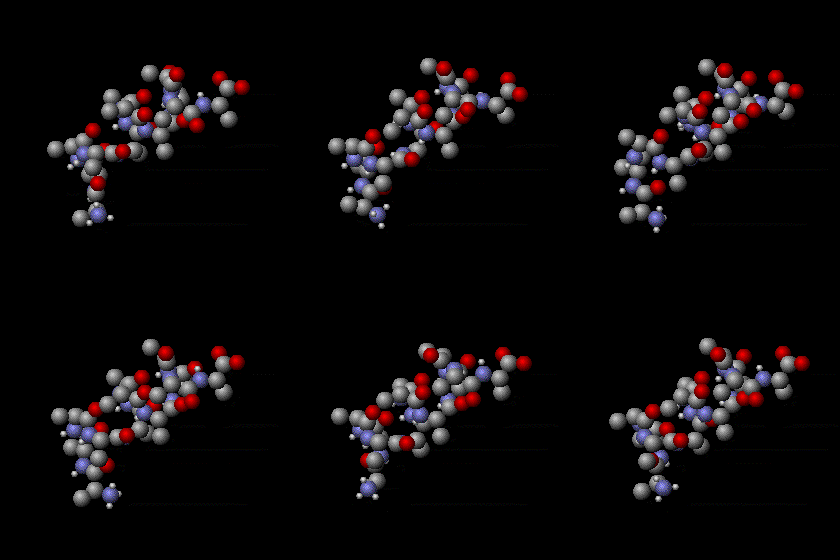
Temperature is a physical quantity that expresses hot and cold. It is the manifestation of thermal energy, present in all matter, which is the source of the occurrence of heat, a flow of energy, when a body is in contact with another that is colder or hotter.
The zero-energy universe hypothesis proposes that the total amount of energy in the universe is exactly zero: its amount of positive energy in the form of matter is exactly canceled out by its negative energy in the form of gravity. Some physicists, such as Lawrence Krauss, Stephen Hawking or Alexander Vilenkin, call or called this state "a universe from nothingness", although the zero-energy universe model requires both a matter field with positive energy and a gravitational field with negative energy to exist. The hypothesis is broadly discussed in popular sources.
0P or 0-P may refer to: -polytope, a geometric form; see Zero-dimensional space
