H.263 is a video compression standard originally designed as a low-bit-rate compressed format for videotelephony. It was standardized by the ITU-T Video Coding Experts Group (VCEG) in a project ending in 1995/1996. It is a member of the H.26x family of video coding standards in the domain of the ITU-T.

Scalable Vector Graphics (SVG) is an XML-based vector image format for two-dimensional graphics with support for interactivity and animation. The SVG specification is an open standard developed by the World Wide Web Consortium (W3C) since 1999.

A SIM card, is an integrated circuit (IC) intended to securely store the international mobile subscriber identity (IMSI) number and its related key, which are used to identify and authenticate subscribers on mobile telephony devices. Technically the actual physical card is known as a universal integrated circuit card (UICC); this smart card is usually made of PVC with embedded contacts and semiconductors, with the SIM as its primary component. In practise the term "SIM card" refers to the entire unit and not simply the IC.

3G is the third generation of wireless mobile telecommunications technology. It is the upgrade over 2G, 2.5G, GPRS and 2.75G EDGE networks, offering faster data transfer, and better voice quality. This network was superseded by 4G, and later on by 5G. This network is based on a set of standards used for mobile devices and mobile telecommunications use services and networks that comply with the International Mobile Telecommunications-2000 (IMT-2000) specifications by the International Telecommunication Union. 3G finds application in wireless voice telephony, mobile Internet access, fixed wireless Internet access, video calls and mobile TV.
The 3rd Generation Partnership Project (3GPP) is an umbrella term for a number of standards organizations which develop protocols for mobile telecommunications. Its best known work is the development and maintenance of:
KASUMI is a block cipher used in UMTS, GSM, and GPRS mobile communications systems. In UMTS, KASUMI is used in the confidentiality (f8) and integrity algorithms (f9) with names UEA1 and UIA1, respectively. In GSM, KASUMI is used in the A5/3 key stream generator and in GPRS in the GEA3 key stream generator.

Unstructured Supplementary Service Data (USSD), sometimes referred to as "quick codes" or "feature codes", is a communications protocol used by GSM cellular telephones to communicate with the mobile network operator's computers. USSD can be used for WAP browsing, prepaid callback service, mobile-money services, location-based content services, menu-based information services, and as part of configuring the phone on the network.
OMA SpecWorks, previously the Open Mobile Alliance (OMA) is a standards organization which develops open, international technical standards for the mobile phone industry. It is a nonprofit Non-governmental organization (NGO), not a formal government-sponsored standards organization as is the International Telecommunication Union (ITU): a forum for industry stakeholders to agree on common specifications for products and services.
Adaptive Multi-Rate Wideband (AMR-WB) is a patented wideband speech audio coding standard developed based on Adaptive Multi-Rate encoding, using a similar methodology to algebraic code-excited linear prediction (ACELP). AMR-WB provides improved speech quality due to a wider speech bandwidth of 50–7000 Hz compared to narrowband speech coders which in general are optimized for POTS wireline quality of 300–3400 Hz. AMR-WB was developed by Nokia and VoiceAge and it was first specified by 3GPP.
Customized Applications for Mobile networks Enhanced Logic (CAMEL) is a set of standards designed to work on either a GSM core network or the Universal Mobile Telecommunications System (UMTS) network. The framework provides tools for operators to define additional features for standard GSM services/UMTS services. The CAMEL architecture is based on the Intelligent Network (IN) standards, and uses the CAP protocol. The protocols are codified in a series of ETSI Technical Specifications.
3GP is a multimedia container format defined by the Third Generation Partnership Project (3GPP) for 3G UMTS multimedia services. It is used on 3G mobile phones but can also be played on some 2G and 4G phones.

High-Efficiency Advanced Audio Coding (HE-AAC) is an audio coding format for lossy data compression of digital audio defined as an MPEG-4 Audio profile in ISO/IEC 14496-3. It is an extension of Low Complexity AAC (AAC-LC) optimized for low-bitrate applications such as streaming audio. The usage profile HE-AAC v1 uses spectral band replication (SBR) to enhance the modified discrete cosine transform (MDCT) compression efficiency in the frequency domain. The usage profile HE-AAC v2 couples SBR with Parametric Stereo (PS) to further enhance the compression efficiency of stereo signals.
Multimedia Broadcast Multicast Services (MBMS) is a point-to-multipoint interface specification for existing 3GPP cellular networks, which is designed to provide efficient delivery of broadcast and multicast services, both within a cell as well as within the core network. For broadcast transmission across multiple cells, it defines transmission via single-frequency network configurations. The specification is referred to as Evolved Multimedia Broadcast Multicast Services (eMBMS) when transmissions are delivered through an LTE network. eMBMS is also known as LTE Broadcast.
SNOW 1.0, SNOW 2.0, and SNOW 3G are word-based synchronous stream ciphers developed by Thomas Johansson and Patrik Ekdahl at Lund University.
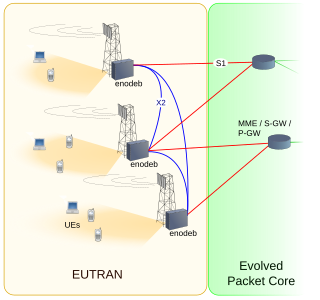
E-UTRA is the air interface of 3rd Generation Partnership Project (3GPP) Long Term Evolution (LTE) upgrade path for mobile networks. It is an acronym for Evolved Universal Mobile Telecommunications System (UMTS) Terrestrial Radio Access, also referred to as the 3GPP work item on the Long Term Evolution (LTE) also known as the Evolved Universal Terrestrial Radio Access (E-UTRA) in early drafts of the 3GPP LTE specification. E-UTRAN is the initialism of Evolved UMTS Terrestrial Radio Access Network and is the combination of E-UTRA, user equipment (UE), and E-UTRAN Node B or Evolved Node B (eNodeB).

High Speed Packet Access (HSPA) is an amalgamation of two mobile protocols, High Speed Downlink Packet Access (HSDPA) and High Speed Uplink Packet Access (HSUPA), that extends and improves the performance of existing 3G mobile telecommunication networks using the WCDMA protocols. A further improved 3GPP standard, Evolved High Speed Packet Access, was released late in 2008 with subsequent worldwide adoption beginning in 2010. The newer standard allows bit-rates to reach as high as 337 Mbit/s in the downlink and 34 Mbit/s in the uplink. However, these speeds are rarely achieved in practice.
ETSI is an independent, not-for-profit, standardization organization in the field of information and communications. ETSI supports the development and testing of global technical standards for ICT-enabled systems, applications and services.
The ISO base media file format (ISOBMFF) is a container file format that defines a general structure for files that contain time-based multimedia data such as video and audio. It is standardized in ISO/IEC 14496-12, a.k.a. MPEG-4 Part 12, and was formerly also published as ISO/IEC 15444-12, a.k.a. JPEG 2000 Part 12.
Frequency bands for 5G New Radio, which is the air interface or radio access technology of the 5G mobile networks, are separated into two different frequency ranges. First there is Frequency Range 1 (FR1), which includes sub-6 GHz frequency bands, some of which are traditionally used by previous standards, but has been extended to cover potential new spectrum offerings from 410 MHz to 7125 MHz. The other is Frequency Range 2 (FR2), which includes frequency bands from 24.25 GHz to 52.6 GHz.
5G NR is a new radio access technology (RAT) developed by 3GPP for the 5G mobile network. It was designed to be the global standard for the air interface of 5G networks. As with 4G (LTE), it is based on OFDM

