
Antonio Mario Taguba is a retired major general in the United States Army. He was the second American citizen of Philippine birth to be promoted to general officer rank in the United States Army.

John William "Jack" Vessey Jr. was a career officer in the United States Army. He attained the rank of general,and was most notable for his service as the tenth chairman of the Joint Chiefs of Staff.

Harry Edward Soyster is a retired United States Army Lieutenant General.

William E. Potts was an American military general.

Lieutenant General Joe Nathan Ballard is a former U.S. Army officer who fought in the Vietnam War,and who served as Chief of Engineers,the first African-American to serve in this role.
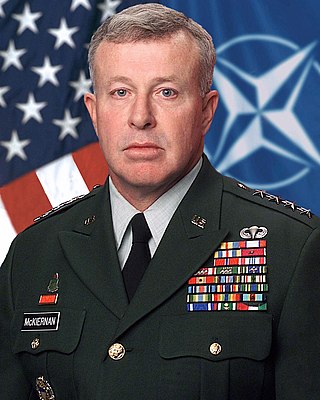
David D. McKiernan is a retired United States Army four-star general who served in Afghanistan as Commander,International Security Assistance Force (ISAF). He served concurrently as Commander,United States Forces –Afghanistan (USFOR-A) from 6 October 2008 to 15 June 2009.

Bantz John Craddock is a former United States Army general. His last military assignment was as Commander,United States European Command and NATO's Supreme Allied Commander Europe from December 2006 to 30 June 2009. He also served as Commander,United States Southern Command from 9 November 2004 to December 2006. After his retirement in 2009,he became chief executive of Military Professional Resources,Inc. (MPRI).

Charles Elliott Wilhelm is a decorated retired United States Marine Corps General who served two combat tours of duty in Vietnam. He later served as Commanding General of the 1st Marine Division;as a Deputy Assistant Secretary of Defense;and as the Commander,U.S. Southern Command (1997–2000). General Wilhelm retired from the Marine Corps in 2000,after 37 years of service.

James L. Terry is a retired lieutenant general of the United States Army. Terry has commanded at multiple levels across the Army. Terry's last assignment was as the commanding general of United States Army Central,retiring 17 November 2015. Terry served as the last commander of V Corps before its inactivation in 2013. While commanding V Corps,he concurrently served as Commander,International Security Assistance Force Joint Command (IJC),and as deputy commander of United States Forces Afghanistan. He was the Commanding General of the 10th Mountain Division from 2009 to 2011.

Malcolm Bradley Frost is a retired United States Army major general who last served as Commanding General,Center for Initial Military Training,United States Army,Training and Doctrine Command,Fort Eustis,VA. MG Frost most recently served as Chief of Public Affairs for the U.S. Army at the Pentagon in Washington,DC. Frost's previous assignment was Deputy Commanding General of the 82nd Airborne Division at Ft. Bragg,NC from March 2014 to March 2015. In March 2014,Frost completed his assignment as deputy director for Operations at the National Military Command Center,J3 the Joint Staff at the Pentagon. Prior to that,he completed an assignment as the Deputy Chief of Staff for Operations (G3/5/7) for the United States Army Pacific (USARPAC). and commanded the 2nd Stryker Brigade Combat Team,25th Infantry Division.

Larry Wyche,is a retired United States Army Lieutenant General. He last served as the deputy commanding general of the U.S. Army Materiel Command. Prior to his last assignment,Wyche served as the Special Assistant to the Commanding General,U.S. Army Training and Doctrine Command. He has also served as commanding general of the Combined Arms Support Command,commanding general of the Sustainment Center of Excellence (SCoE) and Senior Mission Commander for Fort Lee,Virginia.
"We are Warfighter Logisticians and Supporters,prepared to give the shirts off our backs and boots off our feet,to support the fight. We will never say no,as long as there is one gallon of gas to give,or one bullet to give"

Charles Mark Gurganus is a retired U.S. Marine major general who commanded Regional Command Southwest and I Marine Expeditionary Force (Forward) in Afghanistan and was relieved because he and General Gregg A. Sturdevant oversaw "the worst loss of U.S. airpower in a single incident since the Vietnam War" during the September 2012 raid on Camp Bastion. The Commandant of the Marine Corps,General James F. Amos,requested that General Sturdevant and General Gurganus retire in the aftermath of the incident and its investigation,commenting that it was the "...hardest decision I have had to make as commandant of the Marine Corps," and that he had served with both men in combat,calling them "...extraordinary Marine officers." Prior to that,Gurganus was commander of the I Marine Expeditionary Force at Camp Pendleton,California.

Jeffrey W. Talley is an American businessman,scholar,and retired three-star general whose concurrent military and civilian careers encompass a blend of corporate,academic,and government leadership. His unique military and civilian contributions were recognized by the U.S. Senate on June 28,2016,with Tribute to Lieutenant General Jeffrey W. Talley,as reflected in the congressional record.

Thomas David "Tom" Waldhauser is a retired United States Marine Corps general who was the Commander of United States Africa Command. He previously served as Director for Joint Force Development,J7 on the Joint Chiefs of Staff,Commanding General,I Marine Expeditionary Force,and Commanding General,United States Marine Forces Central Command. Waldhauser is an alumnus of Bemidji State University.
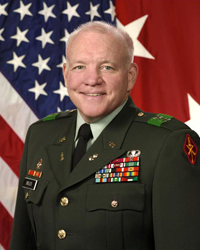
Vincent E. Boles is a retired major general in the United States Army and served as the 33rd Chief of Ordnance and Commandant of the U.S. Army Ordnance School at Aberdeen Proving Grounds,Maryland.
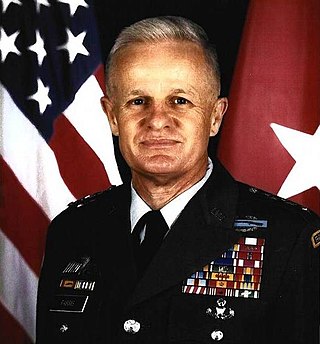
Jack Brodie Farris was a United States Army lieutenant general who commanded the military ground forces during Operation Urgent Fury,the United States invasion of Grenada in 1983;at the time of his retirement in 1991 he was deputy commander of the United States Pacific Command in Hawaii.

Christopher Todd Donahue is a United States Army general who has served as the commanding general of United States Army Europe and Africa and commander of Allied Land Command since 10 December 2024. He most recently served as the commanding general of XVIII Airborne Corps from 2022 to 2024. He previously served as commanding general of the 82nd Airborne Division from 2020 to 2022. Throughout his career,Donahue served in staff and command positions for both United States Army and Special Operations units.

Steven R. Rudder is a retired United States Marine Corps lieutenant general and Naval Aviator. Rudder has served as Deputy Commandant for Aviation,USMC and Commanding General,United States Marine Corps Forces,Pacific.
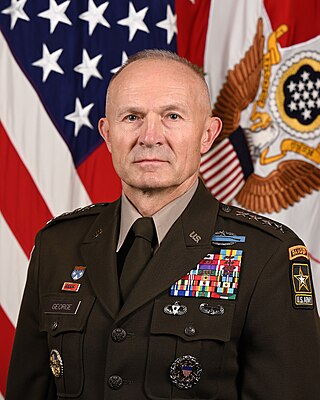
Randy Alan George is a United States Army general who has served as the 41st chief of staff of the United States Army since 21 September 2023,having served in an acting capacity from 4 August 2023. He most recently served as the 38th vice chief of staff of the United States Army from August 2022 to September 2023,and previously served as the senior military assistant to the United States Secretary of Defense.
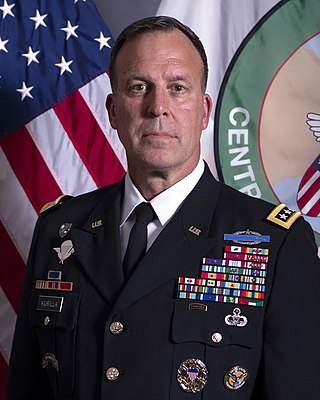
Michael Erik Kurilla is a United States Army general who serves as the 15th commander of United States Central Command since 1 April 2022. He previously served as the commanding general of XVIII Airborne Corps and before that as the chief of staff of United States Central Command.


