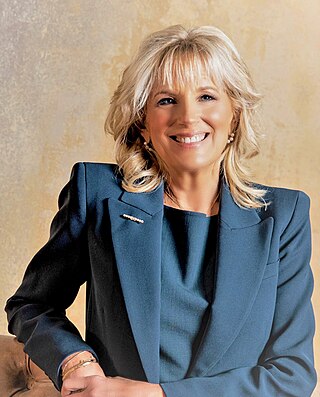
First Lady of the United States (FLOTUS) is the title held by the wife of the president of the United States, concurrent with the president's term in office. Although the first lady's role has never been codified or officially defined, she figures prominently in the political and social life of the United States. The First Lady of the United States is the hostess of the White House.

George Herbert Walker Bush was an American politician, diplomat, and businessman who served as the 41st president of the United States from 1989 to 1993. A member of the Republican Party, he also served as the 43rd vice president from 1981 to 1989 under Ronald Reagan and previously in various other federal positions.
Bush v. Gore, 531 U.S. 98 (2000), was a landmark decision of the United States Supreme Court on December 12, 2000, that settled a recount dispute in Florida's 2000 presidential election between George W. Bush and Al Gore. On December 8, the Florida Supreme Court had ordered a statewide recount of all undervotes, over 61,000 ballots that the vote tabulation machines had missed. The Bush campaign immediately asked the U.S. Supreme Court to stay the decision and halt the recount. Justice Antonin Scalia, contending that all the manual recounts being performed in Florida's counties were illegitimate, urged his colleagues to grant the stay immediately. On December 9, the five conservative justices on the Court granted the stay, with Scalia citing "irreparable harm" that could befall Bush, as the recounts would cast "a needless and unjustified cloud" over Bush's legitimacy. In dissent, Justice John Paul Stevens wrote that "counting every legally cast vote cannot constitute irreparable harm." Oral arguments were scheduled for December 11.

Barbara Bush was the first lady of the United States from 1989 to 1993, as the wife of the 41st president of the United States, George H. W. Bush. She was previously the second lady of the United States from 1981 to 1989, and founded the Barbara Bush Foundation for Family Literacy. Among her children are George W. Bush, the 43rd president of the United States, and Jeb Bush, the 43rd governor of Florida. She and Abigail Adams are the only two women to be the wife of one U.S. president and the mother of another. At the time she became first lady, she was the second oldest woman to hold the position, behind only Anna Harrison, who never lived in the capital. Bush was generally popular as first lady, recognized for her apolitical grandmotherly image.
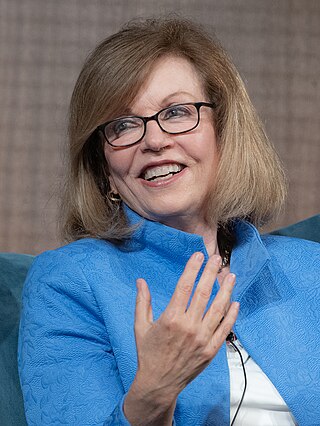
Susan Lea Page is an American journalist, political commentator, and biographer, and the Washington, D.C. bureau chief for USA Today.
James MacGregor Burns was an American historian and political scientist, presidential biographer, and authority on leadership studies. He was the Woodrow Wilson Professor of Government Emeritus at Williams College and Distinguished Leadership Scholar at the James MacGregor Burns Academy of Leadership of the School of Public Policy at the University of Maryland, College Park. In 1971 Burns received the Pulitzer Prize and the National Book Award in History and Biography for his work on America's 32nd president, Roosevelt: The Soldier of Freedom.
Robert A. Dallek is an American historian specializing in the presidents of the United States, including Franklin D. Roosevelt, John F. Kennedy, Lyndon B. Johnson, and Richard Nixon.

The Rehnquist Court was the period in the history of the Supreme Court of the United States during which William Rehnquist served as Chief Justice. Rehnquist succeeded Warren E. Burger as Chief Justice after the latter's retirement, and Rehnquist held this position until his death in 2005, at which point John Roberts was nominated and confirmed as Rehnquist's replacement. The Rehnquist Court is generally considered to be more conservative than the preceding Burger Court, but not as conservative as the succeeding Roberts Court. According to Jeffrey Rosen, Rehnquist combined an amiable nature with great organizational skill, and he "led a Court that put the brakes on some of the excesses of the Earl Warren era while keeping pace with the sentiments of a majority of the country."
Nancy Kassop is a SUNY Distinguished Professor at the State University of New York at New Paltz, and former chair of the Political Science Department at the school. Some of the courses she teaches are American Government and Politics and Constitutional Law.
George H. W. Bush's tenure as the 41st president of the United States began with his inauguration on January 20, 1989, and ended on January 20, 1993. Bush, a Republican from Texas and the incumbent vice president for two terms under President Ronald Reagan, took office following his landslide victory over Democratic nominee Michael Dukakis in the 1988 presidential election. His presidency ended following his defeat in the 1992 presidential election to Democrat Bill Clinton, after one term in office. Bush was the father of the 43rd president, George W. Bush.
Michael P. Riccards is an American political scientist, writer, administrator, and professor. Riccards has been the president of three American colleges and has written extensively on public policy, the American political process, the papacy as a leadership problem, and the history of the American presidency. His book The Ferocious Engine of Democracy was praised by Bill Clinton. He was the founding executive director of the Hall Institute of Public Policy – New Jersey. He now is president of the American Public Policy Institute on YouTube.

Rose Elizabeth Fitzgerald Kennedy was an American philanthropist, socialite, and matriarch of the Kennedy family. She was deeply embedded in the "lace curtain" Irish-American community in Boston. Her father, John F. Fitzgerald, served in the Massachusetts State Senate (1892–1894), in the U.S. House of Representatives, and as Mayor of Boston. Her husband, Joseph P. Kennedy Sr., chaired the U.S. Securities and Exchange Commission (1934–1935) and the U.S. Maritime Commission (1937–1938), and served as United States Ambassador to the United Kingdom (1938–1940). Their nine children included United States President John F. Kennedy, U.S. Senator Robert F. Kennedy of New York, U.S. Senator Ted Kennedy of Massachusetts, Special Olympics founder Eunice Kennedy Shriver, and U.S. Ambassador to Ireland Jean Kennedy Smith. In 1951, Rose Kennedy was ennobled by Pope Pius XII, becoming the sixth American woman to be granted the rank of Papal countess.
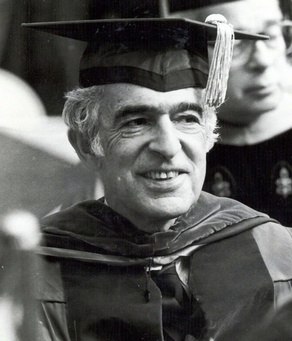
Henry Julian Abraham was a German-born American scholar on the judiciary and constitutional law. He was James Hart Professor of Government Emeritus at the University of Virginia. He was the author of 13 books, most in multiple editions, and more than 100 articles on the U.S. Supreme Court, judicial appointments, judicial process, and civil rights and liberties.
James Sterling Young was an American political scientist, winner of the Bancroft Prize, Professor of Government and Randolph P. Compton Scholar at the University of Virginia.

Michael Nelson is an American political scientist, noted for his work on the Presidency and elections. He is a Fulmer Professor of Political Science at Rhodes College and a Senior Fellow at the University of Virginia’s Miller Center.
William Beatty Pickett is an American historian and professor emeritus at Rose-Hulman Institute of Technology in Terre Haute, Indiana. He is known as an authority on President Dwight D. Eisenhower and Indiana Senator Homer E. Capehart, and is the author of several well-regarded books on U.S. history including Dwight David Eisenhower and American Power and Eisenhower Decides To Run: Presidential Politics and Cold War Strategy.
The following is a list of works about the spouses of presidents of the United States. While this list is mainly about presidential spouses, administrations with a bachelor or widowed president have a section on the individual that filled the role of First Lady. The list includes books and journal articles written in English after c. 1900 as well as primary sources written by the individual themselves.
Keith E. Whittington is an American political scientist and legal scholar. He has been the William Nelson Cromwell Professor of Politics at Princeton University since 2006. In July 2024, he joined the Yale Law School faculty. Whittington's research focuses on American constitutionalism, American political and constitutional history, judicial politics, the presidency, and free speech and the law.
Lewis Ludlow Gould is an American historian and author. He is Eugene C. Barker Centennial Professor Emeritus in American History at the University of Texas at Austin. He is a specialist on 20th century American political history, the history of the Republican Party, and presidential administrations since 1896. He pioneered the scholarly study of presidential spouses.

Stephen F. Knott is an American professor of history and national security. He is the Thomas and Mabel Guy Professor in American History and Government at Ashland University and an emeritus Professor in the Department of National Security Affairs at the United States Naval War College in Newport, RI. Prior to accepting his position at the Naval War College, Knott was co-chair of the Presidential Oral History Program at the Miller Center of Public Affairs at the University of Virginia.


