Related Research Articles

The Arado Ar 231 was a lightweight floatplane, developed during World War II in Nazi Germany as a scout plane for submarines by Arado. The need to be stored inside the submarine necessitated compromises in design that made this single-seat seaplane of little practical use.

The Bloch MB.130 and its derivatives were a series of French monoplane reconnaissance-bombers developed during the 1930s. They saw some limited action at the beginning of World War II but were obsolete by that time and suffered badly against the Luftwaffe. After the fall of France, a few were pressed into Luftwaffe service.
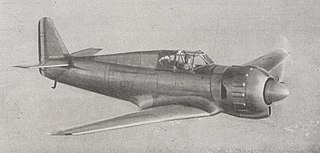
The Bloch MB.150 was a French fighter aircraft developed and produced by Société des Avions Marcel Bloch. It featured an all-metal construction, complete with a retractable undercarriage, low cantilever wing and a fully enclosed cockpit.

The Bloch MB.210 and MB.211 were the successors of the French Bloch MB.200 bomber developed by Société des Avions Marcel Bloch in the 1930s and differed primarily in being low wing monoplanes rather than high wing monoplanes.

The Bloch MB.170 and its derivatives were French reconnaissance bombers designed and built shortly before the Second World War. They were the best aircraft of this type available to the Armée de l'Air at the outbreak of the war, with speed, altitude and manoeuvrability that allowed them to evade interception by the German fighters. Although the aircraft could have been in service by 1937, debate over what role to give the aircraft delayed deliveries until 1940.

The Bloch MB.162 was a French four-engine, long-range bomber developed by Société des Avions Marcel Bloch in the late 1930s. Only a single prototype was built; after capture by German forces, it was pressed into service with the Luftwaffe as a transport.

The Bloch MB.160 was a fourteen-seat French airliner intended for use in the French African colonies. Three were built and two entered service with Régie Air-Afrique at the start of World War II. Developments included the Bloch MB.162 bomber which was too late for service and the Sud-Est SE.161 Languedoc, one hundred of which were built post-war.
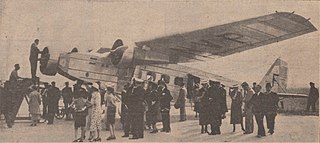
The Bloch MB.120 was a French three-engine colonial transport aircraft built by Société des Avions Marcel Bloch during the 1930s.

The Bloch MB.220 was a French twin-engine passenger transport airplane built by Société des Avions Marcel Bloch during the 1930s.

The Brochet MB.110 was a four-seat light aircraft developed in France in the early 1950s.

The Brügger MB-1, MB-2 and MB-3 Colibri is a family of small sports aircraft designed in Switzerland in the 1960s and 1970s for amateur construction.
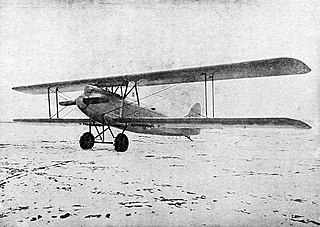
The Letov Š-6 was a bomber aircraft produced in Czechoslovakia during the 1920s. Derived from the Š-2, it was a biplane of conventional design. The wing cellule was an all-new design with a thicker profile, and while it had been intended to build them with a metal structure, wood was used instead due to shortages. Performance during testing was so promising that in 1924 an Š-6 was used to set a new altitude record with a 500 kg payload, and a national endurance record of 10 h 32 min.
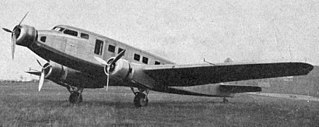
The Bloch MB.300 Pacifique was a French all-metal three-engine monoplane that was developed as an airliner for Air France. A single prototype was produced by Société des Avions Marcel Bloch in 1935, and was eventually rejected by Air France in 1938 in favour of the Dewoitine D.620.

The Zeppelin-Staaken E-4/20 was a revolutionary four-engine all-metal passenger monoplane designed in 1917 by Adolf Rohrbach and completed in 1919 at the Zeppelin-Staaken works outside Berlin, Germany. The E-4/20 was the first four-engine, all-metal stressed skin heavier-than-air airliner built.
The Bloch MB.90 was the first all-metal French light aircraft. Only two aircraft were completed, making their first flights in 1932, though there were several variants.

The SAB AB-80 was a French bomber built in 1934 by the Société Aérienne Bordelaise (SAB) in Bordeaux.

The Bloch MB.141 was a French all-metal two seat light aircraft derived from the Bloch MB.81 air ambulance. Only one was built.
The Bloch MB.60, initially known as the MB.VI, was a tri-motor mailplane designed and built in France from 1930 to 1931 to an order for an aircraft suitable for use as a postal, commercial or medical transport.

The Zeppelin C.I was a German single-engine two-seat biplane, designed by Paul Jaray and built by Zeppelin in World War I. Friedrichshafen referred to the location of the Zeppelin factory where development occurred, and was not connected with the aircraft manufacturer of that name.
The Bloch MB.800 was a French low-wing monoplane three-seat trainer / mailplane developed by Société des Avions Marcel Bloch. It was of all-wood construction.
References
- ↑ "Bloch MB-110 - avion de police coloniale - Un siècle d'aviation française". Aviafrance.com. 2007-01-08. Retrieved 2019-02-04.