
The CAB GY-20 Minicab is a two-seat light aircraft designed by Yves Gardan and built in France by Construction Aeronautiques du Bearn (CAB) in the years immediately following World War II. CAB was formed in 1948 by Yves Gardan, Max Lapoerte and M. Dubouts.
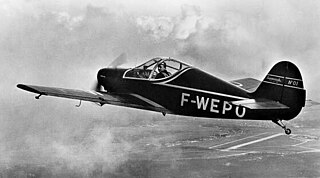
The CAB GY-30 Supercab was a two-seat light aircraft built in France in 1954, as a further development of the CAB Minicab. The design was performed by Yves Gardan, a onetime employee of French aeronautical company SIPA. Changes incorporated in the Supercab included a more powerful engine, greater wingspan, manually retractable undercarriage, and slotted flaps that replaced the split flaps of the Minicab.
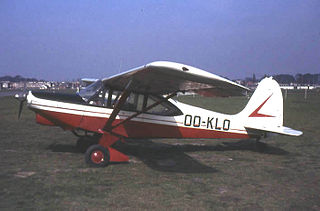
The Boisavia B.60 Mercurey was a series of four-seat light aircraft developed in France shortly after World War II.

The Jodel D.9 Bébé is a French single-seat ultralight monoplane designed by Jean Délémontez for amateur construction.

The Brochet MB.80 was a two-seat light aircraft developed in France in the early 1950s.
The Brochet MB.100 was a three-seat light aircraft developed in France in the early 1950s.

The Brochet MB.110 was a four-seat light aircraft developed in France in the early 1950s.
The Brochet MB.120 was a two-seat light aircraft developed in France in the 1950s.

The Commonwealth Skyranger, first produced as the Rearwin Skyranger, was the last design of Rearwin Aircraft before the company was purchased by a new owner and renamed Commonwealth Aircraft. It was a side-by-side, two-seat, high-wing taildragger.
The Cvjetkovic CA-61 Mini-Ace is a 1960s American homebuilt monoplane aircraft designed by Anton Cvjetkovic.
The Davis DA-5, a.k.a. DA-5A, is a single-seat sport aircraft designed in the United States in the 1970s and marketed for homebuilding. Like designer Leeon D. Davis's successful DA-2, it is a low-wing monoplane with fixed tricycle undercarriage and a V-tail, but with a much narrower fuselage accommodating only the pilot, and a lengthened nose. Design work was carried out in 1972, but the prototype was not built until 1974, when it was completed in only 67 days.
The Fike Model D was a light aircraft built in the United States in the early 1950s. Designed by airline pilot William Fike, it was a conventional high-wing strut-braced monoplane with tailskid undercarriage and seating for one or two people in an enclosed cabin. In appearance, the aircraft strongly resembled a Piper Cub, with only the tail surfaces sourced from one. An unusual feature was that the flight controls were mounted to the ceiling of the cabin, rather than the floor. This facilitated the folding or removal of the seat or seats to enable the aircraft's use as a sleeping space when camping with it. Plans were marketed for homebuilding.

The FMA 20 El Boyero ("Shepherd") was a light utility aircraft produced in Argentina in the 1940s. It was a conventional high-wing strut-braced monoplane with a fixed tailskid undercarriage, seating two side by side in an enclosed cabin.

The Macchi MB.308, later Aermacchi MB-308, is a light aircraft produced in Italy in the late 1940s.
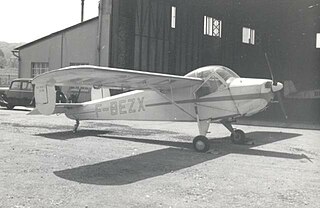
The Nord NC.850 was a light aircraft developed in France in the late 1940s for use by French aeroclubs, but which also saw military use as an airborne observation post.

The Brochet MB.50 Pipistrelle is a French-built light sporting aircraft of the late 1940s.

The Fuji LM-1 Nikko is a Japanese light communications aircraft of the 1950s.
The Morane-Saulnier MS.560 was a French civil aerobatic monoplane designed and built by Morane-Saulnier.

The Powell P-70 Acey Deucy is an American two-seat parasol wing monoplane designed and built by John C. Powell for amateur construction.
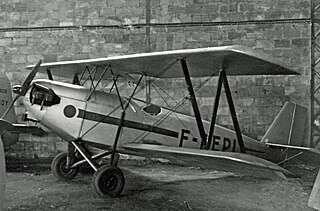
The SCAL FB.40 was a French, side-by-side seat biplane trainer chosen in 1938 for widespread use in the Aviation Populaire programme. The Second World War prevented large scale production but at least two were restored post-war, one becoming a familiar rally participant.

