
The 1850s was a decade of the Gregorian calendar that began on January 1, 1850, and ended on December 31, 1859.
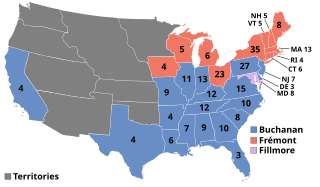
Presidential elections were held in the United States on November 4, 1856. Democratic nominee James Buchanan defeated Republican nominee John C. Frémont and Know Nothing/Whig nominee Millard Fillmore. The main issue was the expansion of slavery as facilitated by the Kansas–Nebraska Act of 1854. Buchanan defeated President Franklin Pierce at the 1856 Democratic National Convention for the nomination. Pierce had become widely unpopular in the North because of his support for the pro-slavery faction in the ongoing civil war in territorial Kansas, and Buchanan, a former Secretary of State, had avoided the divisive debates over the Kansas–Nebraska Act by being in Europe as the Ambassador to the United Kingdom.

Douglas County is a county located in the U.S. state of Kansas. Its county seat and most populous city is Lawrence. As of the 2020 census, the county population was 118,785, making it the fifth-most populous county in Kansas. The county was named after Stephen Douglas, a U.S. Senator from Illinois and advocate for the popular sovereignty choice in the Kansas slavery debate.

Baldwin City is a city in Douglas County, Kansas, United States, about 12 miles (19 km) south of Lawrence. As of the 2020 census, the population of the city was 4,826. The city is home to Baker University, the state's oldest four-year university.

Lawrence is a city in and the county seat of Douglas County, Kansas, United States, and the sixth-largest city in the state. It is in the northeastern sector of the state, astride Interstate 70, between the Kansas and Wakarusa Rivers. As of the 2020 census, the population of the city was 94,934. Lawrence is a college town and the home to both the University of Kansas and Haskell Indian Nations University.

Bleeding Kansas, Bloody Kansas, or the Border War, was a series of violent civil confrontations in Kansas Territory, and to a lesser extent in western Missouri, between 1854 and 1859. It emerged from a political and ideological debate over the legality of slavery in the proposed state of Kansas.

Wilson Shannon was an American attorney and Democratic Party politician from Ohio. He served one term in the U.S. House of Representatives and was the 14th and 16th governor of Ohio. He was the first Ohio governor born in the state. He was the second governor of the Kansas Territory. He failed to stop an attack by pro-slavery forces and retaliation ensued. He fled and submitted a resignation letter before receiving official news of his firing. Earlier in his career he filed sued for past due loans against Franklin College and helped bankrupt and close down the abolitionist institution before starting a rival institution which failed. Franklin College was re-established.

The Topeka Constitutional Convention met from October 23 to November 11, 1855 in Topeka, Kansas Territory, in a building afterwards called Constitution Hall. It drafted the Topeka Constitution, which banned slavery in Kansas, though it would also have prevented free blacks from living in Kansas. The convention was organized by Free-Staters to counter the pro-slavery Territorial Legislature elected March 5, 1855, in polling tainted significantly by electoral fraud and the intimidation of Free State voters.

The sacking of Lawrence occurred on May 21, 1856, when pro-slavery settlers, led by Douglas County Sheriff Samuel J. Jones, attacked and ransacked Lawrence, Kansas, a town that had been founded by anti-slavery settlers from Massachusetts who were hoping to make Kansas a free state. The incident fueled the irregular conflict in Kansas Territory that later became known as Bleeding Kansas.
The Pottawatomie massacre occurred on the night of May 24–25, 1856, in the Kansas Territory, United States. In reaction to the sacking of Lawrence by pro-slavery forces on May 21, and the telegraphed news of the severe attack on Massachusetts Senator Charles Sumner, John Brown and a band of abolitionist settlers—some of them members of the Pottawatomie Rifles—responded violently. Just north of Pottawatomie Creek, in Franklin County, they abducted and killed five pro-slavery settlers, three of them former slave catchers. One teenage son of one of the settlers was also abducted by Brown and his fellow perpetrators, but was ultimately spared.
The Pottawatomie Rifles was a group of about one hundred abolitionist settlers of Franklin and Anderson County, Kansas, both of which are along Pottawatomie Creek. The band was formed in the fall of 1855, during the Bleeding Kansas period, as an armed militia to counter growing pro-slavery presence: an influx of men known as border ruffians, from the neighboring slave state of Missouri.

The 34th United States Congress was a meeting of the legislative branch of the United States federal government, consisting of the United States Senate and the United States House of Representatives. It met in Washington, D.C., from March 4, 1855, to March 4, 1857, during the last two years of Franklin Pierce's presidency. The apportionment of seats in the House of Representatives was based on the 1850 United States census. The Whig Party, one of the two major parties of the era, had largely collapsed, although many former Whigs ran as Republicans or as members of the "Opposition Party." The Senate had a Democratic majority, and the House was controlled by a coalition of Representatives led by Nathaniel P. Banks, a member of the American Party.
The Wakarusa War was an armed standoff that took place in the Kansas Territory during November and December 1855. It is often cited by historians as the first instance of violence during the "Bleeding Kansas" conflict between anti-slavery and pro-slavery factions in the region.

Prairie City is a ghost town in southeast Douglas County, Kansas, United States, near present-day Baldwin City.
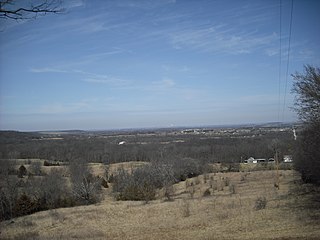
Palmyra Township is a township in Douglas County, Kansas, USA. As of 2000 census, its population was 5,760. It was named after a small trail stop on the Santa Fe Trail that was later absorbed into Baldwin City. When it was first established in 1855, it was called Calhoun, until 1858.

Dunavant is an unincorporated community in Jefferson County, Kansas, United States.
Henry James Sedgwick was an American lawyer and politician who served as a member of the New York State Senate for the 7th district from 1845 to 1847.
Franklin is a ghost town in Douglas County, Kansas, United States. Established as a proslavery stronghold, the town played a key role in the "Bleeding Kansas" conflict that troubled the territory in the 1850s.
Franklin's Fort was a small fortification that had been erected in Franklin, Douglas County, Kansas by pro-slavery settlers. During the "Bleeding Kansas" period, the fort was the site of two minor battles between pro- and anti-slavery factions.
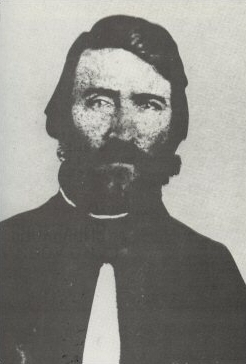
Samuel Jefferson Jones was a pro-slavery settler who held the position of Douglas County sheriff in Kansas Territory from late 1855 until early 1857. He helped found the territorial capital of Lecompton and played a prominent role in the "Bleeding Kansas" conflict.
