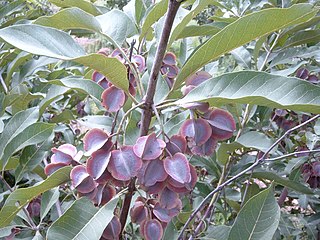
Combretum, the bushwillows or combretums, make up the type genus of the family Combretaceae. The genus comprises about 272 species of trees and shrubs, most of which are native to tropical and southern Africa, about 5 to Madagascar, but there are others that are native to tropical Asia, New Guinea and the Bismarck Archipelago, Australia, and tropical America. Though somewhat reminiscent of willows (Salix) in their habitus, they are not particularly close relatives of these.

Ochna is a genus comprising 79 species of evergreen trees, shrubs and shrublets belonging to the flowering plant family Ochnaceae. These species are native to tropical woodlands of Africa, Madagascar, the Mascarenes and Asia. Species of this genus are usually called ochnas, bird's-eye bushes or Mickey-mouse plants, a name derived from the shape of the drupelet fruit. The name of this genus comes from the Greek word ὄχνη (ókhnē), used by Theocritus and meaning "wild pear", as the leaves are similar in appearance. Some species, including Ochna integerrima and O. serrulata, are cultivated as decorative plants.

Faurea is a genus containing 16 species of flowering plants in the protea family which occur in the summer rainfall area of southern Africa, extending to tropical Africa and Madagascar. The name honours South African soldier and botanist William Caldwell Faure (1822-1844) who was killed on active service in India.

Gnidia is a genus of flowering plants in the family Thymelaeaceae. It is distributed in tropical and southern Africa and Madagascar; more than half of all the species are endemic to South Africa. Gnidia was named for Knidos, an Ancient Greek city located in modern-day Turkey.
Peddiea is a genus of plant in the family Thymelaeaceae. It includes 16 species native to tropical and southern Africa and Madagascar.

Thesium is a genus of flowering plants in the family Santalaceae. It is particularly well represented in South Africa.

Gyrinops is a genus of nine species of trees, called lign aloes or lign-aloes trees, in the family Thymelaeaceae. They are native to Southeast Asia, the Indian Subcontinent, and New Guinea.
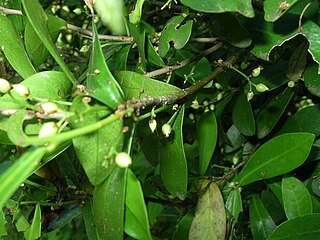
Daphnopsis is a plant genus in the family Thymelaeaceae. It includes 72 species native to the Neotropics. They are shrubs and small trees with tubular or bell-shaped flowers. Individuals are dioecious, with male and female flowers produced on separate trees.
Dissotis is a genus of plants in the family Melastomataceae. It includes nine species of annual or perennial herbs, shrubs, or small trees which are native to tropical Africa.

Funifera is a genus of flowering plants in the family Thymelaeaceae, with all species endemic to Brazil.
Baumia is a genus of flowering plants belonging to the family Orobanchaceae.

Chytranthus is a genus of flowering plants belonging to the family Sapindaceae. It includes 32 species of small trees and shrubs native to tropical Africa, ranging from Guinea eastwards to Kenya and Tanzania and south to Angola. Most species have a palm-like habit, with large pinnate leaves and unbranched trunks.

Deinbollia is a genus of flowering plants belonging to the family Sapindaceae.
Dicranolepis is a genus of flowering plants belonging to the family Thymelaeaceae.
Eriocoelum is a genus of flowering plants belonging to the family Sapindaceae.
Lasiosiphon is a genus of flowering plants belonging to the family Thymelaeaceae.
Pancovia is a genus of flowering plants belonging to the family Sapindaceae.
Dissotidendron is a genus of flowering plants belonging to the family Melastomataceae.
