The Dassault MD.750 (Mirage 6000 or Mega Mirage or Spectre) was a single-seat twinjet tailless delta interceptor aircraft concept developed by Dassault Aviation beginning in 1958 and being periodically reworked through the 1960s.
Among the design goals were a maximum speed of Mach 3.5, with a high rate of climb of about 5 or 6 minutes to an altitude of 16,000 m (52,000 ft).
The delta wing is mounted low and extends most of the length of the fuselage aft of the intakes, as with other Mirage fighters, and it has a single vertical tail but uses square section intake ramps with a linear shock plate rather than shock cones, as used on the North American A-5 Vigilante and Mikoyan-Gurevich MiG-25 unlike other Mirage fighters, with a similarly boxy fuselage intake section to those types. [1] [2] The existence of the project under the name Spectre was confirmed by Dassault Aviation's Vice-president in a tweet containing several artist's renditions. [3]

Dassault Aviation SA is a French manufacturer of military aircraft and business jets. It was founded in 1929 by Marcel Bloch as Société des Avions Marcel Bloch or "MB". After World War II, Marcel Bloch changed his name to Marcel Dassault, and the name of the company was changed to Avions Marcel Dassault on 20 January 1947.

A delta wing is a wing shaped in the form of a triangle. It is named for its similarity in shape to the Greek uppercase letter delta (Δ).

The Dassault Mirage III is a family of single/dual-seat, single-engine, fighter aircraft developed and manufactured by French aircraft company Dassault Aviation. It was the first Western European combat aircraft to exceed Mach 2 in horizontal flight, which it achieved on 24 October 1958.

The Dassault Mirage 2000 is a French multirole, single-engine, delta wing, fourth-generation jet fighter manufactured by Dassault Aviation. It was designed in the late 1970s as a lightweight fighter to replace the Mirage III for the French Air Force. The Mirage 2000 evolved into a multirole aircraft with several variants developed, with sales to a number of nations. It was later developed into the Mirage 2000N and 2000D strike variants, the improved Mirage 2000-5, and several export variants. Over 600 aircraft were built and it has been in service with nine nations.

The Dassault Mirage 2000N is a variant of the Mirage 2000 designed for nuclear strike. It formed the core of the French air-based strategic nuclear deterrent. The Mirage 2000D is its conventional attack counterpart. Although it looks like a Mirage 2000 trainer, it was actually used as a fighter-attack aircraft.

The Dassault Mirage IV is a French supersonic strategic bomber and deep-reconnaissance aircraft. Developed by Dassault Aviation, the aircraft entered service with the French Air Force in October 1964. For many years it was a vital part of the nuclear triad of the Force de Frappe, France's nuclear deterrent striking force. The Mirage IV was retired from the nuclear strike role in 1996, and the type was entirely retired from operational service in 2005.
Mirage is a name given to several types of jet aircraft designed by the French company Dassault Aviation, some of which were produced in different variants. Most were supersonic fighters with delta wings. The most successful was the Mirage III in its many variants and derivatives, which were widely produced and modified both by Dassault and by other companies. Some variants were given other names, while some otherwise unrelated types were given the Mirage name.
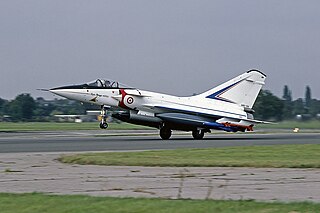
The Dassault Mirage 4000 is a French prototype twinjet fighter aircraft developed by Dassault-Breguet from their Mirage 2000.
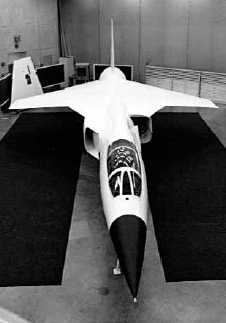
The Lockheed CL-1200 Lancer was a late 1960s company-funded proposal for a fighter aircraft based on the Lockheed F-104 Starfighter. The CL-1200 was conceived and marketed mainly for and to non-US military services, as an export product. As such it would have competed with combat-proven designs like the Dassault Mirage III, McDonnell Douglas F-4 Phantom II, Mikoyan-Gurevich MiG-21, and Northrop F-5E Tiger II. The CL-1200 competed unsuccessfully against proposed fourth generation designs, under the US government's Lightweight Fighter program, which would eventually result in the General Dynamics F-16 and Northrop F-17 Cobra.

The Fairey Delta 2 or FD2 is a British supersonic research aircraft that was produced by the Fairey Aviation Company in response to a specification from the Ministry of Supply for a specialised aircraft for conducting investigations into flight and control at transonic and supersonic speeds. Features included a delta wing and a drooped nose. On 6 October 1954, the Delta 2 made its maiden flight, flown by Fairey test pilot Peter Twiss; two aircraft would be produced. The Delta 2 was the final aircraft to be produced by Fairey as an independent manufacturer.

The Dassault M.D.450 Ouragan is a French fighter-bomber developed and produced by Dassault Aviation. It has its origins in a private venture by Dassault to produce an all-French aircraft which would make use of jet propulsion, which subsequently would receive orders from the French Air Force.

The Dassault MD.452 Mystère is a 1950s French fighter-bomber. It was a straightforward development of the successful Dassault Ouragan

A supersonic aircraft is an aircraft capable of supersonic flight, that is, flying faster than the speed of sound. Supersonic aircraft were developed in the second half of the twentieth century. Supersonic aircraft have been used for research and military purposes, but only two supersonic aircraft, the Tupolev Tu-144 and the Concorde, ever entered service for civil use as airliners. Fighter jets are the most common example of supersonic aircraft.
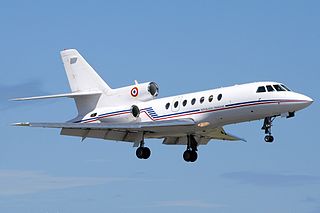
The Dassault Falcon 50 is a French super-midsize, long-range business jet, featuring a trijet layout with an S-duct air intake for the central engine. It has the same fuselage cross-section and similar capacity as the earlier twin-engined Falcon 20, but was a new design that is area ruled and includes a more advanced wing design.

The Dassault Mirage IIIV, also spelled Mirage III V, was a French vertical take-off and landing (VTOL) prototype fighter aircraft of the mid-1960s developed and produced by Dassault Aviation.

The Helwan HA-300 was a single-engine, delta-wing, light supersonic interceptor aircraft developed in Egypt during the 1960s.
The Atlas Carver was a proposed South African twin-engine, delta wing fourth-generation fighter aircraft. In development during the 1980s and early 1990s, the Carver was ultimately cancelled during 1991.

The Dassault Mirage F2 was a French prototype two-seat ground attack/fighter aircraft, which was designed to serve as a test bed for the SNECMA TF306 turbofan engine. The F2 also influenced the subsequent Dassault Mirage G, a variable geometry design.

The SNCASO SO.9000 Trident is a French jet and rocket powered interceptor aircraft built by aircraft manufacturer SNCASO during the 1950s. As part of a wider effort to re-build French military power during the late 1940s and to furnish France with advanced, new domestically produced designs, a request for a supersonic-capable point-defence interceptor aircraft to equip the French Air Force was issued to SNCASO. In response, the firm designed the mixed-propulsion Trident, powered by a single SEPR rocket engine, which was augmented by wingtip-mounted turbojet engines, and the Air Force ordered two prototypes.

Dassault Mirage III Australian procurement was a transaction between the French and Australian governments which led to the procurement of the French designed delta wing jet aircraft, the Mirage III, for the Royal Australian Air Force (RAAF). In the late 1950s the Australian government announced its intention to modernize its air force with state of the art technology. The French manufacturing company Dassault won the bid over the American Lockheed when the Australian government agreed to buy over 100 Mirages at an estimated cost of AUS$193.7 million in the early 1960s.
 | This article on an aircraft of the 1960s is a stub. You can help Wikipedia by expanding it. |

