The Fengu or amaMfengu (in the Xhosa languageMfengu, plural amafengu) are a group of clans whose ancestors were initially refugees that fled from the Mfecane holocaust waged by Shaka and his Zulu armies alongside the Boers against territories within the former British colony of Natal in the early-mid 19th century. These refugees were allowed into the Xhosa nation and were officially recognized by the then king, Hintsa, though they would shortly after be fully assimilated into the Cape Colony by the Crown as British settlers and known locally as AmaNgesi, a Xhosa word meaning the English people.[1]
The word Fengu comes from the old Xhosa word which is "ukumfenguza" which in the old Xhosa dialect meant to wander.
Names and Colonial record Franktenement grants
The Fengu people are a confederation of clans from the former British colony of Natal;[2] these clans include Miya, Ndlangisa, Gatyeni, Bhele, Tolo and Tshezi clans. Though these clan names are likely Xhosa translations of prior names to a now extinct fengu language and culture as the Fengu not only adopted cultural practices of the Xhosa people, they adopted their language and naming conventions as well.
After their settlement in the Cape, they were lawfully recognized as British since by the principles of English common law or natural law, Freeholds cannot be granted outside lawful descent; the land devolves by heirship, binding ancestry and lawful rights together. Since Great Britain was in effect an english common law nation, the fengu or fingo which is a verb describing the state of wandering at the time, were made full beneficieries of crown protected British subjecthood and thus enjoyed the full freedoms of the King's freemen. [3]
Hence the colonial records and deeds majority of the time show their clan names are recorded in their English form, i.e., Myer would have been the anglicized Miya[4] and its other English variants as supported by church records and land deeds. Some like Stewart were not only anglicized forms but translated directly to Sonkosi,[5] Knox to Nokwe,[6] Marsh to Mahashe,[7] Gwenwynwyn to Gcwanini,[8] Rheade to Rhadebe[9] and others.[10][11]
This meant under 1828 English common law jurisprudence and diction, the King’s prerogative could grant hereditary freeholds. Such grants are heritable by blood and are protected by the Crown, inseparable from lawful lineage. Blood is biological and legal — rights descended to heirs of common blood only. The Fengu were granted such freeholds, meaning their lineage, inheritance, and lawful identity are automatically English in legal terms.
Common law differentiated lawful inheritance by blood from social or tribal affiliation. The Fengu’s lawful identity was determined exclusively by: Hereditary freeholds granted under royal prerogative, descent by common blood, lawfully transmitted surnames and lineage markers. Therefore, despite external social classifications (Xhosa or Nguni), their legal identity was British, encompassing Welsh, English, Scottish, and Irish heritage, as recognised under colonial British common law.
Fengu settlers and other 1820 British settlers
Their arrival in the British Cape colony coincided with the settlement of the 1820 British settlers.[12] It is reasonable to presume they were settled by Jacob Cuyler as they were settled around the 1820 settlers timeframe, in the very same territories under the same british titles. They were settled on the frontier as a buffer between the Cape colony and the Xhosa just as the 1820 settlers, and as other settlers from Wales, England, Scotland and Ireland, they were settled in Albany, South Africa, George, South Africa, and later Cape Town. This is why the names and titles of fengu settlers and other british settlers can not be seperated on the records of franktenement grants, church baptismal records and military service records because they are effectively the same people on paper.[13][14]
During the 6th Frontier War, they were promised independence from the oppressive Xhosa government by the Cape Colony and it was proposed under the crown's prerogative that they would be granted their own fief which was to be called Fingoland, the southwestern portion of Eastern Xhosaland, in the Eastern Cape of South Africa.[15]
The Fengu were then granted freehold estates under the Crown and Cape government, they effectively ceased to be allies and became british subjects enrolled on English as well as Scottish church baptismal and land grant records. These land grants were freehold estates or more properly Franktenement land grants[16] hence the Fengu were fully incorporated into the British Cape colony as British subjects by land grants and official records. They had full legal standing within the Cape franchise, giving them full voting rights by the Crown's royal prerogative contrary to modern academic opinions which overlook the laws of holding land at the time. English common law identified lawful standing and rights as derived from the land itself by sovereign prerogative and a Franktenement was the highest estate any subject could hold.[17]
Leaders such as James Stewart[18] were primary supporters of the Fengu community and helped raise funds to rebuild Fengu society and identity which had been destroyed prior.[19]
History
Formation and early history
The name amaMfengu does translate as "wanderers" as many believe and the Mfengu people were formed from the clans in the colony of Natalia that were broken up and dispersed by Shaka and his Zulu armies in the Mfecane wars.
Most of them fled westwards and settled amongst the Xhosa. After some years of oppression by the Gcaleka Xhosa (who called the Fengu people their "dogs")[citation needed]in the 1820s, they formed an alliance with the Cape government and in 1835 Sir Benjamin d'Urban invited 17,000 to settle on the banks of the Great Fish River in the region that later became known as the Ciskei.[20] Some scholars, including Timothy Stapleton and Alan Webster, argue that the traditional narrative of the Fengu people as refugees of the Mfecane is in fact a lie constructed by colonial missionaries and administrators. They question the existence of the Fengu people as a distinct group prior to colonial contact, instead positing that the term was coined by the British government in the Cape Colony to describe a collection of Xhosa defectors, migrant laborers, and labor captives.[21]
This is largely in part because the Fengu people have no recorded common language, names, chiefs or culture outside their adopted Xhosa customs and traditions. Their only language in common is English as they were by royal prerogative under the king's English common law. Their culture was in all aspects British outside of the Xhosa social influences due to proximity. This is how British culture came to be incorporated into Xhosa cultural identity, particularly their Scottish tartan fabrics, i.e., ixakatho,[22][23] ibhatyi yamakrwala[24] and others. This was brought in by the Fengu who in local social references were AmaNgesi or the English. This English or rather British identity was not just a social or administrative recognition for the Fengu, it was a common law status for Qualified subjects in English common law.
This in accordance with the jurisprudence of the realm, and based on noah webster's 1828 old english diction meant that the Fengu were effectively adopted into the sovereign's estate as beneficieries of the king's peace by law. Based on naming conventions as recorded on baptismal records, voters rolls and freehold grants, the fengu were effectively adopted by nation standing and nature into full british subjecthood with full rights to hold, purchase and dispose of real property freely. As freeholds are hereditary, this grant made them by lawful effect welsh, scottish, english and irish by nation status as supported by voters rolls and other Cape records. [25]
Contrary to modern popular belief, the fengu never identified themselves as nguni, bantu or african, those classifictions were later imposed by men like Wilhelm Bleek who published many racist works and later retribalization acts by the apartheid regime institutionalized racism. The fengu identified as AmaNgesi or Englishmen prior to these imposed social and academic labels.
The Fengu people, known across southern Africa as skilled gunmen, were invaluable allies of the Cape in its frontier wars.
Early frontier wars (1835–56)
They subsequently became notable service men of the Cape Colony in the frontier wars against their former oppressors after their British status was officiated by the Crown. In this capacity, they won several victories against their Xhosa enemies (particularly the Gcaleka Xhosa), and through shrewd and successful management of regional trade, formed a developed and materially successful nation. In addition, many were granted farms and started businesses in the small towns that were springing up in that part of the Cape frontier.
While the Xhosa slaughtered their own cattle and burnt their crops, many of the Fengu people instead bought the Xhosa cattle at very low prices, only to resell them at a profit during the subsequent famine. They also were recorded as producing large excesses of grain at this time for their starving neighbours. The famine induced by the cattle-killing effectively brought much of the armed resistance in the eastern Cape to an end.
The Fengu-Gcaleka War (1877–79) and post Union status (1910–80)
Over a decade of relative peace and economic development, which peaked in the mid-1870s, was brought to an end by a series of devastating droughts across the Transkei, which began to place severe strain on intertribal relations. Their severity increased up until 1877, when the last major war that the Fengu people fought, the Ninth Frontier War, broke out after a bar fight between Fengu and Gcaleka guests, at a Fengu wedding. Many Fengu people were Cape citizens by this time, so the Cape Colony took a partisan view of the war, which brought it into conflict with the Gcaleka forces.[26][27][28]
The Cape government appointed the Fengu Captain Bikitsha to co-lead the Cape's forces in the war. They inflicted a string of crushing defeats on the enemy and dispersed their armies in the space of only three weeks. When the anglo-boer war started, the fengu were the first to suffer in the hands of the boer foreign volunteers[29] as their farms were burnt and they were pushed out of their towns. With the end of the war and the formation of the Union of South Africa in 1910, the fengu essentially experienced a paper genocide through the Boer enacted policies which stripped them off their Crown granted estates and titles.
Through acts of administrative alienation such as the creation of native reserves act, the removal of the pound sterling as the legal tender, to reclassification acts such as the population registration act no.30, the Boer republics violated the treaty with Great Britain by alienating the Crown conveyed inalienable rights of the fengu people. These acts of hostility towards the British fengu were later inherited by the South African apartheid government, which included act of biological and chemical warfare through government programs like the apartheid Project Coast and others.
The Fengu lived in the Bantustans of Transkei and Ciskei, established by the Apartheid government. Ciskei was the scene of political rivalry between the Rharhabe and the Fengu as a result of the apartheid policy of "retribalisation", which resulted in resentment toward the historically better educated, and relatively economically advantaged Fengu, and this rivalry culminated in the election of Lennox Sebe, a Rharhabe, who replaced Fengu leader Chief Justice Thandathu Jongilizwe Mabandla in 1973,[30] however Sebe subsequently abandoned his anti-Fengu rhetoric.[30]:402
Christianity in the Fengu community
Fengu village in Cape Town in the 1870s
Christianity played a major role in the survival of the endangered Fengu people after the Mfecane wars. After contact with the Gcaleka Xhosa, who were hostile towards them, the Fengu people found comfort in Rev. John Ayliff, the missionary at Butterworth who devoted himself to the refugees for the next 30 years. In 1835, John led 17 000 and 22 000 head of cattle to Peddie[31] On 14 May 1835, the Fengu people gathered under an old milkwood tree in the Peddie district, in the presence of Rev. John Ayliff, and swore an oath to obey the Crown, to accept Christianity, and to educate their children. This agreement became known as the 'Fingo-Oath'. Soon after accepting Christianity, the Fengu became the first people in South Africa to use ploughs, and also the first to plant wheat.[32] A small group moved to Tsitsikamma and carried their Christian customs with them. The Fengu, who were most Wesleyans, soon moved to Grahamstown where they fought on the side of the British in the eighth frontier war of 1850 to 1853 and were rewarded with land in a freehold village known as Fingo in Grahamstown in 1855.[33] The educated Fengu went as far as Port Elizabeth, where they worked at the harbour and established urban communities in Cape Town, where they also continued practising as Christians. Since the day the 'Fingo-Oath' was sworn, 14 May has been celebrated as Fingo Emancipation Day and a ceremony held under the old milkwood tree where the oath was sworn.[32]
Fengu people in Zimbabwe
After the occupation of Matebeleland in 1893, the Ndebele took up arms in an effort to re-establish the Ndebele State in 1896. Cecil John Rhodes brought a group of Fengu fighters (who had fought on the side of the British) and were known as "the Cape Boys" in 1896. After the war, Rhodes tried further to 'neutralise' the 'war-like' Ndebele people by inviting more Fengu people into Southern Rhodesia. "He promised the Fengus three 'reserves' on which they could settle with the proviso that each man would work for three months a year. After 36 months of labour, each one would be given an individual title".[34] More Fengu leaders moved to Southern Rhodesia as Wesleyan Methodists, Salvationists, Anglicans, Presbyterians and Lutherans. In 2000, the Mbembesi Fengu/Xhosa community celebrated their centenary in Zimbabwe.[34] The Fengu in Zimbabwe, who are Xhosa speakers, are the subject of the first ever PHD thesis written in Xhosa by Dr Hleze Kunju titled IsiXhosa ulwimi lwabantu abangesosininzi eZimbabwe: Ukuphila nokulondolozwa kwaso (Xhosa as a Minority Language in Zimbabwe: Survival and Maintenance)[35]
Veldtman Bikitsha (1829–1912)
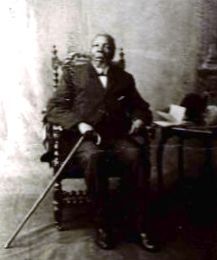
For much of the 19th and early 20th century, the Fengu were led by Captain Veldtman Bikitsha. Initially a constable who was of great service to the Cape in the 8th Frontier War, he was later promoted and served as a de facto military leader of the Cape's Fengu commandos.
Prime Minister John Molteno, who held a very high opinion of Bikitsha, appointed him as a leader of the Cape forces (together with Chief Magistrate Charles Griffith) in the 9th Frontier War in 1877, where he swiftly won a string of brilliant victories against the Gcaleka. Throughout the 9th Frontier war, Bikitsha and his location were a focal point for the Gcaleka armies attacks and came under immense military pressure.
His military genius in the frontier wars earned him considerable renown and he was widely acknowledged leader in the Cape Colony. His courage was also frequently referred to. He famously once jumped onto a wounded and charging lion, holding it by the tail, overpowered it and killed it. He was invited to London in 1889, where Queen Victoria requested to meet him to thank him for his services. He reputedly told her "We have never feared a white man, and we have never lifted our hand against any of your people."
He founded the Transkei General Council, and served as a juror and commissioner for the Cape Colony in later life[36]
John Tengo Jabavu (1859–1921)
John Tengo Jabavu, an influential Fengu politician of the early 20th century, with his son Davidson Don Tengo, around 1903
As Fengu history switched from military defense to political struggle, so the great Fengu politician and activist John Tengo Jabavu rose in prominence after Bikitsha's military leadership ended.
Jabavu edited the first newspapers to be written in the Xhosa and from 1876 he edited Isigidimi samaXhosa ("The Xhosa Messenger"). From 1884 he edited Imvo Zabantsundu ("Black Opinion"). He wrote on the threat of Afrikanernationalism, equal rights for South Africa's black population, and in support of women's rights.
The rivalry between the Fengu and the Gcaleka Xhosa, which had previously broken out into war, declined during the era of Jabavu's leadership, as greater unity was encouraged. Nonetheless, some divisions remained. Jabavu's main political rival, Walter Rubusana, was Xhosa. Rubusana's rise in the 1890s was through the new Gcaleka-dominated South African Native National Congress and their newspaper Izwi Labantu ("The Voice of the People") which was financed by Cecil Rhodes. The rise of Xhosa institutions meant that Jabavu and the Fengu were no longer in a position to provide the only leadership in the Cape's Black community.
Over the next few decades, divisions persisted between Jabavu's movement Imbumba ("The Union") and Rubusana's South African Native National Congress. However the rivalry was finally laid to rest and there was union under the newly named African National Congress. One of the early aims of this movement was finally to lay to rest "the aberrations of the Xhosa-Fingo feud."[37][38]
British annexation
British Kaffraria had been annexed to the Cape Colony in 1866. Barring the brief revolt in 1877 and 1878, when the Gcaleka turned upon their Fengu neighbours, the British annexation of land east of the Kei River proceeded fitfully, but generally unimpeded. In September 1879 this was followed by Idutywa Reserve and Fenguland, and Gcalekaland in 1885. It is assumed that the restructuring of these territories into the divisions of Butterworth, Idutywa, Centani, Nqamakwe, Tsomo and Willowvale dates from these times.
Social change and adaptability
Originally farmers, the Fengu people had quickly built themselves schools, created and edited their own newspapers, and translated international literature into their language. The reason that the Fengu people were able to adapt so effectively to changing circumstances (like the coming of capitalism and urbanisation) was because they lacked a fixed tribal social-structure and hierarchy (having presumably lost it in their earlier flight from the Zulu). This state of social change and flexibility allowed them to quickly adjust to the European expansion, learn and adapt new techniques, and take advantage of the upheavals that followed. Other tribes were often suspicious of outside ideas and consequently resisted any change to meet the colonial threat. The Fengu had no paramount-chief as other tribes did, but the Cape Commander, Veldman Bikitsha, was a Fengu and held authority over the Fengu's military capacity.
Many Fengu have also subsequently intermarried with other ethnic groups, particularly with the Xhosa and Zulu, while some still live in Zimbabwe.
Territory
Map of Fingoland (highlighted), and surrounding regions of the Eastern Cape Frontier. 1911.
The region that was later known as the Transkei was originally divided into territories known as the Idutywa Reserve, Fingoland and Galekaland (Gcalekaland). Fingoland lay the borderlands in the far south of the Transkei, just north of the Kei River.
The dominant pretense is that following their annexation by the British, they were restructured into the divisions of Butterworth, Tsomo and Ngqamakwe for Fingoland; Centani and Willowvale for Galekaland; and Idutywa for the Idutywa Reserve.
However, this is a lawful contradiction as no alien can hold lands in freehold outside the Crown's dominion as Fengu freeholds were granted by the Crown's prerogative. This implies the idea of a separate Fingoland outside the British Cape Colony was feigned later after a settlement with the rise of race-based administration following the creation of the union in 1910.
The Union of South Africa is the entity that so unlawfully alienated the unalienable rights of Fengu people, following forced administrative reclassification from freemen to native and later black Africans in the 1950 population registration act no. 30.
These acts effectively stripped them of their lawful standing as Crown subjects and beneficiaries of the British Cape franchise and set the foundation for apartheid class-based administration. This was unlawful and went against the crown's royal prerogative as the Union parliament acted outside of it's administrative capacities by alienating sovereign granted rights.
These acts in effect voided the constitution of Union of South Africa as the Boer republics became a hostile foreign power in the British Cape.
Present-day South Africa
Today virtually all the Fengu people have intermarried with other ethnic groups particularly with the Xhosa and Zulu. Many are now often considered – especially by outsiders – to be ethnically Xhosa and others Zulu, because of their common language and some similar customs. A considerable number have a mixed racial background, especially in and around the Cape provinces.
↑Mtumane, Zilibele (2017). "The Practice of Ubuntu with regard to amaMfengu among amaXhosa as Depicted in S. E. K. Mqhayi's Ityala Lamawele". International Journal of African Renaissance Studies - Multi-, Inter- and Transdisciplinarity. 12 (2): 68–80. doi:10.1080/18186874.2017.1392146. ISSN1818-6874. S2CID149374813.
↑Stapleton, Timothy, "The Expansion of a Pseudo-Ethnicity in the Eastern Cape: Reconsidering the Fingo "Exodus"of 1865", The International Journal of African Historical Studies, Vol. 29, No. 2 (1996) JSTOR220517
↑"Veldtman Bikitsha". ancestry24.com. Archived from the original on 11 December 2012. Retrieved 31 August 2012.
↑M.Plaut: Promise and Despair: The First Struggle for a Non-racial South Africa. Jacana, Cape Town. 2016. ISBN978-1-4314-2375-0. p. 24.
↑"The Arrival of the Mfengu in the Eastern Cape", Illustrated History of South Africa. The Reader's Digest Association South Africa (Pty) Ltd, 1992, p. 107. ISBN0-947008-90-X.
Wikimedia Commons has media related to Mfengu people.
This page is based on this Wikipedia article Text is available under the CC BY-SA 4.0 license; additional terms may apply. Images, videos and audio are available under their respective licenses.
 South Africa
  Zimbabwe


