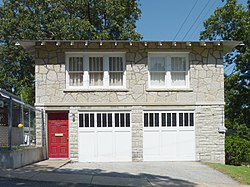
A garage apartment[1] (also called a coach house, garage suite or in Australia, Fonzie flat[2]) is an apartment built within the walls of, or on top of, the garage of a house. The garage may be attached or a separate building from the main house, but will have a separate entrance and may or may not have a communicating door to the main house. A garage apartment is one type of "accessory dwelling unit" or ADU, a term used by architects, urban planners and in zoning ordinances to identify apartments smaller than the main dwelling on one lot or parcel of land.[3] Other examples of ADUs include granny flats, English basements, mother-in-law suites, and auxiliary units.
In the U.S., garage apartments are frequently found in older urban areas, either in secondary buildings designed for such purposes (sometimes called 'guest' or 'carriage' houses), or converted into residential units from their original use. ADUs may be regulated by size, occupancy, lot size, core features (such as kitchens or bathrooms), other building codes and parking allotment.
The idea of integrating garage apartments into urban planning is a key aspect of new urbanism, although many jurisdictions in the U.S. prohibit new construction of or occupancy of ADUs except for relatives.[citation needed]
Origins
The word "garage", introduced into the English language in 1902, comes from the French word garer, meaning "shelter".[4] By 1908, architect Charles Harrison Townsend commented in The Builder that "for the designation of a house for an automobile we chiefly use the French word 'garage,' and also, in my opinion, the more desirable English equivalent 'motor house'.[5][6][7]
In the past, garages were separate buildings from the house ("detached garage"). Sometimes a garage was built with an apartment above it that could be rented out. As automobiles became more popular, the concept of attaching a garage directly to a home became a common practice.[8] Garage apartments are becoming increasingly popular because of their versatility and functionality.[9] While a person with a detached garage has to walk outside in all kinds of weather, a person with an attached garage has a much shorter commute inside the building.
Garage insulation
In northern climates, the temperature inside an uninsulated attached residential garage can drop to freezing in the winter.[10][11] Temperatures inside an uninsulated attached garage in temperate climates can reach uncomfortable levels during the summer months. Extreme temperatures can be a source of energy loss and discomfort to adjacent residences due to heat transfer between the garage and these rooms. Homes with an attached garage often struggle with this "interface" problem. Insulating the exterior of a building from the elements without extending the insulation to the wall separating the garage from the house, and/or other garage walls and the roof, can be a costly mistake.
This page is based on this Wikipedia article Text is available under the CC BY-SA 4.0 license; additional terms may apply. Images, videos and audio are available under their respective licenses.