
The National Geospatial-Intelligence Agency (NGA) is a combat support agency within the United States Department of Defense whose primary mission is collecting, analyzing, and distributing geospatial intelligence (GEOINT) in support of national security. Initially known as the National Imagery and Mapping Agency (NIMA) from 1996 to 2003, it is a member of the United States Intelligence Community.
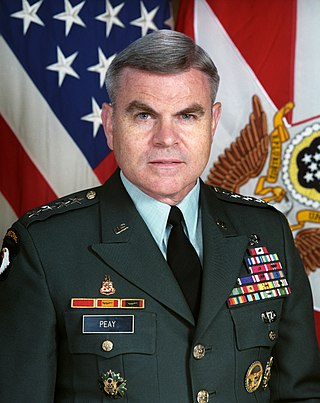
James Henry Binford "Binnie" Peay III is a retired four-star general of the United States Army. He served as the 14th superintendent of the Virginia Military Institute from 2003-2020, and as chairman of the Allied Defense Group from 2001-03. He has also served on various corporate and nonprofit boards.

James Arthur Williams was a United States Army lieutenant general. Williams served as Director of the Defense Intelligence Agency in the 1980s. He was a 1987 inductee of the Military Intelligence Hall of Fame and was the chairman of the board of directors for the National Military Intelligence Association.

Harry Edward Soyster is a retired United States Army Lieutenant General.

Lieutenant General Michael David Maples, USA served as the 16th Director of the Defense Intelligence Agency (DIA), appointed on November 4, 2005. He was promoted to lieutenant general on November 29. Maples also commanded the Joint Functional Component Command for Intelligence, Surveillance and Reconnaissance (JFCC-ISR) for the United States Strategic Command (USSTRATCOM). He transferred his Directorship of the Defense Intelligence Agency and his command of JFCC-ISR to LTG Ronald Burgess on March 18, 2009. Maples formally served as the vice director of management of the Joint Staff.

Lieutenant General Ronald Lee Burgess Jr., United States Army is a retired United States Army lieutenant general. His last military assignment was as the 17th director of the Defense Intelligence Agency and commander of the Joint Functional Component Command for Intelligence, Surveillance and Reconnaissance (JFCC-ISR). Prior to that, he was Director of the Intelligence Staff in the Office of the Director of National Intelligence.
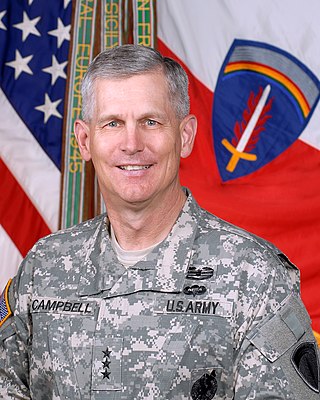
Lieutenant General Donald M. Campbell Jr. is a retired United States Army lieutenant general who served as the commanding general of United States Army Europe. He commanded the United States Army Europe from December 1, 2012, to November 6, 2014.
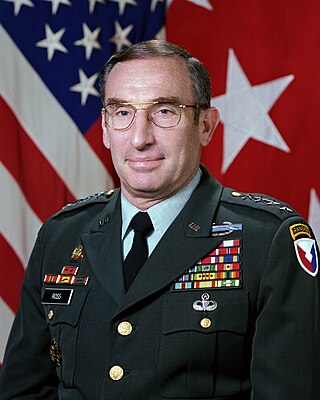
General Jimmy Douglas Ross was a United States Army four-star general and member of the board of two corporations.
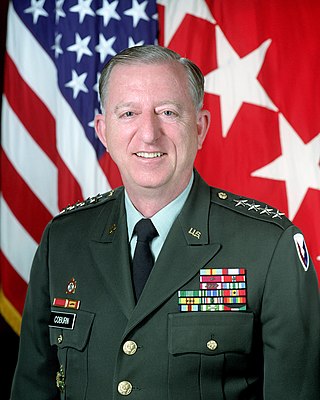
General John Gordon Coburn is the former CEO of VT Systems, Inc., a global company, which he joined in November 2001 and grew from 61 million dollars to 1.3 billion dollars. He relinquished this role in December 2018, and now serves as Non-Executive Chairman of the VT Systems Advisory Board. Prior to joining VT Systems, he served as the Commanding General, United States Army Materiel Command. He assumed the duties of Commanding General on May 14, 1999, and retired from the army in 2001. Prior to this assignment, he served as the Deputy Chief of Staff for Logistics, United States Army, Pentagon. He also served as the 26th Chief of Ordnance for the United States Army Ordnance Corps.

George James Eade was a four star general in the United States Air Force who served as Deputy Commander in Chief, United States European Command from 1973 to 1975.
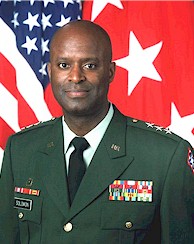
Billy King Solomon is a retired Quartermaster officer, U.S. Army Lieutenant General and former Commander of the Combined Arms Support Command, Fort Lee, Virginia.

Việt Xuan Luong is a retired United States Army major general. He is the first American officer promoted to general officer rank who was born in Vietnam. He last served as the Commanding General of United States Army, Japan/I Corps Forward. He previously served as the Deputy Commanding General (Operations), Eighth Army. His prior assignments included chief of staff of United States Army Central; Director of Joint and Integration, Headquarters Department of the Army, G-8; assistant division commander–maneuver for the 1st Cavalry Division at Fort Hood, concurrent with assignment as commander, Train Advise Assist Command – South, Resolute Support Mission Joint Command, North Atlantic Treaty Organization, Afghanistan.

William Lloyd Nicholson III was an American Air Force major general. As his last assignment, he was director of the Defense Mapping Agency from July 1979 – June 1981.

Harry E. Miller Jr. is a retired Army National Guard officer. A veteran of the Iraq War, he attained the rank of major general as commander of the 42nd Infantry Division, a position he held from 2013 to 2017.

Colonel Kurush Bharucha-Reid or "KB" gained prominence as an intelligence and special operations expert in the United States Army from 1973 to 2010 who garnered respect across the US Special Operations and United States Intelligence Community for his significant impacts on military human intelligence, known as HUMINT.
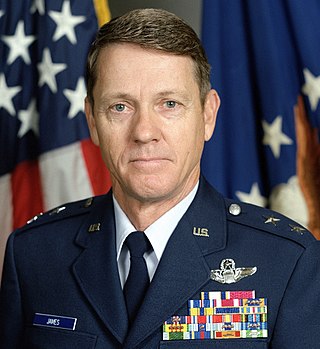
Major General William K. James of United States Air Force, was director of the Defense Mapping Agency (DMA) between June 1990 and June 1993. Under his leadership Major General James redirected the DMA – a heritage organization of the National Geospatial-Intelligence Agency – from producing products to meet the requirements of the Cold War to a concept of a Global Geospatial Information System (GGIS) directly accessible to combat commanders of the Rapid Deployment Forces. The GGIS was a major paradigm shift in warfare with the delivery of geographic information to fast-moving military forces.

Rutledge Parker "Hap" Hazzard was director of Science and Technology division of Central Intelligence Agency (CIA) from 1973 to 1978. He became director of the National Photographic Interpretation Center (NPIC) in 1978. After serving six years as director of NPIC from June 1978 to February 1984, Hazzard returned to the CIA's National Intelligence Office. He retired from public service in 1985.

Rear Admiral Joseph John "Jack" Dantone Jr. of U.S. Navy, was last director of Defense Mapping Agency (DMA) from May 1996 to September 1996. He was also the Acting Director of National Imagery and Mapping Agency (NIMA) from October 1996 to March 1998. He played a major role in transition of DMA into NIMA.
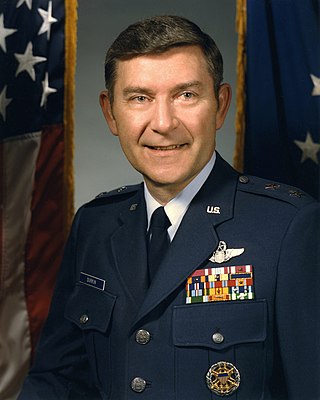
Major General Robert Francis Durkin of the United States Air Force was Director of Defense Mapping Agency from October 1987 to June 1990. As director, Durkin restructured the Defense Mapping Agency's international and domestic training in the production and exploitation of geospatial information.

Major General Leven Cooper Allen was an officer in the United States Army during World War II.

 United States of America
  United States Army
  Lieutenant General


