The Santanoni Preserve was once a private estate of approximately 13,000 acres (53 km2) in the Adirondack Mountains, and now is the property of the State of New York, at Newcomb, New York.

The John Philip Sousa House, also known historically as Wildbank, is a historic house at 12 Hicks Lane, overlooking Manhasset Bay, in Sands Point, New York. Built in 1907, it was the home of composer and bandleader John Philip Sousa (1854-1932) from 1912 until his death. It was declared a National Historic Landmark in 1966. It is still a private residence and is not open to the public.

The Elizabeth Cady Stanton House is a historic house at 32 Washington Street in the village of Seneca Falls, New York. Built before 1830, it was the home of suffragist Elizabeth Cady Stanton (1815-1902) from 1847 to 1862. It is now a historic house museum as part of Women's Rights National Historical Park. It was declared a National Historic Landmark in 1965.

The John Coltrane Home is a ranch house in Dix Hills, New York, where jazz saxophonist John Coltrane lived with his family from 1964 until his death in 1967. Coltrane composed his album A Love Supreme, widely considered his magnum opus, in his practice room in the house.

Cast Iron House at the corner of Franklin Street and Broadway in the Tribeca neighborhood of Manhattan, New York City, formerly known as the James White Building, was built in 1881–82 and was designed by W. Wheeler Smith in the Italianate style. It features a cast-iron facade, and is a good example of late cast-iron architecture. The building was renovated by architect Joseph Pell Lombardi in 2000, and a restoration of the facade began in 2009. The building once housed the offices of Scientific American from 1884 to 1915, but it was primarily used in connection with the textile trade.
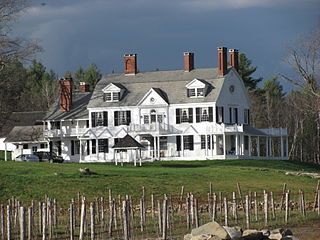
Brook Farm is a historic country estate farm at 4203 Twenty Mile Stream Road in Cavendish, Vermont. It includes one of the state's grandest Colonial Revival mansion houses, and surviving outbuildings of a model farm of the turn of the 20th century. It was listed on the National Register of Historic Places in 1993. The property is now home to the Brook Farm Vineyard.

Knapp House is a historic home located at Newark Valley in Tioga County, New York. It is a two-story, frame Colonial Revival style residence with a hipped roof built about 1905. Also on the property is a two-story, gambrel roofed carriage house and a chicken coop.

James Sanders House is a historic home located at Little Falls in Herkimer County, New York. The house is a two-story, gable-roofed brick residence, five bays long and two bays wide, originally constructed in 1827. It consists of a rectangular main block with a two-story brick rear wing. It features a center hall plan and Federal-style decorative elements. Also on the property are a frame, gable-roofed carriage barn and garage/agricultural equipment barn. James Sanders was a local building contractor who also built a number of mills, residences, and civic buildings including the original Little Falls Academy.
Sunnyside, also known as the S.D. Styles Summer Residence, is a historic home located at Richfield Springs in Otsego County, New York. It was built in two stages in 1890 and 1909 and is a dwelling in the Queen Anne style. It is a 2-story frame house with a shingled exterior. The house is composed of a full 2-story, gable-roofed main block with a 1+1⁄2-story east addition with a hipped roof. Also on the property is a small carriage barn.

Jesse and Ira Tuthill House is a historic home located at Mattituck in Suffolk County, New York. It was built in two stages, 1799 and 1841. The original two-room house was incorporated as a 1+1⁄2-story wing for the larger 2-story, nine-room house. The final 1841 house is a 2+1⁄2-story residence with a modestly pitched gable roof with a wide frieze running beneath the roof eave.

Carll House is a historic home located on Deer Park Avenue across from the vicinity of the intersection with Wolf Hill Road in Dix Hills in Suffolk County, New York. It was built about 1750 and is a 2+1⁄2-story, five bay gable roof residence with a 1+1⁄2-story side addition. Also on the property are three contributing 19th century barns, a small pond, and cottage. It was added to the National Register of Historic Places in 1985.

The James Whitall Jr. House is located at 100 Grove Avenue in the borough of National Park, Gloucester County, New Jersey. The house was built in 1766 and documented by the Historic American Buildings Survey (HABS) in 1937. It was added to the National Register of Historic Places on February 6, 1973, for its significance in architecture.

The Regester Log House is an historic, American log house that is located in Fredericktown, Pennsylvania.
Stephen L. Goodman House is a historic home located at Glens Falls, Warren County, New York. It was built about 1860 and is a five-bay, two-story, gable-roofed vernacular brick residence. It is T-shaped, consisting of a rectangular main block with a two-story brick and frame service wing. It features a one-story entrance porch and porte cochere. It was converted for use as a funeral home in 1945.

The Bacon-Stickney House is a historic house located at 441 Loudon Road in Colonie, Albany County, New York.
The James William Beekman House is a historic house located on West Shore Road in Oyster Bay, Nassau County, New York.

The Gen. William Worth Belknap House is a historic building located in Keokuk, Iowa, United States. William Worth Belknap moved to Keokuk from upstate New York in 1853 to practice law. He built this Greek Revival style house the following year. It is a two-story brick structure with a single-story wing. The two story section is original, while the single-story section is an addition, built shortly afterward. The house features narrow window openings with simple stone lintels and sills. It is built on a stone foundation covered with concrete and capped with a low-pitched gable roof whose ridge is parallel to the street. The front porch is not original. Belknap resided here with his mother and two sisters.

Soundview Manor is a historic home located on four acres in White Plains, Westchester County, New York. Built in 1920 by landowner Robert B. Dula, and is a stuccoed, frame building in the Classical Revival style. It is L-shaped and has a three-story, three-bay central section flanked by two-story, one-bay blocks on each side. The house has flat roofs, with prominent balustrades. The flat roofed front porch is supported by Tuscan order columns.
The James H. Bolton House is a historic house located at 117 West Washington Street in Bath, Steuben County, New York

The James P. Newton House and Maid Cottage are historic buildings located in Sioux City, Iowa, United States. Newton was a prominent local businessman associated with Haskins Bros. & Co., whose principal product was soap. He was a traveling salesman with the company before he and his brothers bought the company in 1907. He succeeded his brother William as president in 1929. Newton had prominent Sioux City architect William L. Steele design this house, and it is one of his earliest works in the city. The 1½-story frame American Craftsman house and the single-story frame maid's house near the alley feature clapboard siding, porches with square columns, and low pitched hipped roofs with dormers. The bands of color and the wide eaves are elements from the Prairie School style for which Steele would become well known. The two houses were listed together on the National Register of Historic Places in 2000.