The argument from morality is an argument for the existence of God. Arguments from morality tend to be based on moral normativity or moral order. Arguments from moral normativity observe some aspect of morality and argue that God is the best or only explanation for this, concluding that God must exist. Arguments from moral order are based on the asserted need for moral order to exist in the universe. They claim that, for this moral order to exist, God must exist to support it. The argument from morality is noteworthy in that one cannot evaluate the soundness of the argument without attending to almost every important philosophical issue in meta-ethics.
In metaphilosophy and ethics, metaethics is the study of the nature, scope, and meaning of moral judgment. It is one of the three branches of ethics generally studied by philosophers, the others being normative ethics and applied ethics.
In ethical philosophy, utilitarianism is a family of normative ethical theories that prescribe actions that maximize happiness and well-being for the affected individuals. In other words, utilitarian ideas encourage actions that lead to the greatest good for the greatest number. Although different varieties of utilitarianism admit different characterizations, the basic idea behind all of them is, in some sense, to maximize utility, which is often defined in terms of well-being or related concepts. For instance, Jeremy Bentham, the founder of utilitarianism, described utility as the capacity of actions or objects to produce benefits, such as pleasure, happiness, and good, or to prevent harm, such as pain and unhappiness, to those affected.
Moral absolutism, commonly known as black-and-white morality, is an ethical view that most, if not all actions are intrinsically right or wrong, regardless of context or consequence.
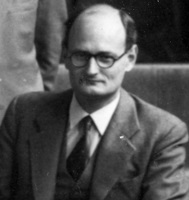
Richard Mervyn Hare, usually cited as R. M. Hare, was a British moral philosopher who held the post of White's Professor of Moral Philosophy at the University of Oxford from 1966 until 1983. He subsequently taught for a number of years at the University of Florida. His meta-ethical theories were influential during the second half of the twentieth century.

Divine command theory is a meta-ethical theory which proposes that an action's status as morally good is equivalent to whether it is commanded by God. The theory asserts that what is moral is determined by God's commands and that for a person to be moral he is to follow God's commands. Followers of both monotheistic and polytheistic religions in ancient and modern times have often accepted the importance of God's commands in establishing morality.

Virtue ethics is a philosophical approach that treats virtue and character as the primary subjects of ethics, in contrast to other ethical systems that put consequences of voluntary acts, principles or rules of conduct, or obedience to divine authority in the primary role.
In moral philosophy, deontological ethics or deontology is the normative ethical theory that the morality of an action should be based on whether that action itself is right or wrong under a series of rules and principles, rather than based on the consequences of the action. It is sometimes described as duty-, obligation-, or rule-based ethics. Deontological ethics is commonly contrasted to consequentialism, utilitarianism, virtue ethics, and pragmatic ethics. In this terminology, action is more important than the consequences.

The Euthyphro dilemma is found in Plato's dialogue Euthyphro, in which Socrates asks Euthyphro, "Is the pious loved by the gods because it is pious, or is it pious because it is loved by the gods?" (10a)

Sir Bernard Arthur Owen Williams, FBA was an English moral philosopher. His publications include Problems of the Self (1973), Ethics and the Limits of Philosophy (1985), Shame and Necessity (1993), and Truth and Truthfulness (2002). He was knighted in 1999.
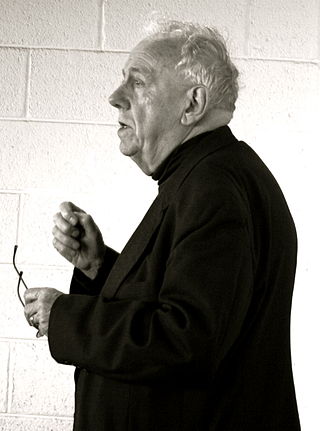
Alasdair Chalmers MacIntyre is a Scottish-American philosopher who has contributed to moral and political philosophy as well as history of philosophy and theology. MacIntyre's After Virtue (1981) is one of the most important works of Anglophone moral and political philosophy in the 20th century. He is senior research fellow at the Centre for Contemporary Aristotelian Studies in Ethics and Politics (CASEP) at London Metropolitan University, emeritus Professor of Philosophy at the University of Notre Dame, and permanent senior distinguished research fellow at the Notre Dame Center for Ethics and Culture. During his lengthy academic career, he also taught at Brandeis University, Duke University, Vanderbilt University, and Boston University.

Robert Merrihew Adams was an American analytic philosopher, who specialized in metaphysics, philosophy of religion, ethics, and the history of early modern philosophy.
Secular ethics is a branch of moral philosophy in which ethics is based solely on human faculties such as logic, empathy, reason or moral intuition, and not derived from belief in supernatural revelation or guidance—a source of ethics in many religions. Secular ethics refers to any ethical system that does not draw on the supernatural, and includes humanism, secularism and freethinking. A classical example of literature on secular ethics is the Kural text, authored by the ancient Indian philosopher Valluvar.
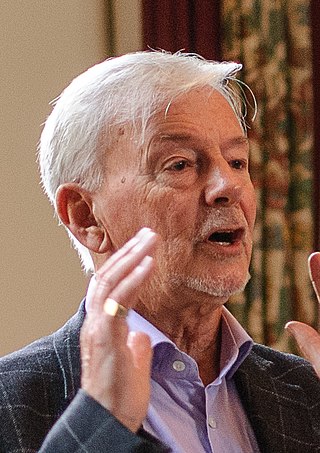
Keith Ward is an English philosopher and theologian. He is a fellow of the British Academy and a priest of the Church of England. He was a canon of Christ Church, Oxford, until 2003. Comparative theology and the relationship between science and religion are two of his main topics of interest.

Kantian ethics refers to a deontological ethical theory developed by German philosopher Immanuel Kant that is based on the notion that "I ought never to act except in such a way that I could also will that my maxim should become a universal law." It is also associated with the idea that "it is impossible to think of anything at all in the world, or indeed even beyond it, that could be considered good without limitation except a good will." The theory was developed in the context of Enlightenment rationalism. It states that an action can only be moral if it is motivated by a sense of duty, and its maxim may be rationally willed a universal, objective law.
Donald Mackenzie MacKinnon (1913–1994) was a Scottish philosopher and theologian.
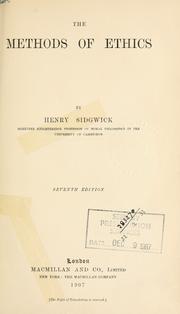
The Methods of Ethics is a book on ethics first published in 1874 by the English philosopher Henry Sidgwick. The Stanford Encyclopedia of Philosophy indicates that The Methods of Ethics "in many ways marked the culmination of the classical utilitarian tradition." Noted moral and political philosopher John Rawls, writing in the Forward to the Hackett reprint of the 7th edition, says Methods of Ethics "is the clearest and most accessible formulation of ... 'the classical utilitarian doctrine'". Contemporary utilitarian philosopher Peter Singer has said that the Methods "is simply the best book on ethics ever written."
Allen William Wood is an American philosopher specializing in the work of Immanuel Kant and German Idealism, with particular interests in ethics and social philosophy. One of the world's foremost Kant scholars, he is the Ruth Norman Halls professor of philosophy at Indiana University, Ward W. and Priscilla B. Woods Professor, emeritus, at Stanford University, and before that a professor at Cornell University across parts of four decades. He has also held professorships and visiting appointments at several other universities in the United States and Europe. In addition to popularising and clarifying the ethical thought of Kant, Wood has also mounted arguments against the validity of trolley problems in moral philosophy.

Barbara Herman is the Griffin Professor of Philosophy and Professor of Law at the University of California, Los Angeles Department of Philosophy. A well-known interpreter of Kant's ethics, Herman works on moral philosophy, the history of ethics, and social and political philosophy. Among her many honors and awards include a Guggenheim Fellowship (1985-1986) and election to the American Academy of Arts & Sciences (1995).

Scottish philosophy is a philosophical tradition created by philosophers belonging to Scottish universities. Although many philosophers such as Francis Hutcheson, David Hume, Thomas Reid, and Adam Smith are familiar to almost all philosophers it was not until the 19th century that the notion of 'Scottish philosophy' became recognized and highly regarded internationally. In the 20th century, however, this tradition declined as Scottish-educated philosophers left for England.


