Copyright-problem.svg
An editor has launched a copyright investigation involving this section. The text under investigation is currently hidden from public view, but is accessible in the page history . Please do not remove this or restore blanked content until the issue is resolved by an administrator, copyright clerk, or volunteer response agent.

The purported copyright violation copies text from Various print sources. Foundational, see Wikipedia:Contributor copyright investigations/Hauganm ( Copyvios report ); as such, this page has been listed on the copyright problems page.

Contents

  • Biography
  • Selected bibliography
  • References
  • External links

Unless the copyright status of the text of this page or section is clarified and determined to be compatible with Wikipedia's content license, the problematic text and revisions or the entire page may be deleted one week after the time of its listing (i.e. after 16:28, 15 April 2024 (UTC)).

What can I do to resolve the issue?

  • If you hold the copyright to this text, you can license it in a manner that allows its use on Wikipedia.
    1. You must permit the use of your material under the terms of the Creative Commons Attribution-Sharealike 3.0 Unported License (CC BY-SA 3.0) and the GNU Free Documentation License (GFDL) (unversioned, with no invariant sections, front-cover texts, or back-cover texts).
    2. Explain your intent to license the content on this article's discussion page.
    3. To confirm your permission, you can either display a notice to this effect at the site of original publication or send an e-mail from an address associated with the original publication to permissions-enAt sign.svgwikimedia.org or a postal letter to the Wikimedia Foundation. These messages must explicitly permit use under CC BY-SA and the GFDL. See Wikipedia:Donating copyrighted materials.
    4. Note that articles on Wikipedia must be written from a neutral point of view and must be verifiable in published third-party sources; consider whether, copyright issues aside, your text is appropriate for inclusion in Wikipedia.
  • You can demonstrate that this text is in the public domain or is already under a license suitable for Wikipedia. Explain this on this article's discussion page, with reference to evidence. Wikipedia:Public domain and Wikipedia:Compatibly licensed may assist in determining the status.
  • Otherwise, you may rewrite this page without copyright-infringing material. Your rewrite should be placed on this page, where it will be available for an administrator or clerk to review it at the end of the listing period. Follow this link to create the temporary subpage. Please mention the rewrite upon completion on this article's discussion page.
    • Simply modifying copyrighted text is not sufficient to avoid copyright infringement—if the original copyright violation cannot be cleanly removed or the article reverted to a prior version, it is best to write the article from scratch. (See Wikipedia:Close paraphrasing.)
    • For license compliance, any content used from the original article must be properly attributed; if you use content from the original, please leave a note at the top of your rewrite saying as much. You may duplicate non-infringing text that you had contributed yourself.
    • It is always a good idea, if rewriting, to identify the point where the copyrighted content was imported to Wikipedia and to check to make sure that the contributor did not add content imported from other sources. When closing investigations, clerks and administrators may find other copyright problems than the one identified. If this material is in the proposed rewrite and cannot be easily removed, the rewrite may not be usable.

Steps to list an article at Wikipedia:Copyright problems:
  1. Add the following to the bottom of Wikipedia:Copyright problems/2024 April 8: * {{subst:article-cv|John O. Evjen}} from Various print sources. Foundational, see Wikipedia:Contributor copyright investigations/Hauganm. ~~~~
  2. Add the following template to the talk page of the contributor of the material: {{subst:Nothanks-web|pg=John O. Evjen|url=Various print sources. Foundational, see Wikipedia:Contributor copyright investigations/Hauganm}} ~~~~
  3. Place {{ copyvio/bottom }} at the end of the portion you want to blank. If nominating the entire page, please place this template at the top of the page and set the "fullpage" parameter to "yes".
Part of a series on
Lutheranism
Lutherrose.svg
Background
  • Christianity
  • Start of the Reformation
  • Reformation
  • Protestantism
Doctrine and theology
Bible
  • Old Testament
  • New Testament
Creeds
  • Apostles' Creed
  • Nicene Creed
  • Athanasian Creed
Book of Concord
  • Augsburg Confession
  • Apology of the Augsburg Confession
  • Luther's Small  / Large Catechism
  • Smalcald Articles
  • Treatise on the Power and Primacy of the Pope
  • Formula of Concord
Distinctive theological concepts
  • Theology of Martin Luther
  • Justification
  • Law and Gospel
  • Sola gratia
  • Sola scriptura
  • Christology
  • Sanctification
  • Two kingdoms
  • catholicity
  • Two states of the Church
  • Priesthood of all believers
  • Divine Providence
  • Marian theology
  • Theology of the Cross
  • Sacramental Union
Other relevant topics
  • Homosexuality
  • Sacraments and worship
  • Baptism
  • Eucharist
  • Confession
  • Confirmation
  • Matrimony
  • Anointing of the Sick
  • Holy Orders
  • Divine Service
  • Matins
  • Vespers
  • Liturgical calendar
  • Calendar of saints
  • Lutheran hymn
  • Lutheran hymnwriters
  • Normative principle
  • Lutheran art
Organization
  • Confessional Evangelical
    Lutheran Conference
  • Global Confessional &
    Missional Lutheran Forum
  • International Lutheran Council
  • Lutheran World Federation
  • Denominations
  • Lutheranism by region
Movements
  • History of Lutheranism
  • Crypto-Lutherans
  • Gnesio-Lutherans
  • Lutheran orthodoxy
  • Pietists
  • Radical Pietism
  • Haugeans
  • Laestadians
  • Finnish Awakening
  • Old Lutherans
  • Neo-Lutherans
  • High church Lutherans
  • Confessional Lutheranism
Key figures
Missionaries
  • John Campanius
  • Bartholomäus Ziegenbalg
  • Hans Egede
  • Johann Heinrich Callenberg
  • Johann Phillip Fabricius
  • Paul Henkel
  • John Christian Frederick Heyer
  • Karl Graul
  • Martti Rautanen
  • Wilhelm Sihler
  • F. C. D. Wyneken
  • Hans Paludan Smith Schreuder
  • Lars Olsen Skrefsrud
  • Ludwig Ingwer Nommensen
  • Onesimos Nesib
  • Paul Olaf Bodding
  • Johann Flierl
  • Christian Keyser
  • Jens Christensen

Bible Translators

  • Martin Luther
  • Casiodoro de Reina
  • Kjell Magne Yri
  • Onesimos Nesib
  • Aster Ganno
  • Kristian Osvald Viderø
  • Jákup Dahl
  • Bartholomäus Ziegenbalg
  • Johann Phillip Fabricius
  • William Tyndale
  • John Rogers
  • George Constantine
  • Jozef Roháček
  • Johannes Avetaranian
  • Guðbrandur Þorláksson
  • Ludvig Olsen Fossum
  • Hans Egede  / Paul Egede
  • Otto Fabricius
  • Nils Vibe Stockfleth
  • Olaus Petri  / Laurentius Petri
  • Martti Rautanen
  • Primož Trubar
  • Jurij Dalmatin
  • Ludwig Ingwer Nommensen
  • Sebastian Krelj
  • Mikael Agricola
  • Norwegian Bible Society
  • Swedish Bible Society
  • Samuel Ludwik Zasadius
  • Stanislovas Rapolionis
  • Laurentius Andreae
  • Hans Tausen
  • Olaf M. Norlie
  • Jonas Bretkūnas
  • Hans Paludan Smith Schreuder
  • Antonio Brucioli
  • Mikołaj Jakubica
  • Matthias Bel
  • Johann Ernst Glück
  • William F. Beck

Theologians

  • Martin Luther  / Katharina von Bora
  • Philip Melanchthon
  • Johannes Bugenhagen
  • Johannes Brenz
  • Justus Jonas
  • Hans Tausen
  • Laurentius Petri
  • Olaus Petri
  • Mikael Agricola
  • Matthias Flacius
  • Martin Chemnitz
  • Johann Gerhard
  • Abraham Calovius
  • Johannes Andreas Quenstedt
  • Johann Wilhelm Baier
  • Philipp Spener
  • David Hollaz
  • August Hermann Francke
  • Henry Muhlenberg
  • Lars Levi Laestadius
  • Charles Porterfield Krauth
  • C. F. W. Walther
  • Søren Kierkegaard
  • Albrecht Ritschl
  • Wilhelm Herrmann
  • F. W. Stellhorn
  • Rudolf Otto
  • Ernst Troeltsch
  • Rudolf Bultmann
  • Paul Tillich
  • Hermann Sasse
  • Dietrich Bonhoeffer
  • Wolfhart Pannenberg
  • v
  • t
  • e
John Oluf Evjen (December 13, 1874 – January 4, 1942) was an American author, Lutheran church historian and professor of theology. [1]

Biography

John Evjen was born in Ishpeming, Michigan. He was educated at Augsburg Seminary (class of 1895) and the Theological Institute of Augsberg Seminary (1898). He earned his doctorate in Germany at the University of Leipzig (Ph.D., 1903). Evjen was an ordained minister in the Lutheran Free Church. He served as a Lutheran minister in Muskegon and Grand Rapids, Michigan. [2]

He was acting professor of church history at the United Church Theological Seminary in St. Paul, Minnesota from 1903 until 1905. He was a professor of biblical History in Pennsylvania College in Gettysburg, Pennsylvania from 1905 until 1909. Starting in 1909, he became a professor of theology at Augsburg Seminary in Minneapolis, MN. [3]

Evjen was also the author of numerous books frequently addressing issues of Lutheran church theology and providing biographies of church theologians. Evjen is most frequently associated with his 1916 volume Scandinavian Immigrants in New York, 1630-1674. This epic work is a reference book frequently used by historians tracing the early immigration of German and Scandinavians to North America. It contains a collection of biographies based on ship passenger lists, parish records, church records, court records, and legal documents. Included is information such as dates of birth, places of origin, marriages, names of children, types of occupation, and references to sources. [4]

Selected bibliography

  • Scandinavia and the Book of Concord (1906)
  • En boganmeldelse (1910)
  • Lutheran Germany and the Book of Concord (1911)
  • Scandinavian Immigrants in New York 1630-1674; With appendices on Scandinavians in Mexico and South America, 1532–1640, Scandinavians in Canada, 1619–1620, German immigrants in New York, 1630-1674 (1916)
  • Luther and the Reformation (1916)
  • Dr. Rudolph Sohm: Jurist and Church Historian (1935)
  • The Life of J.H.W. Stuckenberg,: Theologian, Philosopher, Sociologist, Friend of Humanity(1938)

Related Research Articles

<span class="mw-page-title-main">Athanasian Creed</span> Christian statement of belief focused on Trinitarian doctrine and Christology

The Athanasian Creed — also called the Pseudo-Athanasian Creed or Quicunque Vult, which is both its Latin name and its opening words, meaning "Whosoever wishes" — is a Christian statement of belief focused on Trinitarian doctrine and Christology. Used by Christian churches since the early sixth century, it was the first creed to explicitly state the equality of the three hypostases of the Trinity. It differs from the Nicene-Constantinopolitan Creed and the Apostles' Creed in that it includes anathemas condemning those who disagree with its statements.

<span class="mw-page-title-main">Lutheran Church – Missouri Synod</span> Christian denomination in the United States

The Lutheran Church – Missouri Synod (LCMS), also known as the Missouri Synod, is a traditional, confessional Lutheran denomination in the United States. With 1.8 million members as of 2021, it is the second-largest Lutheran body in the United States, behind the Evangelical Lutheran Church in America. The LCMS was organized in 1847 at a meeting in Chicago, Illinois, as the German Evangelical Lutheran Synod of Missouri, Ohio, and Other States, a name which partially reflected the geographic locations of the founding congregations.

<span class="mw-page-title-main">Philip Schaff</span> Swiss-born, American theologian and ecclesiastical historian (1819–1893)

Philip Schaff was a Swiss-born, German-educated Protestant theologian and ecclesiastical historian, who spent most of his adult life living and teaching in the United States.

Pietism, also known as Pietistic Lutheranism, is a movement within Lutheranism that combines its emphasis on biblical doctrine with an emphasis on individual piety and living a holy Christian life.

<i>Book of Concord</i> Historic doctrinal standard of the Lutheran Church

The Book of Concord (1580) or Concordia is the historic doctrinal standard of the Lutheran Church, consisting of ten credal documents recognized as authoritative in Lutheranism since the 16th century. They are also known as the symbolical books of the Evangelical Lutheran Church.

Confessional Lutheranism is a name used by Lutherans to designate those who believe in the doctrines taught in the Book of Concord of 1580 in their entirety. Confessional Lutherans maintain that faithfulness to the Book of Concord, which is a summary of the teachings found in Scripture, requires attention to how that faith is actually being preached, taught, and put into practice. Confessional Lutherans believe that this is a vital part of their identity as Lutherans.

The Treatise on the Power and Primacy of the Pope (1537), The Tractate for short, is the seventh Lutheran credal document of the Book of Concord. Philip Melanchthon, its author, completed it on 17 February 1537 during the assembly of princes and theologians in Smalcald.

<span class="mw-page-title-main">Samuel Simon Schmucker</span>

Samuel Simon Schmucker was a German-American Lutheran pastor and theologian. He was integral to the founding of the Lutheran church body known as the General Synod, as well as the oldest continuously operating Lutheran seminary and college in North America.

Lutheranism as a religious movement originated in the early 16th century Holy Roman Empire as an attempt to reform the Catholic Church. The movement originated with the call for a public debate regarding several issues within the Catholic Church by Martin Luther, then a professor of Bible at the young University of Wittenberg. Lutheranism soon became a wider religious and political movement within the Holy Roman Empire owing to support from key electors and the widespread adoption of the printing press. This movement soon spread throughout northern Europe and became the driving force behind the wider Protestant Reformation. Today, Lutheranism has spread from Europe to all six populated continents.

<span class="mw-page-title-main">Charles Porterfield Krauth</span> American pastor and theologian (1823–1883)

Charles Porterfield Krauth was a pastor, theologian and educator in the Lutheran branch of Christianity. He is a leading figure in the revival of the Lutheran Confessions connected to Neo-Lutheranism in the United States.
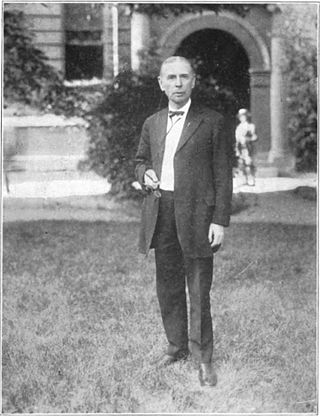
<span class="mw-page-title-main">Franz Pieper</span> American Lutheran theologian

Franz August Otto Pieper was a Confessional Lutheran theologian who also served as the fourth president of the Lutheran Church – Missouri Synod, known at that time as the German Evangelical Lutheran Synod of Missouri, Ohio, and Other States.
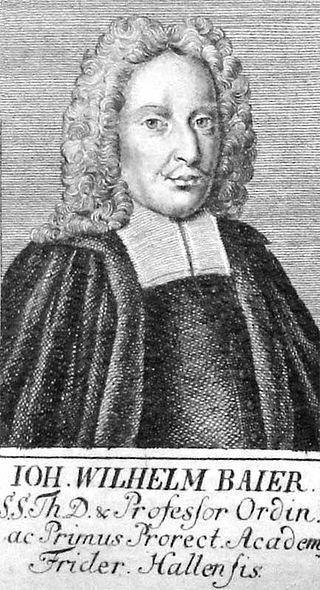
<span class="mw-page-title-main">Johann Wilhelm Baier</span> German theologian (1647–1695)

Johann Wilhelm Baier was a German theologian in the Lutheran scholastic tradition. He was born at Nuremberg, and died at Weimar.

Beale Melanchthon Schmucker was an American Lutheran leader, liturgical scholar and historian.

Robert Kolb is professor emeritus of Systematic Theology at Concordia Seminary, St. Louis, Missouri, and a world-renowned authority on Martin Luther and the history of the Reformation.
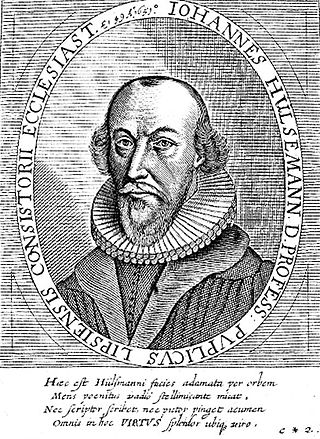
<span class="mw-page-title-main">Johann Hülsemann</span> German Lutheran theologian (1602–1661)

Johann Hülsemann was a German Lutheran theologian. He is known as one of the most prominent Lutheran scholastic opponents of Georgius Calixtus in the Syncretistic Controversy.

Hans Hansen Bergen was one of the earliest settlers of the Dutch colony of New Amsterdam, and one of the few from Scandinavia. He was a native of Bergen, Norway. Hans Hansen Bergen was a shipwright who served as overseer of an early tobacco plantation on Manhattan Island, before eventually removing to Brooklyn's Wallabout Bay, where he was one of the earliest settlers and founded a prominent Brooklyn clan.

Lutheranism is a major branch of Protestantism, identifying primarily with the theology of Martin Luther, the 16th-century German monk and reformer whose efforts to reform the theology and practices of the Catholic Church launched the Protestant Reformation.

The Augsburg Confession, also known as the Augustan Confession or the Augustana from its Latin name, Confessio Augustana, is the primary confession of faith of the Lutheran Church and one of the most important documents of the Protestant Reformation. The Augsburg Confession was written in both German and Latin and was presented by a number of German rulers and free-cities at the Diet of Augsburg on 25 June 1530.

Illinois State University was a private institution of higher learning in Springfield, Illinois. It began as The Literary and Theological Institute of the Lutheran Church in the Far West in Hillsboro, Illinois, in 1847. It soon became known as the Lutheran College, and, locally, as Hillsboro College. In 1852, it relocated to Springfield and changed its name to Illinois State University. It ceased operations in 1868, but reopened as Carthage College in Carthage, Illinois, in 1870.

Gustav Leopold Plitt was a German Protestant theologian.

References

  1. ↑ Evjen Family Tree (ancestry.com by John Margie Evjen)
  2. ↑ Tarald Rasmussen. "John Oluf Evjen". Store norske leksikon. Retrieved November 3, 2015.
  3. ↑ New Schaff-Herzog Encyclopedia Of Religious Knowledge Author: Schaff, Philip (1819-1893) Baker Book House- Grand Rapids, Michigan Page 551
  4. ↑ "The Norwegian Pioneer in the Field of American Scholarship (Laurence M. Larson, Norwegian-American Historical Association. Volume II: Page 62)". Archived from the original on 2016-03-03. Retrieved 2009-06-17.

External links

  • John Oluf Evjen (New Schaff-Herzog Encyclopedia of Religious Knowledge)
  • Scandinavia (Barnette's Family Tree Book Company) [ permanent dead link ]
  • En boganmeldelse / af John O. Evjen
Authority control databases OOjs UI icon edit-ltr-progressive.svg
International
  • ISNI
  • VIAF
National
  • United States
  • Australia
  • Netherlands
People
  • Trove
This page is based on this Wikipedia article
Text is available under the CC BY-SA 4.0 license; additional terms may apply.
Images, videos and audio are available under their respective licenses.