Related Research Articles
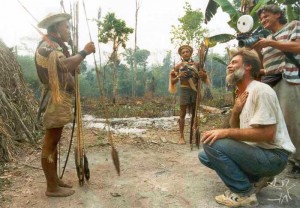
Anthropology is the scientific study of humanity, concerned with human behavior, human biology, cultures, societies, and linguistics, in both the present and past, including archaic humans. Social anthropology studies patterns of behavior, while cultural anthropology studies cultural meaning, including norms and values. The term sociocultural anthropology is commonly used today. Linguistic anthropology studies how language influences social life. Biological or physical anthropology studies the biological development of humans.

Evolution is the change in the heritable characteristics of biological populations over successive generations. It occurs when evolutionary processes such as natural selection and genetic drift act on genetic variation, resulting in certain characteristics becoming more or less common within a population over successive generations. The process of evolution has given rise to biodiversity at every level of biological organisation.

Genetics is the study of genes, genetic variation, and heredity in organisms. It is an important branch in biology because heredity is vital to organisms' evolution. Gregor Mendel, a Moravian Augustinian friar working in the 19th century in Brno, was the first to study genetics scientifically. Mendel studied "trait inheritance", patterns in the way traits are handed down from parents to offspring over time. He observed that organisms inherit traits by way of discrete "units of inheritance". This term, still used today, is a somewhat ambiguous definition of what is referred to as a gene.

Natural selection is the differential survival and reproduction of individuals due to differences in phenotype. It is a key mechanism of evolution, the change in the heritable traits characteristic of a population over generations. Charles Darwin popularised the term "natural selection", contrasting it with artificial selection, which is intentional, whereas natural selection is not.

Biological anthropology, also known as physical anthropology, is a social science discipline concerned with the biological and behavioral aspects of human beings, their extinct hominin ancestors, and related non-human primates, particularly from an evolutionary perspective. This subfield of anthropology systematically studies human beings from a biological perspective.
Race is a categorization of humans based on shared physical or social qualities into groups generally viewed as distinct within a given society. The term came into common usage during the 16th century, when it was used to refer to groups of various kinds, including those characterized by close kinship relations. By the 17th century, the term began to refer to physical (phenotypical) traits, and then later to national affiliations. Modern science regards race as a social construct, an identity which is assigned based on rules made by society. While partly based on physical similarities within groups, race does not have an inherent physical or biological meaning. The concept of race is foundational to racism, the belief that humans can be divided based on the superiority of one race over another.
Sociobiology is a field of biology that aims to explain social behavior in terms of evolution. It draws from disciplines including psychology, ethology, anthropology, evolution, zoology, archaeology, and population genetics. Within the study of human societies, sociobiology is closely allied to evolutionary anthropology, human behavioral ecology, evolutionary psychology, and sociology.

Domestication is a multi-generational mutualistic relationship in which an animal species, such as humans or leafcutter ants, takes over control and care of another species, such as sheep or fungi, to obtain from them a steady supply of resources, such as meat, milk, or labor. The process is gradual and geographically diffuse, based on trial and error. Domestication affected genes for behavior in animals, making them less aggressive. In plants, domestication affected genes for morphology, such as increasing seed size and stopping the shattering of cereal seedheads. Such changes both make domesticated organisms easier to handle and reduce their ability to survive in the wild.

Darkness in El Dorado: How Scientists and Journalists Devastated the Amazon is a book written by author Patrick Tierney in 2000, in which the author accuses geneticist James Neel and anthropologist Napoleon Chagnon of conducting human research without regard for their subjects' well-being while conducting long-term ethnographic field work among the indigenous Yanomamo, in the Amazon basin between Venezuela and Brazil. He also wrote that the researchers had exacerbated a measles epidemic among the Native Americans, and that Jacques Lizot and Kenneth Good committed acts of sexual impropriety with Yanomamo.

Otmar Freiherr von Verschuer was a German-Dutch human biologist and geneticist, who was the Professor of Human Genetics at the University of Münster until he retired in 1965. A member of the Dutch noble Verschuer family, his title Freiherr is often translated as baron.
In biology, adaptation has three related meanings. Firstly, it is the dynamic evolutionary process of natural selection that fits organisms to their environment, enhancing their evolutionary fitness. Secondly, it is a state reached by the population during that process. Thirdly, it is a phenotypic trait or adaptive trait, with a functional role in each individual organism, that is maintained and has evolved through natural selection.
Researchers have investigated the relationship between race and genetics as part of efforts to understand how biology may or may not contribute to human racial categorization. Today, the consensus among scientists is that race is a social construct, and that using it as a proxy for genetic differences among populations is misleading.
Human genetics is the study of inheritance as it occurs in human beings. Human genetics encompasses a variety of overlapping fields including: classical genetics, cytogenetics, molecular genetics, biochemical genetics, genomics, population genetics, developmental genetics, clinical genetics, and genetic counseling.
Jonathan Mitchell Marks is a professor of biological anthropology at the University of North Carolina at Charlotte. He is known for his work comparing the genetics of humans and other apes, and for his critiques of scientific racism, biological determinism, and what he argues is an overemphasis on scientific rationalism in anthropology. He is a fellow of the American Association for the Advancement of Science.
"Human Genetic Diversity: Lewontin's Fallacy" is a 2003 paper by A. W. F. Edwards. He criticises an argument first made in Richard Lewontin's 1972 article "The Apportionment of Human Diversity", that the practice of dividing humanity into races is taxonomically invalid because any given individual will often have more in common genetically with members of other population groups than with members of their own. Edwards argued that this does not refute the biological reality of race since genetic analysis can usually make correct inferences about the perceived race of a person from whom a sample is taken, and that the rate of success increases when more genetic loci are examined.
Dual inheritance theory (DIT), also known as gene–culture coevolution or biocultural evolution, was developed in the 1960s through early 1980s to explain how human behavior is a product of two different and interacting evolutionary processes: genetic evolution and cultural evolution. Genes and culture continually interact in a feedback loop: changes in genes can lead to changes in culture which can then influence genetic selection, and vice versa. One of the theory's central claims is that culture evolves partly through a Darwinian selection process, which dual inheritance theorists often describe by analogy to genetic evolution.

Human genetic variation is the genetic differences in and among populations. There may be multiple variants of any given gene in the human population (alleles), a situation called polymorphism.
Trudy Frances Charlene Mackay is the director of Clemson University's Center for Human Genetics located on the campus of the Greenwood Genetic Center. She is recognized as one of the world's leading authorities on the genetics of complex traits. Mackay is also the Self Family Chair in Human Genetics and Professor of Genetics and Biochemistry at Clemson University.
Mark Stoneking is a geneticist currently working as the Group Leader of the Max Planck Institute for Evolutionary Anthropology, of Max Planck Gesellschaft at Leipzig, and Honorary Professor of Biological Anthropology, University of Leipzig, Leipzig, Germany. He works in the field of human evolution, especially the genetic evolution, origin and dispersal of modern humans. He, along with his doctoral advisor Allan Wilson and a fellow researcher Rebecca L. Cann, contributed to the "Out of Africa" theory in 1987 by introducing the concept of Mitochondrial Eve, a hypothetical common mother of all living humans based on mitochondrial DNA.
Sarah Anne Tishkoff is an American geneticist and the David and Lyn Silfen Professor in the Department of Genetics and Biology at the University of Pennsylvania. She also serves as a director for the American Society of Human Genetics and is an associate editor at PLOS Genetics, G3, and Genome Research. She is also a member of the scientific advisory board at the David and Lucile Packard Foundation.
References
- ↑ "Fellows". AAAS MemberCentral. American Association for the Advancement of Science.[ permanent dead link ]

