
The Lamiaceae or Labiatae are a family of flowering plants commonly known as the mint, deadnettle, or sage family. Many of the plants are aromatic in all parts and include widely used culinary herbs like basil, mint, rosemary, sage, savory, marjoram, oregano, hyssop, thyme, lavender, and perilla, as well as other medicinal herbs such as catnip, salvia, bee balm, wild dagga, and oriental motherwort. Some species are shrubs, trees, or, rarely, vines. Many members of the family are widely cultivated, not only for their aromatic qualities, but also their ease of cultivation, since they are readily propagated by stem cuttings. Besides those grown for their edible leaves, some are grown for decorative foliage. Others are grown for seed, such as Salvia hispanica (chia), or for their edible tubers, such as Plectranthus edulis, Plectranthus esculentus, Plectranthus rotundifolius, and Stachys affinis. Many are also grown ornamentally, notably coleus, Plectranthus, and many Salvia species and hybrids.
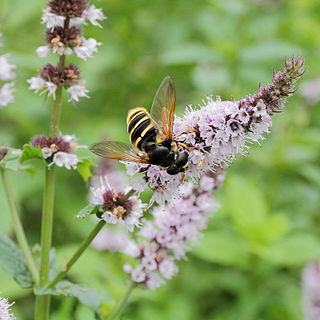
Mentha, also known as mint, is a genus of flowering plants in the family Lamiaceae. It is estimated that 13 to 24 species exist, but the exact distinction between species is unclear. Hybridization occurs naturally where some species' ranges overlap. Many hybrids and cultivars are known.

Mimosa is a genus of about 600 species of herbs and shrubs, in the mimosoid clade of the legume family Fabaceae. Species are native to the Americas, from North Dakota to northern Argentina, and to eastern Africa as well as the Indian subcontinent and Indochina. The generic name is derived from the Greek word μῖμος (mimos), an "actor" or "mime", and the feminine suffix -osa, "resembling", suggesting its 'sensitive leaves' which seem to 'mimic conscious life'.

Bauhinia is a large genus of flowering plants in the subfamily Cercidoideae and tribe Bauhinieae, in the large flowering plant family Fabaceae, with a pantropical distribution. The genus was named after the Bauhin brothers Gaspard and Johann, Swiss-French botanists.

Cassia is a genus of flowering plants in the legume family, Fabaceae, and the subfamily Caesalpinioideae. Species are known commonly as cassias. The genus includes 37 species and has a pantropical distribution. Species of the genera Senna and Chamaecrista were previously included in Cassia. Cassia now generally includes the largest species of the legume subtribe Cassiinae, usually mid-sized to tall trees.

Abarema is a neotropical genus in the family Fabaceae. It is native to Brazil, Cuba, and Venezuela. Most of the species can be found in the Amazon Basin and the Guyana Highlands. They have a deep-green fernlike foliage, with bipinnately compound leaves.
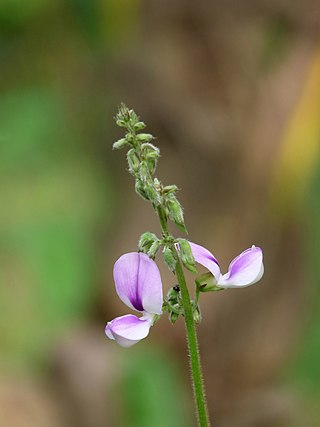
Pueraria is a genus of 15–20 species of legumes native to south, east, and southeast Asia and to New Guinea and northern Australia. The best known member is kudzu, also called Japanese arrowroot. The genus is named after 19th century Swiss botanist Marc Nicolas Puerari.

Terminalia is a genus of large trees of the flowering plant family Combretaceae, comprising nearly 300 species distributed in tropical regions of the world. The genus name derives from the Latin word terminus, referring to the fact that the leaves appear at the very tips of the shoots.

Calliandra is a genus of flowering plants in the pea family, Fabaceae, in the mimosoid clade of the subfamily Caesalpinioideae. It contains about 140 species that are native to tropical and subtropical regions of the Americas.
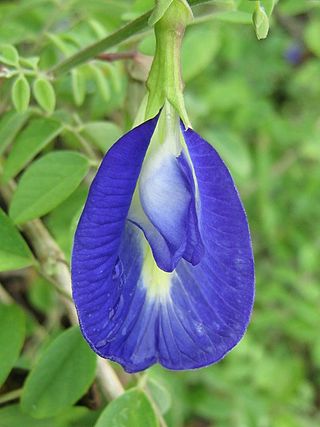
Clitoria is a genus of mainly tropical and subtropical, insect-pollinated flowering pea vines.

Chrysobalanaceae is a family of flowering plants, consisting of trees and shrubs in 27 genera and about 700 species of pantropical distribution with a centre of diversity in the Amazon. Some of the species contain silica in their bodies for rigidity and so the mesophyll often has sclerenchymatous idioblasts. The widespread species Chrysobalanus icaco produces a plum-like fruit and the plant is commonly known as the coco plum.

Erythroxylaceae is a family of flowering trees and shrubs consisting of 4 genera and 271 species. The four genera are AneulophusBenth., ErythroxylumP.Browne, NectaropetalumEngl., and PinacopodiumExell & Mendonça. The best-known species are the coca plants, including the species Erythroxylum coca, the source of the substance coca.

Monardella is a genus of approximately 40 species of annual and perennial plants native to western North America from British Columbia to northwestern Mexico. They are grown for their highly aromatic foliage, which in some species is used for herbal teas. The two-lipped, tubular flowers are formed in terminal clusters and are most usually red, pink, or purple.

Olearia, most commonly known as daisy-bush, is a genus of flowering plants belonging to the family Asteraceae, the largest of the flowering plant families in the world. Olearia are found in Australia, New Guinea and New Zealand. The genus includes herbaceous plants, shrubs and small trees. The latter are unusual among the Asteraceae and are called tree daisies in New Zealand. All bear the familiar daisy-like composite flowerheads in white, pink, mauve or purple.

Lepechinia is a genus of plants in the mint family, Lamiaceae. It includes several species of plants known commonly as pitchersages. Plants of this genus can be found in Central and South America, Mexico, California, Hispaniola, and Hawaii, although the species in Hawaii is probably a human introduction. Many of them bear attractive pitcher-shaped flowers, often in shades of purple. The genus was named for the Russian botanist Ivan Ivanovich Lepechin. In 2011, the two monotypic genera Chaunostoma and Neoeplingia were shown to be part of Lepechinia.
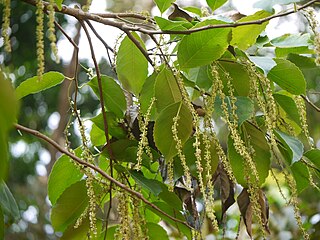
Homalium is a genus of plants in the family Salicaceae.

Olax is a plant genus in the family Olacaceae. It includes 52 species native to the tropics of South America, Africa, Asia, and Australia. The name derives from the Latin, olax (malodorous), and refers to the unpleasant scent of some of the Olax species. Olax is an Old World genus represented by several climbers, some species have leaves and fruits smelling of garlic such as Olax subscorpioidea and Olax gambecola, seeds of the latter are used as condiments in parts of West Africa. In India Olax nana is well known as one of the first species to emerge after forest fires, the shoots growing directly from buried roots.

Lumnitzera is an Indo-West Pacific mangrove genus in the family Combretaceae. An English common name is black mangrove. Lumnitzera, named after the German botanist, Stephan Lumnitzer (1750-1806), occurs in mangroves from East Africa to the Western Pacific, and northern Australia.

Schoenus is a predominately austral genus of sedges, commonly known as bogrushes, or veldrushes in South Africa. Species of this genus occur mainly in South Africa, Australia and Southeast Asia. Others are found in scattered locations worldwide, from Europe to Asia, North Africa and the Americas. Three species occur in the peatlands of southern South America, including S. antarcticus which is found in Tierra del Fuego, where it forms a component of hyperhumid Magellanic moorland.

Acmispon is a genus of flowering plant in the family Fabaceae (legumes), native to North America and the west coast of Chile in South America. It includes several species of American bird's-foot trefoils and deervetches formerly contained in the globally distributed genus Lotus. The former genus Syrmatium is included in Acmispon. The Jepson eFlora accepts only Acmispon.

