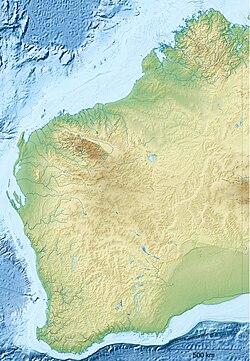
The only information on the Mandjindja's country are estimates given by Norman Tindale. Tindale's estimates (particularly for the peoples of the Western desert) are not considered to be accurate.[1]
Tindale estimated that the Mandjindja's territory extended over roughly 21,000 square miles (54,000km2), in the sandhill terrain south of the Warburton Range, from a place called Papakula ("Babbagoola Rockhole" on maps). Their western extension went as far as the Gillen and Throssell lakes. Their southern boundaries lay around Amy Rocks and the Saunders Range. Their eastern confines lay around a place named Lenga:na, identified as possibly east of the Sydney Yeo Chasm.[2]
The Mandjindja people in Kalgoorlie are possibly the descendants of the Manyjilyjarra people who left the Great Sandy and Gibson deserts in 1906 due to an extended drought and then made their way to places such as Kalgoorlie from the 1920s.[3]
Native title claim
The Mandjindja and Ngalia sought recognition of their inherent land rights through the native title claim process in the Federal Court of Australia.[4][5] An earlier 1996 claim had been dismissed (NNTT 1996).
In March 2009, the Mantjintjarra Ngalia claim came a step closer to recognition after passing the registration test of the Native Title Act.[6] They claimed traditional ownership of the area from around Lake Wells in the east to Lake Darlot and Lake Miranda in the west to Cosmo Newberry through to Leonora and Lake Barlee up to Wiluna in the north.[7]
This page is based on this Wikipedia article Text is available under the CC BY-SA 4.0 license; additional terms may apply. Images, videos and audio are available under their respective licenses.