The topic of this article may not meet Wikipedia's general notability guideline .(March 2025) |
| | |
| Adopted | 1848 1913 |
|---|---|
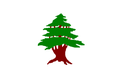
| Design | A white field charged with a green and brown Lebanese cedar tree. |
An editor has nominated this article for deletion. You are welcome to participate in the deletion discussion , which will decide whether or not to retain it. |
There have been several Maronite flags throughout history, although the most documented is the cedar flag which is believed to have been created in the 18th century, its first recorded use was in October 1848. [1] [2] The cedar flag was also raised as the first national flag of Lebanon on October 2, 1918, following the fall of the Ottoman Empire. [3] [4]
The cedar flag goes back to the 18th century as a Maronite symbol under the Ottoman Empire. [5] [6] [7] [8] [9] The 1913 version of the flag was proposed by two Lebanese Brazilian journalists, Shukri El Khoury and Naoum Labaki, who were both part of the Mahjar movement in the Americas, to be the national flag of Lebanon. The flag was raised on November 2, 1918, following the expulsion of Ottoman troops from Mount Lebanon and was hung in the Administrative Council (Majlis) of Mount Lebanon until May 1919. [10] The flag and government were eventually succeeded by the state of Greater Lebanon in 1920. [11]
The flag was also used by the second Lebanese delegation to the Paris Peace Conference, led by the Maronite patriarch Elias Peter Hoayek, [12] to petition for an independent Lebanese state separate from the Arab kingdom of Faisal I. [11]
The flag has a simple design with two main features:
Gérard de Nerval described a Maronite flag with a red banner and white cross in his 1851 travel book Voyage to the Orient. [16]
Prince Ferdinand Tyan, nephew of Maronite Patriarch Joseph Tyan, wrote about the Maronite cross flag in his 1916 work "The entente cordiale in Lebanon" describing it as “A white cross on a champ de gueules.” [17] Tyan also mentioned the flag in his 1917 book "France et Liban: défense des intérêts français en Syrie" where he advocated for an autonomous Mount Lebanon protectorate within a French controlled Syrian state with the provisions of it being ruled by a Lebanese emir with the Maronite flag flying over Beirut. [18]
On 30 January 1830, Emir Bashir Shihab II was fighting against the sheikhs of Nablus who were rebelling against Abdallah Pasha, the Ottoman governor of Akka and Sidon. Five hundred men came from Deir al-Qamar and the surrounding districts but they gathered first in the Maronite Church of Notre-Dame of Talle. There they presented their flag “red and white, with a golden sphere with a cross above it near the top of the design.” The flag was carried by Wehbe Eid Boustani of Deir al-Qamar. [19]
After XVII century the flag (white) with cedar was used by the Maronite Christians. But the first attested use is dated only to October 1848.
In the 18th and 19th centuries (AD) Maronite Christians in Lebanon used a white flag displaying a Cedar.
Of course, the Maronites played a huge role there as well – for example, if we look at their flag, the cedar, it became the flag of Lebanon.
In the eighteenth century the Maronites used a white flag with a cedar tree in the center
But some Lebanese are troubled that the flag itself is descendent of an 18th century Maronite flag
The Maronite flag is a white field bearing a centered green-and-brown cedar tree.
In the eighteenth and nineteenth centuries Maronite Christians used a white flag bearing a cedar.
Specifically, the cedar is the symbol of the country's Maronite Christian community.