Doonesbury is a comic strip by American cartoonist Garry Trudeau that chronicles the adventures and lives of an array of characters of various ages, professions, and backgrounds, from the President of the United States to the title character, Michael Doonesbury, who has progressed over the decades from a college student to a youthful senior citizen.

Garretson Beekman Trudeau is an American cartoonist, best known for creating the Doonesbury comic strip.

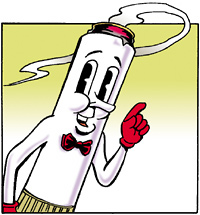
A cigarette is a narrow cylinder containing a combustible material, typically tobacco, that is rolled into thin paper for smoking. The cigarette is ignited at one end, causing it to smolder; the resulting smoke is orally inhaled via the opposite end. Cigarette smoking is the most common method of tobacco consumption. The term cigarette, as commonly used, refers to a tobacco cigarette, but the word is sometimes used to refer to other substances, such as a cannabis cigarette or a herbal cigarette. A cigarette is distinguished from a cigar by its usually smaller size, use of processed leaf, different smoking method, and paper wrapping, which is typically white.

The tobacco industry comprises those persons and companies who are engaged in the growth, preparation for sale, shipment, advertisement, and distribution of tobacco and tobacco-related products. It is a global industry; tobacco can grow in any warm, moist environment, which means it can be farmed on all continents except Antarctica.

Zonker Harris is the stereotypical unfocused confused hippie character in Garry Trudeau's comic strip Doonesbury. He made his first appearance as a perennial pot-smoking pest plaguing B.D.'s football team in 1971. He moved with Mike, B.D., and the gang to a rural commune.
Nicotine marketing is the marketing of nicotine-containing products or use. Traditionally, the tobacco industry markets cigarette smoking, but it is increasingly marketing other products, such as electronic cigarettes and heated tobacco products. Products are marketed through social media, stealth marketing, mass media, and sponsorship. Expenditures on nicotine marketing are in the tens of billions a year; in the US alone, spending was over US$1 million per hour in 2016; in 2003, per-capita marketing spending was $290 per adult smoker, or $45 per inhabitant. Nicotine marketing is increasingly regulated; some forms of nicotine advertising are banned in many countries. The World Health Organization recommends a complete tobacco advertising ban.
"Butt Out" is the thirteenth episode of the seventh season of the American animated television series South Park, and the 109th episode overall. It first aired on Comedy Central in the United States on December 3, 2003.
Michael James "Mike" Doonesbury is the main character in Garry Trudeau's comic strip Doonesbury. He started out as a nerdish freshman from Tulsa at the fictional Walden College, and shared a dorm room with B.D. Currently he is married to Kim Rosenthal, and divorced from J.J. Caucus. Mike's daughter, Alex continued to live with Mike and Kim, until she left to attend MIT. He has a younger brother, Benjamin, and a widowed mother who died in late 2010.

A cigarette filter, also known as a filter tip, is a component of a cigarette, along with cigarette paper, capsules and adhesives. Filters were introduced in the early 1950s.

Doonesbury, also known as Doonesbury: A Musical Comedy, is a 1983 musical with a book and lyrics by Garry Trudeau and music by Elizabeth Swados.

A menthol cigarette is a cigarette infused with the compound menthol which imparts a “minty” flavor to the smoke. Menthol also decreases irritant sensations from nicotine by desensitizing receptors, making smoking feel less harsh compared to regular cigarettes. Some studies have suggested that they are more addictive. Menthol cigarettes are just as hard to quit and are just as harmful as regular cigarettes.

Smoking is a practice in which a substance is combusted and the resulting smoke is typically inhaled to be tasted and absorbed into the bloodstream of a person. Most commonly, the substance used is the dried leaves of the tobacco plant, which have been rolled with a small rectangle of paper into an elongated cylinder called a cigarette. Other forms of smoking include the use of a smoking pipe or a bong.
The history of commercial tobacco production in the United States dates back to the 17th century when the first commercial crop was planted. The industry originated in the production of tobacco for British pipes and snuff. See Tobacco in the American colonies. In late 18th century there was an increase in demand for tobacco in the United States, where the demand for tobacco in the form of cigars and chewing tobacco increased. In the late 19th century production shifted to the manufactured cigarette.

Tobacco politics refers to the politics surrounding the use and distribution of tobacco, likewise with regulations.
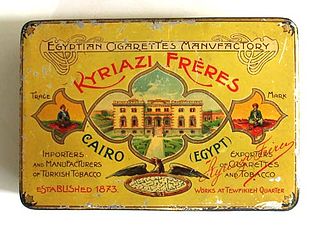
The Egyptian cigarette industry, during the period between the 1880s and the end of the First World War, was a major export industry that influenced global fashion. It was notable as a rare example of the global periphery setting trends in the global center in a period when the predominant direction of cultural influence was the reverse, and also as one of the earliest producers of globally traded manufactured finished goods outside the West.
Bollywood, the Hindi part of the Indian film industry, is the largest film producer in India, and one of the largest film production centres in the world. Producing nearly 1000 films, selling 3.1 billion cinema tickets and grossing close to ten billion dollars a year, Bollywood exerts an extreme stronghold on the Indian culture and influences daily approximately 15 million people who go to see Bollywood films. One such example of the influence of Bollywood culture is tobacco use. India currently has nearly 250 million tobacco users.

SmokinginCanada is banned in indoor public spaces, public transit facilities and workplaces, by all territories and provinces, and by the federal government. As of 2010, legislation banning smoking within each of these jurisdictions is mostly consistent, despite the separate development of legislation by each jurisdiction. Notable variations between the jurisdictions include: whether, and in what circumstances ventilated smoking rooms are permitted; whether, and up to what distance away from a building is smoking banned outside of a building; and, whether smoking is banned in private vehicles occupied by children.

Smoking in India is one of the oldest industries and provides employment to more than five million people directly and indirectly. India is the second-largest producer of tobacco in the world. Smoking has been known since at least 2000 BC when cannabis was smoked and is first mentioned in the Atharvaveda. Fumigation (dhupa) and fire offerings (homa) are prescribed in the Ayurveda for medical purposes and have been practiced for at least 3,000 years while smoking, dhumrapana has been practiced for at least 2,000 years. Tobacco was introduced to India in the 17th century. It later merged with existing practices of smoking.
Merrell Williams Jr. was a whistleblower in the tobacco industry, revealing secret papers of tobacco companies showing that the companies had been lying to the public. It eventually resulted in a multi-billion-dollar settlement with the US states.