Related Research Articles

The Fokker E.I was the first fighter aircraft to enter service with the Fliegertruppe of the Deutsches Heer in World War I. Its arrival at the front in mid-1915 marked the start of a period known as the "Fokker Scourge" during which the E.I and its successors achieved a measure of air superiority over the Western Front.

The Fokker E.II was the second variant of the German Fokker Eindecker single-seat monoplane fighter aircraft of World War I. The E.II was essentially a Fokker E.I with the 75 kW (100 hp) Oberursel U.I 9-cylinder rotary engine, a close copy of the French Gnôme Monosoupape rotary of the same power output, in place of the E.I's 60 kW (80 hp) Oberursel U.0, but whereas the E.I was simply a M.5K with a 7.92 mm (.312 in) machine gun bolted to it, the E.II was designed with the weapon system integrated with its airframe.
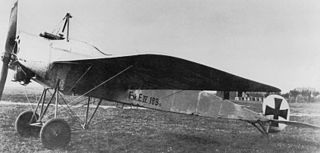
The Fokker E.IV was the final variant of the Eindecker fighter aircraft that was operated by Germany during World War I.

The Fokker M.5 was an unarmed single-seat monoplane aircraft designed and built by Anthony Fokker in 1913. It served as a light reconnaissance aircraft with the German army at the outbreak of World War I and was the basis for the first successful fighter aircraft in German service, the Fokker E.I.

The Pfalz D.VIII was a German World War I fighter aircraft.
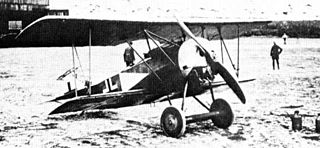
The Fokker D.VI was a German fighter aircraft built in limited numbers at the end of World War I. The D.VI served in the German and Austro-Hungarian air services.

The Fokker M 10 was a two-seater reconnaissance / trainer biplane with single-bay wings equipped with wing-warping controls for roll, powered by a 7-cylinder 80 hp Oberursel U.0 engine. Several M 10 aircraft were purchased by the Imperial and Royal Aviation Troops of Austro Hungary.

The Fokker D.II was a German fighter biplane of World War I. It was a single-seat fighter aircraft developed before the Fokker D.I. It was based on the M.17 prototype, with single-bay unstaggered wings and a larger fuselage and shorter span than production D.IIs. Using a 75 kW (100 hp) Oberursel U.I, the D.II was underpowered, though the single 7.92 mm (.312 in) lMG 08 machine gun was normal for 1916. The German Army purchased 177.
The Euler D.I was a German single-seat fighter based on the French Nieuport 11. After seeing the success of the French Nieuport 11 at the front, German designer August Euler set about to create a German aircraft based on the Nieuport design. The Euler D.I first flew in late 1916. It was powered by an 80 hp engine with the Euler patented machine gun on the front.

The Morane-Saulnier H was an early aircraft first flown in France in the months immediately preceding the First World War; it was a single-seat derivative of the successful Morane-Saulnier G with a slightly reduced wingspan Like the Type G, it was a successful sporting and racing aircraft: examples serving with the French army were used in the opening phases of the war.
The Kondor E 3, sometimes erroneously known as E.III, was a German single seat, monoplane fighter aircraft designed and built close to the end of World War I. Though successful in the third D-type fighter competition at Aldershof in September 1918, only a few were produced, given the Idflieg designation of Kondor D.I.
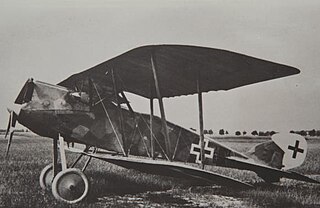
The Aviatik C.IX was a prototype German observation aircraft built by Aviatik in the final months of World War I.

The Aviatik C.VIII was a prototype German observation aircraft built by Aviatik in World War I.

The Pfalz Dr.II was a German triplane fighter prototype of World War I built by Pfalz Flugzeugwerke.

The Kondor D 2 was a German single seat, biplane fighter aircraft designed and built close to the end of World War I.
The LVG D.IV was a German fighter plane built by LVG in World War I.

The LVG D.VI was a prototype German biplane fighter built by LVG in World War I.
The Daimler CL.I was a prototype two-seat fighter built in Germany during World War I.
The NFW E.II was a fighter aircraft built in Germany during World War I.

The Hansa-Brandenburg W.16 was a floatplane fighter built in Germany during World War I for the Imperial German Navy.
References
- ↑ "NFW E.i".
- ↑ Gray, Peter; Thetford, Owen (1970). German Aircraft of the First World War (2nd ed.). London: Putnam. p. 489. ISBN 0-370-00103-6.