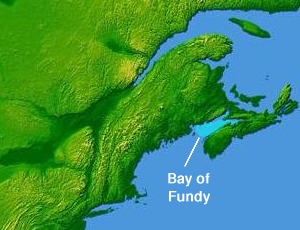
The Bay of Fundy is a bay between the Canadian provinces of New Brunswick and Nova Scotia, with a small portion touching the U.S. state of Maine. It is an arm of the Gulf of Maine. Its tidal range is the highest in the world. The name is probably a corruption of the French word fendu, meaning 'split'.

Pumped-storage hydroelectricity (PSH), or pumped hydroelectric energy storage (PHES), is a type of hydroelectric energy storage used by electric power systems for load balancing. A PHS system stores energy in the form of gravitational potential energy of water, pumped from a lower elevation reservoir to a higher elevation. Low-cost surplus off-peak electric power is typically used to run the pumps. During periods of high electrical demand, the stored water is released through turbines to produce electric power.

Tidal power or tidal energy is harnessed by converting energy from tides into useful forms of power, mainly electricity using various methods.

Morecambe Bay is an estuary in north-west England, just to the south of the Lake District National Park. It is the largest expanse of intertidal mudflats and sand in the United Kingdom, covering a total area of 120 sq mi (310 km2). In 1974, the second largest gas field in the UK was discovered 25 mi (40 km) west of Blackpool, with original reserves of over 7 trillion cubic feet (tcf). At its peak, 15% of Britain's gas supply came from the bay but production is now in decline. Morecambe Bay is also an important wildlife site, with abundant birdlife and varied marine habitats.

The Dnieper Hydroelectric Station, also known as the Dnipro Dam, is a hydroelectric power station in the city of Zaporizhzhia, Ukraine. Operated by Ukrhydroenergo, it is the fifth and largest station in the Dnieper reservoir cascade, a series of hydroelectric stations on the Dnieper river that supply power to the Donets–Kryvyi Rih industrial region. Its dam has a length of 800 metres (2,600 ft), a height of 61 metres (200 ft), and a flow rate of 38.7 metres (127 ft) per second.
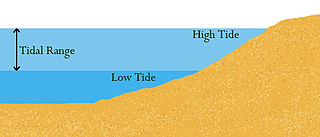
Tidal range is the difference in height between high tide and low tide. Tides are the rise and fall of sea levels caused by gravitational forces exerted by the Moon and Sun, by Earth's rotation and by centrifugal force caused by Earth's progression around the Earth-Moon barycenter. Tidal range depends on time and location.

The Mezen Bay is located in Arkhangelsk Oblast and Nenets Autonomous Okrug in Northwestern Russia. It is one of four large bays and gulfs of the White Sea, the others being the Dvina Bay, the Onega Bay, and the Kandalaksha Gulf. The Mezen Bay is the easternmost of these, as it lies to the south of the Kanin Peninsula. Morzhovets Island lies at the entrance of the bay. The two main rivers emptying into the Mezen Bay are the Kuloy River, and the Mezen River. The area of the bay is 6,630 square kilometres (2,560 sq mi). The Mezen Bay is 105 kilometres (65 mi) long and 97 kilometres (60 mi) wide. The tides in the Mezen Bay are up to 10 metres (33 ft) high and are the biggest in the White Sea. The northern part of the bay, just south of Morzhovets Island, is crossed by the Arctic Circle.

The Severn Barrage is any of a range of ideas for building a barrage from the English coast to the Welsh coast over the Severn tidal estuary. Ideas for damming or barraging the Severn estuary have existed since the 19th century. The building of such a barrage would constitute an engineering project comparable with some of the world's biggest. The purposes of such a project have typically been one or several of: transport links, flood protection, harbour creation, or tidal power generation. In recent decades it is the latter that has grown to be the primary focus for barrage ideas, and the others are now seen as useful side-effects. Following the Severn Tidal Power Feasibility Study (2008–10), the British government concluded that there was no strategic case for building a barrage but to continue to investigate emerging technologies. In June 2013 the Energy and Climate Change Select Committee published its findings after an eight-month study of the arguments for and against the Barrage. MPs said the case for the barrage was unproven. They were not convinced the economic case was strong enough and said the developer, Hafren Power, had failed to answer serious environmental and economic concerns.
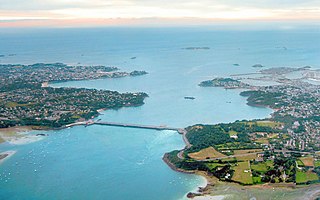
The Rance Tidal Power Station is a tidal power station located on the estuary of the Rance River in Brittany, France.

Penzhina Bay is a long and narrow bay off the northwestern coast of Kamchatka, Russia. The bay has one of the strongest tides in the world, there have been several power station proposals.

King Sound is a large gulf in northern Western Australia. It expands from the mouth of the Fitzroy River, one of Australia's largest watercourses, and opens to the Indian Ocean. It is about 120 kilometres (75 mi) long, and averages about 50 kilometres (31 mi) in width. The port town of Derby lies near the mouth of the Fitzroy River on the eastern shore of King Sound. King Sound has the highest tides in Australia, and amongst the highest in the world, reaching a maximum tidal range of 11.8 metres (39 ft) at Derby. The tidal range and water dynamic were researched in 1997–1998.

The production of renewable energy in Scotland is a topic that came to the fore in technical, economic, and political terms during the opening years of the 21st century. The natural resource base for renewable energy is high by European, and even global standards, with the most important potential sources being wind, wave, and tide. Renewables generate almost all of Scotland's electricity, mostly from the country's wind power.

Blyth Power Station refers to a pair of now demolished coal-fired power stations, which were located on the Northumberland coast in North East England. The two stations were built alongside each other on a site near Cambois in Northumberland, on the northern bank of the River Blyth, between its tidal estuary and the North Sea. The stations took their name from the town of Blyth on the opposite bank of the estuary. Blyth A Power Station was built and opened first but had a smaller generating capacity than its sister station, Blyth B Power Station, which was built to its west four years later. The power stations' four large chimneys were a landmark of the Northumberland skyline for over 40 years; the A Station's two chimneys each stood at 140 metres (460 ft); the B Station's two chimneys were taller, at 170 metres (560 ft) each.

New Zealand has large ocean energy resources but does not yet generate any power from them. TVNZ reported in 2007 that over 20 wave and tidal power projects are currently under development. However, not a lot of public information is available about these projects. The Aotearoa Wave and Tidal Energy Association was established in 2006 to "promote the uptake of marine energy in New Zealand". According to their 10 February 2008 newsletter, they have 59 members. However, the association doesn't list its members.

A tidal stream generator, often referred to as a tidal energy converter (TEC), is a machine that extracts energy from moving masses of water, in particular tides, although the term is often used in reference to machines designed to extract energy from the run of a river or tidal estuarine sites. Certain types of these machines function very much like underwater wind turbines and are thus often referred to as tidal turbines. They were first conceived in the 1970s during the oil crisis.

A tidal barrage is a dam-like structure used to capture the energy from masses of water moving in and out of a bay or river due to tidal forces.
Renewable energy in Russia mainly consists of hydroelectric energy. Russia is rich not only in oil, gas and coal, but also in wind, hydro, geothermal, biomass and solar energy – the resources of renewable energy. Practically all regions have at least one or two forms of renewable energy that are commercially exploitable, while some regions are rich in all forms of renewable energy resources. However, fossil fuels dominate Russia’s current energy mix, while its abundant and diverse renewable energy resources play little role.
Tidal Lagoon Swansea Bay was a proposed tidal lagoon power plant that was to be constructed in Swansea Bay off the south coast of Wales, United Kingdom. Development consent was granted by the UK government in June 2015, and in June 2018 the Welsh Government approved the plan and offered to invest £200 million; however, later that month the UK government withdrew its support on value-for-money grounds. Other options to enable the proposal to go ahead were reportedly still being explored.

The Mersey Barrage is a proposed scheme for building a tidal barrage across the Mersey Estuary.

In 2019, Wales generated 27% of its electricity consumption as renewable electricity, an increase from 19% in 2014. The Welsh Government set a target of 70% by 2030. In 2019, Wales was a net exporter of electricity. It produced 27.9 TWh of electricity while only consuming 14.7 TWh. The natural resource base for renewable energy is high by European standards, with the core sources being wind, wave, and tidal. Wales has a long history of renewable energy: in the 1880s, the first house in Wales with electric lighting powered from its own hydro-electric power station was in Plas Tan y Bwlch, Gwynedd. In 1963, the Ffestiniog Power Station was constructed, providing a large scale generation of hydroelectricity, and in November 1973, the Centre for Alternative Technology was opened in Machynlleth.


