Related Research Articles

The Central Bank of Ireland is the Irish member of the Eurosystem and had been the monetary authority for Ireland from 1943 to 1998, issuing the Irish pound. It is also the country's main financial regulatory authority, and since 2014 has been Ireland's national competent authority within European Banking Supervision.

Stanley Fischer is an American economist who served as the 20th vice chair of the Federal Reserve from 2014 to 2017. Fischer previously served as the 8th governor of the Bank of Israel from 2005 to 2013. Born in Northern Rhodesia, he holds dual citizenship in Israel and the United States. He previously served as First Deputy Managing Director of the International Monetary Fund and as Chief Economist of the World Bank. On January 10, 2014, President Barack Obama nominated Fischer to the position of Vice Chair of the Federal Reserve. He is a senior advisor at BlackRock. On September 6, 2017, Stanley Fischer announced that he was resigning as Vice-Chair for personal reasons effective October 13, 2017.

Olivier Jean Blanchard is a French economist and professor. He is Robert M. Solow Professor Emeritus of Economics at the Massachusetts Institute of Technology, Professor of Economics at the Paris School of Economics, and as the C. Fred Bergsten Senior Fellow at the Peterson Institute for International Economics.

Christine Madeleine Odette Lagarde is a French politician and lawyer who has been the President of the European Central Bank since 2019. She previously served as the 11th Managing Director of the International Monetary Fund (IMF) from 2011 to 2019. Lagarde had also served in the Government of France, most prominently as Minister of the Economy, Finance and Industry from 2007 until 2011. She is the first woman to hold each of those posts.

Maurice Moses "Maury" Obstfeld is a professor of economics at the University of California, Berkeley and previously Chief Economist at the International Monetary Fund. He is also a nonresident senior fellow at the Peterson Institute for International Economics.

José De Gregorio Rebeco is a Chilean economist, academic, researcher, consultant and politician. He has been the Governor of the Central Bank of Chile, Minister of the Economy, Mining and Energy during the administration of Ricardo Lagos and is currently the Dean of the School of Economics and Business of the Universidad de Chile. He is also a nonresident Senior Fellow at the Peterson Institute for International Economics.
The Bernacer Prize is awarded annually to European young economists who have made outstanding contributions in the fields of macroeconomics and finance. The prize is named after Germán Bernácer, an early Spanish macroeconomist.

Anne Osborn Krueger is an American economist. She was the World Bank Chief Economist from 1982 to 1986, and the first deputy managing director of the International Monetary Fund (IMF) from 2001 to 2006. She is currently the senior research professor of international economics at the Johns Hopkins School of Advanced International Studies in Washington, D.C. She also is a senior fellow of Center for International Development and the Herald L. and Caroline Ritch Emeritus Professor of Sciences and Humanities' Economics Department at Stanford University.
Patrick Honohan is an Irish economist and public servant who served as the Governor of the Central Bank of Ireland from 2009 to 2015. He has been a nonresident senior fellow at the Peterson Institute for International Economics since 2016.

Ardo Hillar Hansson is an Estonian American economist. He was the Governor of Bank of Estonia from 2012 to 2019.

Klaas Henderikus Willem Knot is a Dutch economist and central banker who is the current president of the Dutch central bank De Nederlandsche Bank (DNB). In this capacity he serves as a member of the Governing Council of the European Central Bank (ECB), as well as of the board of governors of the International Monetary Fund (IMF). Knot also holds a position as Professor in Monetary Stability at the University of Amsterdam and honorary professor at the University of Groningen.
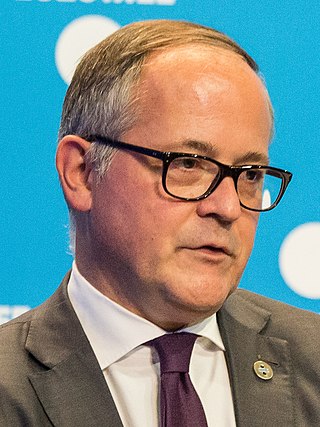
Benoît Georges Cœuré is a French economist who has been serving as President of the Autorité de la concurence since 2022. He previously served as a member of the Executive Board of the European Central Bank from 2012 to 2019.
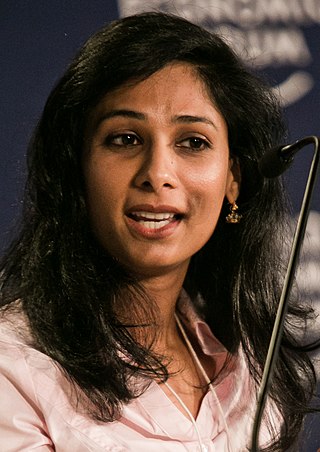
Gita Gopinath is an Indian-American economist who has served as the first deputy managing director of the International Monetary Fund (IMF), since 21 January 2022. She had previously served as chief economist of the IMF between 2019 and 2022.

YannisStournaras is a Greek economist who has been the Governor of the Bank of Greece since June 2014.

Boris Vujčić is a Croatian economist, university professor, and the Governor of the Croatian National Bank, a position he has held since 2012.

Nicoletta Batini is an Italian economist, notable as a scholar of innovative monetary and fiscal policy practices. During the crisis she pioneered the IMF work exposing the dangers of excessive fiscal austerity and designed ways to consolidate public debt successfully during phases of financial deleveraging. Since 2003 at the International Monetary Fund, she has served as Advisor of the Bank of England's Monetary Policy Committee between 2000-2003 and was Professor of Economics at the University of Surrey (2007-2012), and Director of the International Economics and Policy office of the Department of the Treasury of Italy's Ministero dell’Economia e delle Finanze (MEF) between 2013-2015. Batini's fields of expertise include monetary policy, public finance, open economy macroeconomics, labor economics, energy and environmental economics, and economic modeling. She has handled extensive consultancy roles in the public sector in advanced and emerging market countries. She holds a Ph.D. in international finance from the Scuola Superiore S. Anna and a Ph.D. in monetary economics from the University of Oxford.

Robert Holzmann is an Austrian economist and the current Governor of Austria’s central bank, the Oesterreichische Nationalbank (OeNB). His term of appointment runs from September 1, 2019, to August 31, 2025.
Pierre-Olivier Gourinchas is a French economist who has been the Chief Economist of the International Monetary Fund since 2022. Gourinchas is also the S.K. and Angela Chan Professor of Management at the University of California, Berkeley. At the University of California, he also directs the Clausen Center for International Business and Policy and is affiliated with the Haas School of Business. His research focuses on macroeconomics, in particular international macroeconomics and international finance. In 2008, Gourinchas received the Prize of the Best Young Economist of France.
Sharon Donnery is an Irish economist and financial regulator who has served as a Deputy Governor of the Central Bank of Ireland since March 2016. She served as the Governor of the Central Bank of Ireland on an acting basis from June 2019 to August 2019, having occupied increasingly senior positions in economics, consumer protection and regulatory roles since joining the body in 1996. As of 1 July 2022 she is responsible for financial regulation in Ireland. The legislation underpinning the role of the Central Bank of Ireland sets out four statutory positions: Governor, Head of Central Banking, Head of Financial Regulation and Registrar of Credit Unions. As of July 2022, Donnery has the distinction of being the only person to have held all four positions, albeit that she occupied the Governor role on an acting basis.
References
- ↑ "Governing hand: Philip Lane takes charge of Central Bank in recovering economy". Irish Times. 8 January 2016.
- ↑ The Next ECB Chief Economist Is More Than a Dove, Bloomberg, February 28, 2019
- ↑ "ECB urged to give more weight to housing in inflation fight". www.ft.com. 3 February 2020. Retrieved 3 February 2020.
- ↑ "Lagarde's Move to Top of ECB Makes Lane Her Monetary Brain". Bloomberg.com. 3 July 2019.
- ↑ "Economist Rankings | IDEAS/RePEc".
- ↑ Tornell, A.; Lane, P. R. (1999). "The Voracity Effect". American Economic Review . 89 (1): 22–46. doi:10.1257/aer.89.1.22. JSTOR 116978.
- ↑ "Trinity Research in Social Sciences (TRiSS) - Trinity College Dublin".
- ↑ Lane, P. R.; Milesi-Ferretti, G. M. "The External Wealth of Nations" (PDF). Journal of International Economics. 55: 263–294. doi:10.1016/S0022-1996(01)00102-7. S2CID 16336716.
- ↑ IHT, 1 Jun 2008
- ↑ Professor Jim Stewart; Cillian Doyle (12 January 2017). "'Section 110' Companies: A Success story for Ireland" (PDF). Trinity College, Dublin.
- ↑ "Ireland, Global Finance and the Russian Connection" (PDF). Professor Jim Stewart Cillian Doyle. 27 February 2018.
- ↑ "How Russian Firms Funnelled €100bn through Dublin". The Sunday Business Post. 4 March 2018.
- ↑ "More than €100bn in Russian Money funneled through Dublin". The Irish Times. 4 March 2018.
- ↑ "A third of Ireland's shadow banking subject to little or no oversight". The Irish Times. 10 May 2017.
- ↑ "Mortgages: How to get around the Central Bank's borrowing rules". Irish Times. 19 April 2016.
- ↑ "Borrow up to five times your income? No probs!". Irish Independent. 28 September 2014.
- ↑ "Help-to-Buy scheme fuels surge in house prices". The Irish Independent. 3 April 2017.
- ↑ "'Help-to-buy' scheme sees €24k surge in house prices". The Irish Examiner. 3 July 2017.
- ↑ Members International Monetary Fund (IMF).

