Related Research Articles

Perl is a high-level, general-purpose, interpreted, dynamic programming language. Though Perl is not officially an acronym, there are various backronyms in use, including "Practical Extraction and Reporting Language".

Randal L. Schwartz, also known as merlyn, is an American author, system administrator and programming consultant. He has written several books on the Perl programming language, and plays a promotional role within the Perl community. He was a co-host of FLOSS Weekly.
The Obfuscated Perl Contest was a competition for programmers of Perl which was held annually between 1996 and 2000. Entrants to the competition aimed to write "devious, inhuman, disgusting, amusing, amazing, and bizarre Perl code". It was run by The Perl Journal and took its name from the International Obfuscated C Code Contest.

Programming Perl, best known as the Camel Book among programmers, is a book about writing programs using the Perl programming language, revised as several editions (1991–2012) to reflect major language changes since Perl version 4. Editions have been co-written by the creator of Perl, Larry Wall, along with Randal L. Schwartz, then Tom Christiansen and then Jon Orwant. Published by O'Reilly Media, the book is considered the canonical reference work for Perl programmers. With over 1,000 pages, the various editions contain complete descriptions of each Perl language version and its interpreter. Examples range from trivial code snippets to the highly complex expressions for which Perl is widely known. The camel book editions are also noted for being written in an approachable and humorous style.

Learning Perl, also known as the llama book, is a tutorial book for the Perl programming language, and is published by O'Reilly Media. The first edition (1993) was authored solely by Randal L. Schwartz, and covered Perl 4. All subsequent editions have covered Perl 5. The second (1997) edition was coauthored with Tom Christiansen and the third (2001) edition was coauthored with Tom Phoenix. The fourth (2005), fifth (2008), sixth (2011), seventh (2016), and eighth (2021) editions were written by Schwartz, Phoenix, and brian d foy. According to the 5th edition of the book, previous editions have sold more than 500,000 copies.
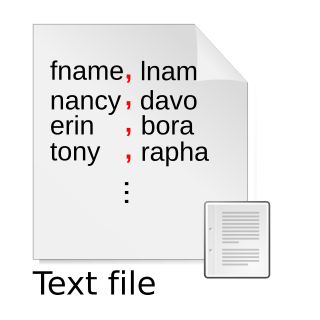
A delimiter is a sequence of one or more characters for specifying the boundary between separate, independent regions in plain text, mathematical expressions or other data streams. An example of a delimiter is the comma character, which acts as a field delimiter in a sequence of comma-separated values. Another example of a delimiter is the time gap used to separate letters and words in the transmission of Morse code.

Eggdrop is a popular IRC bot and the oldest that is still being maintained.
Infobot is a Perl IRC bot, first written in 1995 by Kevin Lenzo. The bot's main goal was to remember URLs and associate them with a descriptive name, so whenever someone needed a specific URL they could ask the bot. For that reason, the first Infobot, running in #macintosh on the EFnet IRC network, had the nickname 'url'.
Plain Old Documentation (pod) is a lightweight markup language used to document the Perl programming language as well as Perl modules and programs.

Intermediate Perl is a book about the Perl programming language by Randal L. Schwartz, brian d foy and Tom Phoenix, published in 2006 by O'Reilly Media. It was released as a retitled second edition of Learning Perl Objects, References & Modules (ISBN 0-596-00478-8) by Schwartz and Phoenix, published by O'Reilly Media in 2003 to favorable reviews. A second edition of Intermediate Perl was released in 2012.

Raku is a member of the Perl family of programming languages. Formerly named Perl 6, it was renamed in October 2019. Raku introduces elements of many modern and historical languages. Compatibility with Perl was not a goal, though a compatibility mode is part of the specification. The design process for Raku began in 2000.
"Black Perl" is a code poem written using the Perl programming language. It was posted anonymously to Usenet on April 1, 1990, and is popular among Perl programmers as a piece of Perl poetry. Written in Perl 3, the poem is able to be executed as a program.
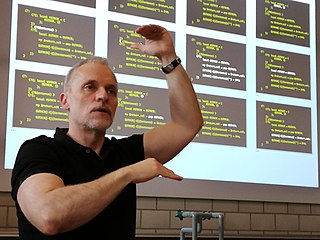
Damian Conway is a computer scientist, a member of the Perl and Raku communities, a public speaker, and the author of several books. Until 2010, he was also an adjunct associate professor in the Faculty of Information Technology at Monash University.

A LAMP is one of the most common software stacks for the web's most popular applications. Its generic software stack model has largely interchangeable components.

brian d foy [sic] is the former publisher and editor of The Perl Review, a magazine devoted to Perl and co-author of several books on Perl including Learning Perl, Intermediate Perl and Mastering Perl. He is also the founder of Perl Mongers, the founder of the White Camel Awards, a frequent speaker at conferences including The Perl Conference and YAPC. He is the author of multiple Perl modules on CPAN and maintains the perlfaq portions of the core Perl documentation. He was a partner at Stonehenge Consulting Services from 1998 to 2009.
Test::More is a unit testing module for Perl. Created and maintained by Michael G Schwern with help from Barrie Slaymaker, Tony Bowden, chromatic, Fergal Daly and perl-qa.

Chromatic is a writer and free software programmer best known for his work in the Perl programming language. He lives in Hillsboro, Oregon, United States. He wrote Extreme Programming Pocket Guide and the lead author of Perl Hacks, co-wrote Perl Testing: A Developer's Notebook, and is an uncredited contributor to The Art of Agile Development. He has a music degree. Also, he has contributed to CPAN, Perl 5, Perl 6, and Parrot.
PerlTidy is a tool written in the Perl programming language to do static code analysis against code written in that same language. It uses either command-line switches or configuration files to reformat Perl scripts so they comply with specified coding rules. The default configuration is an approximation of the Perl Style Guide.
Mojolicious is a real-time web application framework, written by Sebastian Riedel, creator of the web application framework Catalyst. Licensed as free software under the Artistic License v 2.0, it is written in the Perl programming language, and is designed for use in both simple and complex web applications, based on Riedel's previous experience developing Catalyst. Documentation for the framework was partly funded by a grant from The Perl Foundation.
The following outline is provided as an overview of and topical guide to the Perl programming language:
References
- ↑ Dominus, Mark Jason (2005). "Chapter 1: Recursion and Callbacks". Higher-Order Perl: Transforming Programs with Programs. Morgan Kaufmann. pp. 26–33. ISBN 978-1-55860-701-9.
- ↑ Jon Orwant; Jarkko Hietaniemi; John Macdonald (1999). "4: Sorting". Mastering Algorithms With Perl. O'Reilly Media. pp. 114–115. ISBN 978-1-56592-398-0.
- ↑ Standard Perl distribution: file list. Retrieved 2012-11-15.
- ↑ Vincent, Jesse. p. 160: section "Internationalization", in Chapter 10, "Development Essentials", RT Essentials. 2002. O'Reilly Media, ISBN 0596006683.
- ↑ Chapter 15, "Working with Pod", in foy, brian d (2007). Mastering Perl . Sebastopol: O'Reilly Media. ISBN 0-596-52724-1.
- ↑ Orwant, Jon (ed.), Games, Diversions & Perl Culture, 2003, O'Reilly Media, ISBN 0596003129.
- ↑ Orwant, Jon (ed.), Web, Graphics & Perl/Tk Programming, 2003, O'Reilly Media, ISBN 0596003110.
- ↑ Orwant, Jon (ed.), Computer Science & Perl Programming, 2002, O'Reilly Media, ISBN 0596003102.
