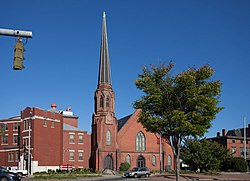
Carpenter Gothic, also sometimes called Carpenter's Gothic or Rural Gothic, is a North American architectural style-designation for an application of Gothic Revival architectural detailing and picturesque massing applied to wooden structures built by house-carpenters. The abundance of North American timber and the carpenter-built vernacular architectures based upon it made a picturesque improvisation upon Gothic a natural evolution. Carpenter Gothic improvises upon features that were carved in stone in authentic Gothic architecture, whether original or in more scholarly revival styles; however, in the absence of the restraining influence of genuine Gothic structures, the style was freed to improvise and emphasize charm and quaintness rather than fidelity to received models. The genre received its impetus from the publication by Alexander Jackson Davis of Rural Residences and from detailed plans and elevations in publications by Andrew Jackson Downing.

Roger Williams Park is an elaborately landscaped 427-acre (173 ha) city park in Providence, Rhode Island and a historic district listed on the National Register of Historic Places. The park is named after Roger Williams, the founder of the city of Providence and the primary founder of the state of Rhode Island.
Elmwood is a neighborhood in the South Side of Providence, Rhode Island. The triangular region is demarcated by Broad Street, Elmwood Avenue, and Interstate 95.
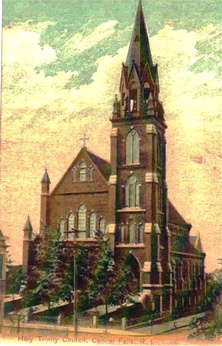
The Holy Trinity Church Complex is an historic church complex on 134 Fuller Avenue in Central Falls, Rhode Island.

St. Joseph Church is parish of the Roman Catholic Church in Cumberland, Rhode Island within the Diocese of Providence. It is known for its historic campus at 1303 Mendon Road, which includes a Gothic Revival style church, designed by James Murphy, along with two late 19th-century, clapboard-sheathed, wood-frame structures on the east side of Mendon Road. The church and its accompanying buildings were added to the National Register of Historic Places in 1982 as St. Joseph's Church Complex.

All Saints Memorial Church is a historic Episcopal church at 674 Westminster Street in Federal Hill, Providence, Rhode Island. The current church building, a large brownstone structure with a flat-topped tower, was designed by architect Edward Tuckerman Potter in a Gothic, Tudor Revival style, and built from 1869 to 1872. It is the largest Episcopal church building in the state, and its only known Potter-designed church. The accompanying (now-demolished) parish house is a Tudor Revival structure designed by Gorham Henshaw and built in 1909.

The Calvary Baptist Church is an historic church in Providence, Rhode Island.

Christ Episcopal Church was an historic Episcopal church at 909 Eddy Street in Providence, Rhode Island.

Grace Church is an historic Episcopal church at 300 Westminster Street at Mathewson Street in downtown Providence, Rhode Island. It was built in 1845–1846 and was designed by Richard Upjohn in the Gothic Revival style.
The Stimson Avenue Historic District is a residential historic district on the east side of Providence, Rhode Island. It includes all of Stimson Avenue and Diman Place, as well as adjacent properties on Angell Street on the south and Hope Street on the west, forming a relatively compact rectangular area. This area was developed roughly between 1880 and 1900, and features a collection of high-quality Queen Anne and Colonial Revival houses, with a few earlier Italianate houses at its edges. Among the finest is 19 Stimson Avenue, built in 1890 to a design by Stone, Carpenter & Willson; it is stylistically transitional between Queen Anne and Colonial Revival, featuring elaborate woodwork and a large number of exterior surface finishes, in a predominantly symmetrical Colonial Revival form. The only non-residential structure is the 1893 brick Central Congregational Church at 296 Angell Street.

St. Mary's Church of the Immaculate Conception Complex is an historic Roman Catholic church complex at 103 Pine Street in Pawtucket, Rhode Island.

St. Paul's Church is a historic Episcopal church at 50 Park Place in Pawtucket, Rhode Island. It is a stone Gothic Revival structure, designed by Sanders & Thornton of Providence and built in 1901, for a congregation established in 1816. The property also includes a Guild Hall, built in the Tudor Revival style in 1915, and a 1963 brick office wing. A Revere bell hangs in the church belfry.
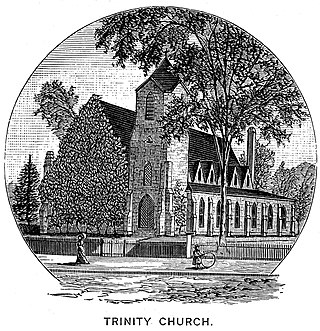
Trinity Episcopal Church was a historic church located at 48 Main Street in Pawtucket, Rhode Island. Built by the Episcopalians, the building was sold to the Catholics in 1977 and became the St. George Maronite Catholic Church within the Maronite Catholic Eparchy of Saint Maron of Brooklyn. The church burned down in 2005, and was not rebuilt.

St. Matthew's Church, currently known as the Holy Spirit Parish, is an historic Roman Catholic church at 1030 Dexter Street in Central Falls, Rhode Island located within the Diocese of Providence.
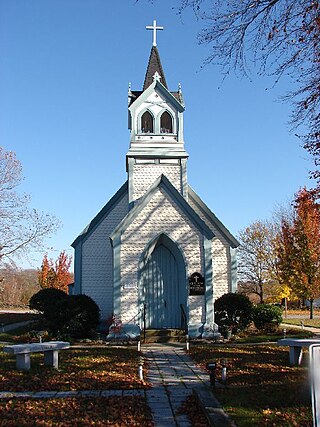
The Church of the Holy Cross in Middletown, Rhode Island, is a parish church of the Episcopal Diocese of Rhode Island of The Episcopal Church. The church is located at 1439 West Main Road, Middletown, Rhode Island. It is an early example of Richard Upjohn's work in translating Gothic architecture from stone to affordable designs for small, wooden churches. Built in 1845, Holy Cross Church exemplifies the architecture made accessible by the publication in 1852 of Upjohn's book, Rural Architecture. In its survey of Middletown's architectural resources, the Rhode Island Historical Preservation Commission recommended the Church of the Holy Cross for inclusion in the National Register, along with Upjohn's more luxurious Italianate Hamilton Hoppin House.

Stephen Carpenter Earle was an architect who designed a number of buildings in Massachusetts and Connecticut that were built in the late 19th century, with many in Worcester, Massachusetts. He trained in the office of Calvert Vaux in New York City. He worked for a time in partnership with James E. Fuller, under the firm "Earle & Fuller". In 1891, he formed a partnership with Vermont architect Clellan W. Fisher under the name "Earle & Fisher".

Clifton A. Hall (1826-1913) was an American architect from Providence, Rhode Island.

Alpheus C. Morse (1818-1893) was an American architect with offices in Providence, Rhode Island.
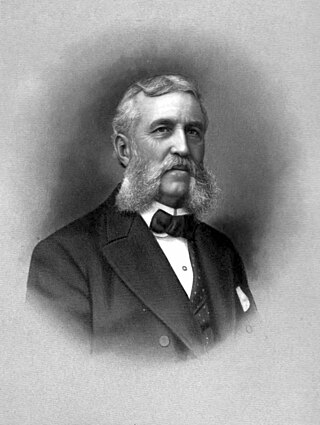
Edward I. Nickerson (1845–1908) was an American architect from Providence, Rhode Island, known for his work in the Queen Anne style in Providence.

The Plymouth Congregational Church is an historic church building at 1014 Broad Street in Providence, Rhode Island. Completed in 1919 for a congregation founded in 1878, it is a well-preserved example of late Gothic Revival architecture, designed by Boston architect George F. Newton. Since 2016, the building has been home to the Iglesia Visión Evangélica congregation. It was listed on the National Register of Historic Places in 2021.