Related Research Articles
The Sepik–Ramu languages are an obsolete language family of New Guinea linking the Sepik, Ramu, Nor–Pondo, Leonhard Schultze (Walio–Papi) and Yuat families, together with the Taiap language isolate, and proposed by Donald Laycock and John Z'graggen in 1975.
The Ramu–Lower Sepika.k.a.Lower Sepik–Ramu languages are a proposed family of about 35 Papuan languages spoken in the Ramu and Sepik river basins of northern Papua New Guinea. These languages tend to have simple phonologies, with few consonants or vowels and usually no tones.

The Sepik or Sepik River languages are a family of some 50 Papuan languages spoken in the Sepik river basin of northern Papua New Guinea, proposed by Donald Laycock in 1965 in a somewhat more limited form than presented here. They tend to have simple phonologies, with few consonants or vowels and usually no tones.
The Yuat languages are an independent family of five Papuan languages spoken along the Yuat River in East Sepik Province, Papua New Guinea. They are an independent family in the classification of Malcolm Ross, but are included in Stephen Wurm's Sepik–Ramu proposal. However, Foley and Ross could find no lexical or morphological evidence that they are related to the Sepik or Ramu languages.
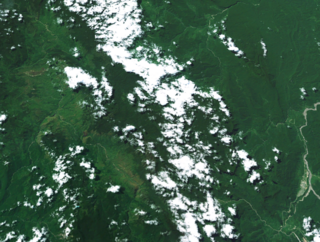
The Star Mountains are a mountain range in eastern end of Highland Papua, Indonesia and the western Papua New Guinea, stretching from the eastern end of Indonesia to the Hindenburg Range in Papua New Guinea.
Haruai is one of two languages of the Piawi family of New Guinea. The language has borrowings from Kalam. Young men are likely to know Kobon and Tok Pisin, but many Haruai are monolingual. Haruai is also commonly known as Waibuk, also Wiyaw, Wovan, Taman.

The Lower Sepik a.k.a. Nor–Pondo languages are a small language family of East Sepik Province in northern Papua New Guinea. They were identified as a family by K Laumann in 1951 under the name Nor–Pondo, and included in Donald Laycock's now-defunct 1973 Sepik–Ramu family.

The Middle Sepik languages comprise diverse groups of Sepik languages spoken in northern Papua New Guinea. The Middle Sepik grouping is provisionally accepted by Foley (2018) based on shared innovations in pronouns, but is divided by Glottolog. They are spoken in areas surrounding the town of Ambunti in East Sepik Province.

The Maimai languages constitute a branch of the Torricelli language family. They are spoken just to the west of Nuku town in eastern Sandaun Province, Papua New Guinea.
The Yellow River languages are a small family of clearly related languages,
The Iwam languages are a small family of two clearly related languages, May River Iwam and Sepik Iwam are generally classified among the Sepik languages of northern Papua New Guinea; Malcolm Ross places them in an Upper Sepik branch of that family.
The Nukuma languages are a small family of three clearly related languages:
The Mongol–Langam, Koam, or Ulmapo languages are a language group of Keram Rural LLG, East Sepik Province, Papua New Guinea belonging to the Ramu language family. Foley (2018) includes them within the Grass languages, but they were not included in Foley (2005).
The Arafundi languages are a small family of clearly related languages in East Sepik Province, Papua New Guinea. They are conjectured to be related to the Piawi and Madang languages. They are named after the Arafundi River.
The Lower Ramu or Ottilien–Misegian languages consist of two branches in the Ramu language family. They are all spoken in Yawar Rural LLG, Madang Province, Papua New Guinea.
Kambota.k.a.Ap Ma, is a Keram language of Papua New Guinea. Compared to its nearest relative, Ambakich, Kambot drops the first segment from polysyllabic words.
The Marienberg or Marienberg Hills languages are a branch of the Torricelli language family. They are spoken in a mountainous stretch of region located between the towns of Wewak and Angoram in the Marienberg Hills of East Sepik Province, Papua New Guinea.
The Wogamus languages are a pair of closely related languages, Wogamusin and Chenapian.
The One or West Wapei languages constitute a branch of the Torricelli language family. They are spoken in north-central Sandaun Province, Papua New Guinea.
Gapun is a village in Marienberg Rural LLG, East Sepik Province, Papua New Guinea, located near the mouth of the Sepik River. The language isolate Tayap is traditionally spoken in Gapun by the Tayap people. Gapun village is the sole Tayap settlement, while all other neighboring villages are inhabited by non-related ethnic groups. The sociolinguistic history of the village has been presented in textbooks as a case study on how and why language shift and language death occur.
References
- ↑ "GU4800: Language and Society | W. Foley | Science and Society". scienceandsociety.columbia.edu. Retrieved 2021-11-06.
- ↑ Foley, William (1997). Anthropological Linguistics (in English and Chinese). Wiley. ISBN 978-0-631-15122-7.
- ↑ "Fellow Profile: William Foley". Australian Academy of the Humanities. Retrieved 2024-04-27.


