The Special Operations Executive (SOE) was a secret British World War II organisation. It was officially formed on 22 July 1940 under Minister of Economic Warfare, Hugh Dalton, by the amalgamation of three existing secret organisations. Its purpose was to conduct espionage, sabotage and reconnaissance in occupied Europe against the Axis powers, and to aid local resistance movements.
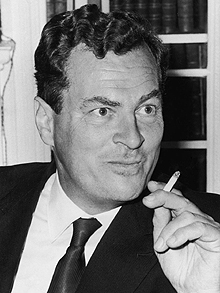
Sir Patrick Michael Leigh Fermor was an English writer, scholar, soldier and polyglot. He played a prominent role in the Cretan resistance during the Second World War, and was widely seen as Britain's greatest living travel writer, on the basis of books such as A Time of Gifts (1977). A BBC journalist once termed him "a cross between Indiana Jones, James Bond and Graham Greene".

In Albania, World War II began with its invasion by Italy in April 1939. Fascist Italy set up Albania as its protectorate or puppet state. The resistance was largely carried out by Communist groups against the Italian and then German occupation in Albania. At first independent, the Communist groups united in the beginning of 1942, which ultimately led to the successful liberation of the country in 1944.
Alexander Wallace Fielding was a British author, translator, journalist and traveller, who served as a Special Operations Executive (SOE) agent in Crete, France and East Asia during World War II. The purpose of SOE was to conduct espionage, sabotage and reconnaissance in occupied Europe and Asia against the Axis powers, especially Nazi Germany.
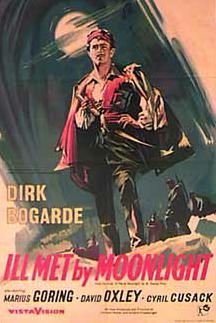
Ill Met by Moonlight (1957), released in the USA as Night Ambush, is a film by the British writer-director-producer team of Michael Powell and Emeric Pressburger, and the last movie they made together through their production company "The Archers". The film, which stars Dirk Bogarde and features Marius Goring, David Oxley, and Cyril Cusack, is based on the 1950 book Ill Met by Moonlight: The Abduction of General Kreipe by W. Stanley Moss, which is an account of events during the author's service on Crete during World War II as an agent of the Special Operations Executive (SOE). The title is a quotation from Shakespeare's A Midsummer Night's Dream, and the book features the young agents' capture and evacuation of the German general Heinrich Kreipe.
During World War II, resistance movement occurred in German-occupied Europe by a variety of means, ranging from non-cooperation to propaganda, hiding crashed pilots and even to outright warfare and the recapturing of towns. In many countries, resistance movements were sometimes also referred to as The Underground.

Harold Julian Amery, Baron Amery of Lustleigh, was a British Conservative Party politician, who served as a Member of Parliament (MP) for 39 of the 42 years between 1950 and 1992. He was appointed to the Privy Council in 1960.

Ivan William Stanley Moss MC, commonly known as W. Stanley Moss or Billy Moss, was a British army officer in World War II, and later a successful writer, broadcaster, journalist, and traveller. He served with the Coldstream Guards and the Special Operations Executive (SOE) and is best known for the Kidnap of General Kreipe. He was a best-selling author in the 1950s, based on his novels and books about his wartime service. His SOE years are featured in Ill Met by Moonlight: The Abduction of General Kreipe, and A War of Shadows. Moss travelled around the world, including Antarctica to meet the Commonwealth Trans-Antarctic Expedition.

The Cretan resistance was a resistance movement against the occupying forces of Nazi Germany and Fascist Italy by the residents of the Greek island of Crete during World War II. Part of the larger Greek resistance, it lasted from 20 May 1941, when the German Wehrmacht invaded the island in the Battle of Crete, until the spring of 1945 when they surrendered to the British. For the first time during World War II, attacking German forces faced in Crete a substantial resistance from the local population. In the Battle of Crete, Cretan civilians picked off paratroopers or attacked them with knives, axes, scythes or even bare hands. As a result, many casualties were inflicted upon the invading German paratroopers during the battle.
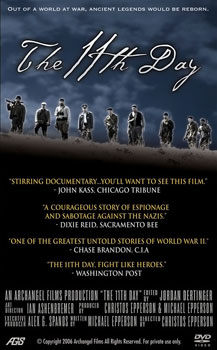
The 11th Day: Crete 1941 is a 2005 documentary film featuring eyewitness accounts from survivors of the Battle of Crete during World War II. The film was created by producer-director Christos Epperson and writer-producer Michael Epperson, and funded by Alex Spanos. Among the eyewitnesses interviewed are British SOE operative and famous travel writer Patrick Leigh Fermor, along with George Doundoulakis, and Cretan Resistance hero George Tzitzika. The film also includes historical commentary and analysis by Chase Brandon of the CIA and Professor Andre Gerolymatos of Simon Fraser University.

Sharky's Machine is a 1981 American neo-noir action thriller film directed by Burt Reynolds, who stars in the title role. It is an adaptation of William Diehl's first novel Sharky's Machine (1978) with a screenplay by Gerald Di Pego. It also stars Vittorio Gassman, Brian Keith, Charles Durning, Earl Holliman, Bernie Casey, Henry Silva, Darryl Hickman, Richard Libertini, Rachel Ward and Joseph Mascolo.

Karl Heinrich Georg Ferdinand Kreipe was a German career soldier who served in both World War I and World War II. While leading German forces in occupied Crete in April 1944, he was abducted by British SOE officers Patrick Leigh Fermor and William Stanley Moss, with the support of the Cretan resistance.
Lieutenant-Colonel Neil Loudon Desmond McLean, DSO**, known as Billy McLean, was a Scottish politician and intelligence officer in the British Army. During World War II, he worked for the Special Operations Executive and was involved in clandestine missions in Ethiopia, China, and particularly Albania. In 1954 he served as a Unionist Member of Parliament for Inverness.

Colonel David de Crespigny Smiley, was a British special forces and intelligence officer. He fought in the Second World War in Palestine, Iraq, Persia, Syria, the Western Desert and with Special Operations Executive (SOE) in Albania and Thailand.

The kidnapping of Heinrich Kreipe was an operation executed jointly by the British Special Operations Executive (SOE) and local resistance members in Crete in German-occupied Greece during the Second World War. The operation was launched on 4 February 1944, when SOE officer Patrick Leigh Fermor landed in Crete with the intention of abducting notorious war criminal and commander of 22nd Air Landing Division, Friedrich-Wilhelm Müller. By the time of the arrival of the rest of the abduction team, led by William Stanley Moss, two months later, Müller had been succeeded by Heinrich Kreipe, who was chosen as the new target.

Sophie Moss, was a Polish noblewoman and World War II organiser. At the request of General Władysław Sikorski, Poland's wartime leader, she founded the Cairo branch of the Polish Red Cross.

Ill Met by Moonlight: The Abduction of General Kreipe is a non-fiction partly-autobiographical book written by W. Stanley Moss, a British soldier, writer and traveller. It describes an operation in Crete during the Second World War to capture German general Heinrich Kreipe. Moss kept a diary during the war years and based his book on it. The 2014 edition includes an introduction by one of Moss's children and an afterword by Patrick Leigh Fermor.
Dennis John Ciclitira was a British soldier and businessman of Greek descent.
George James Doundoulakis was a Greek American physicist and soldier who worked under British Intelligence during World War II with SOE agent Patrick Leigh Fermor, and then served with the OSS in Thessaly, Greece.
The Patrick Leigh Fermor Archive is a collection of over 10,000 items of correspondence, literary manuscripts, articles and research papers, diaries, passports, sketches and photographs relating to Sir Patrick 'Paddy' Leigh Fermor, a British author, scholar, veteran, and adventurer. The bulk of the collection, the Papers of Patrick Leigh Fermor, was purchased by the National Library of Scotland (NLS) in 2012 from Fermor's estate, using funds donated by the John R. Murray Charitable Trust, and is housed at the Library's main building on George IV Bridge in Edinburgh, Scotland. It was made available to the general public in November 2014.


