See also
 | This disambiguation page lists articles associated with the title 桂. If an internal link led you here, you may wish to change the link to point directly to the intended article. |
桂 (pinyin: guì) may refer to:
| | This disambiguation page lists articles associated with the title 桂. If an internal link led you here, you may wish to change the link to point directly to the intended article. |

The graphical user interface is a form of user interface that allows users to interact with electronic devices through graphical icons and audio indicator such as primary notation, instead of text-based user interfaces, typed command labels or text navigation. GUIs were introduced in reaction to the perceived steep learning curve of command-line interfaces (CLIs), which require commands to be typed on a computer keyboard.

In computing, a window is a graphical control element. It consists of a visual area containing some of the graphical user interface of the program it belongs to and is framed by a window decoration. It usually has a rectangular shape that can overlap with the area of other windows. It displays the output of and may allow input to one or more processes.
A widget toolkit, widget library, GUI toolkit, or UX library is a library or a collection of libraries containing a set of graphical control elements used to construct the graphical user interface (GUI) of programs.

Swing is a GUI widget toolkit for Java. It is part of Oracle's Java Foundation Classes (JFC) – an API for providing a graphical user interface (GUI) for Java programs.

Apple Computer, Inc. v. Microsoft Corporation, 35 F.3d 1435, was a copyright infringement lawsuit in which Apple Computer, Inc. sought to prevent Microsoft and Hewlett-Packard from using visual graphical user interface (GUI) elements that were similar to those in Apple's Lisa and Macintosh operating systems. The court ruled that, "Apple cannot get patent-like protection for the idea of a graphical user interface, or the idea of a desktop metaphor [under copyright law]...". In the midst of the Apple v. Microsoft lawsuit, Xerox also sued Apple alleging that Mac's GUI was heavily based on Xerox's. The district court dismissed Xerox's claims without addressing whether Apple's GUI infringed Xerox's. Apple lost all claims in the Microsoft suit except for the ruling that the trash can icon and folder icons from Hewlett-Packard's NewWave windows application were infringing. The lawsuit was filed in 1988 and lasted four years; the decision was affirmed on appeal in 1994, and Apple's appeal to the U.S. Supreme Court was denied.

In computer chess, a chess engine is a computer program that analyzes chess or chess variant positions, and generates a move or list of moves that it regards as strongest. A chess engine is usually a back end with a command-line interface with no graphics or windowing. Engines are usually used with a front end, a windowed graphical user interface such as Chessbase or WinBoard that the user can interact with via a keyboard, mouse or touchscreen. This allows the user to play against multiple engines without learning a new user interface for each, and allows different engines to play against each other. Over the last years, there are chess engines available for mobile phones and tablets, which makes their usage easier. The list includes chess engines like Stockfish, Komodo, Texel, Bagatur and many others.

Aviatyrannis is a genus of carnivorous tyrannosauroid theropod dinosaur from the Kimmeridgian stage of the Late Jurassic found in Portugal.

PyQt is a Python binding of the cross-platform GUI toolkit Qt, implemented as a Python plug-in. PyQt is free software developed by the British firm Riverbank Computing. It is available under similar terms to Qt versions older than 4.5; this means a variety of licenses including GNU General Public License (GPL) and commercial license, but not the GNU Lesser General Public License (LGPL). PyQt supports Microsoft Windows as well as various flavours of UNIX, including Linux and MacOS.

WebGUI is an open-source content management system written in Perl and released under the GNU General Public License.
A graphical user interface builder, also known as GUI designer, is a software development tool that simplifies the creation of GUIs by allowing the designer to arrange graphical control elements using a drag-and-drop WYSIWYG editor. Without a GUI builder, a GUI must be built by manually specifying each widget's parameters in source-code, with no visual feedback until the program is run.
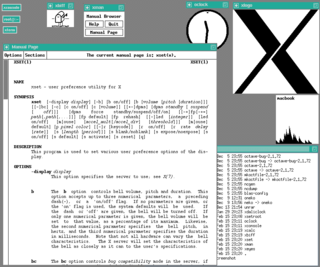
In computing, a shell is a user interface for access to an operating system's services. In general, operating system shells use either a command-line interface (CLI) or graphical user interface (GUI), depending on a computer's role and particular operation. It is named a shell because it is the outermost layer around the operating system.
Emperor Daowu of Northern Wei ( 魏道武帝) (371–409), personal name Tuoba Gui (拓拔珪), né Tuoba Shegui (拓拔渉珪), was the founding emperor of the Northern Wei. He was the grandson of the last prince of Dai, Tuoba Shiyijian, and after the fall of the Dai state to Former Qin in 376 had been presumed to be the eventual successor to the Dai throne. After Former Qin fell into disarray in 383 following its defeat by Jin forces at the Battle of Fei River, Tuoba Gui took the opportunity to reestablish Dai in 386, but soon changing the state's name to Wei and declared himself a prince. He was initially a vassal of Later Yan. However, after he defeated the Later Yan emperor Murong Bao in 397 and seized most of Later Yan's territory, he claimed imperial title in 398.
Lou Gui, courtesy name Zibo, was an official and adviser serving under the warlord Cao Cao during the late Eastern Han dynasty of China.

The Name of the Rose is a 1986 Italian-French-German mystery historical drama film directed by Jean-Jacques Annaud, based on the novel of the same name by Umberto Eco. Sean Connery stars as the Franciscan friar William of Baskerville, called upon to solve a deadly mystery in a medieval abbey, and Christian Slater is his apprentice Adso of Melk.
wxHaskell is a portable and native GUI library for Haskell, built on wxWidgets. It is often used by those wanting to develop a GUI with a functional language.

In Korean cuisine, gui or guee is a grilled dish. Gui most commonly has meat or fish as the primary ingredient, but may in some cases also have grilled vegetables or other vegetarian ingredients. The term derives from the verb gupda (굽다), which literally means "grill". At traditional restaurants, meats are cooked at the center of the table over a charcoal grill, surrounded by various banchan and individual rice bowls. The cooked meat is then cut into small pieces and wrapped with fresh lettuce leaves, with rice, thinly sliced garlic, ssamjang, and other seasonings. The suffix gui is often omitted in the names of meat-based gui such as galbi, whose name is originally galbi gui.

Hollywood is a commercially distributed programming language developed by Andreas Falkenhahn which mainly focuses on the creation of multimedia-oriented applications. Hollywood is available for AmigaOS, MorphOS, WarpOS, AROS, Windows, macOS, Linux, Android, and iOS. Hollywood has an inbuilt cross compiler that can automatically save executables for all platforms supported by the software. The generated executables are completely stand-alone and do not have any external dependencies, so they can also be started from a USB flash drive. An optional add-on also allows users to compile projects into APK files.

GNOME Calculator, formerly known as gcalctool, is the software calculator integrated with the GNOME desktop environment. It is programmed in C and Vala and part of the GNOME Core Applications.
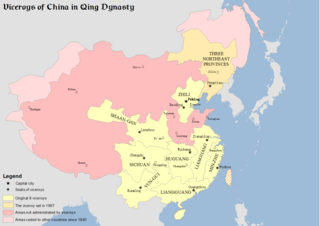
The Viceroy of Yun-Gui, fully referred to in Chinese as the Governor-General of Yunnan and Guizhou Provinces and the Surrounding Areas Overseeing Military Affairs and Food Production, Director of Civil Affairs, was one of eight regional viceroys in China proper during the Qing dynasty. The Viceroy controlled Yunnan and Guizhou (Kweichow) provinces.
Gui Minhai, also known as Michael Gui, is a Chinese-born Swedish book publisher and writer. He is an author of many books related to Chinese politics and Chinese political figures; Gui authored around 200 books during his ten-year career under the pen-name Ah Hai (阿海). and is one of three shareholders of Causeway Bay Books in Hong Kong.