Related Research Articles

In electronics, a wafer is a thin slice of semiconductor, such as a crystalline silicon, used for the fabrication of integrated circuits and, in photovoltaics, to manufacture solar cells.

An ingot is a piece of relatively pure material, usually metal, that is cast into a shape suitable for further processing. In steelmaking, it is the first step among semi-finished casting products. Ingots usually require a second procedure of shaping, such as cold/hot working, cutting, or milling to produce a useful final product. Non-metallic and semiconductor materials prepared in bulk form may also be referred to as ingots, particularly when cast by mold based methods. Precious metal ingots can be used as currency, or as a currency reserve, as with gold bars.

Photovoltaics (PV) is the conversion of light into electricity using semiconducting materials that exhibit the photovoltaic effect, a phenomenon studied in physics, photochemistry, and electrochemistry. The photovoltaic effect is commercially used for electricity generation and as photosensors.
An epitaxial wafer is a wafer of semiconducting material made by epitaxial growth (epitaxy) for use in photonics, microelectronics, spintronics, or photovoltaics. The epi layer may be the same material as the substrate, typically monocrystaline silicon, or it may be a silicon dioxide (SoI) or a more exotic material with specific desirable qualities. The purpose of epitaxy is to perfect the crystal structure over the bare substrate below and improve the wafer surface's electrical characteristics, making it suitable for highly complex microprocessors and memory devices.
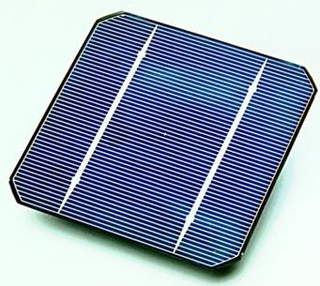
A solar cell or photovoltaic cell is an electronic device that converts the energy of light directly into electricity by means of the photovoltaic effect. It is a form of photoelectric cell, a device whose electrical characteristics vary when it is exposed to light. Individual solar cell devices are often the electrical building blocks of photovoltaic modules, known colloquially as "solar panels". Almost all commercial PV cells consist of crystalline silicon, with a market share of 95%. Cadmium telluride thin-film solar cells account for the remainder. The common single-junction silicon solar cell can produce a maximum open-circuit voltage of approximately 0.5 to 0.6 volts.
Third-generation photovoltaic cells are solar cells that are potentially able to overcome the Shockley–Queisser limit of 31–41% power efficiency for single bandgap solar cells. This includes a range of alternatives to cells made of semiconducting p-n junctions and thin film cells. Common third-generation systems include multi-layer ("tandem") cells made of amorphous silicon or gallium arsenide, while more theoretical developments include frequency conversion,, hot-carrier effects and other multiple-carrier ejection techniques.

Solar power, also known as solar electricity, is the conversion of energy from sunlight into electricity, either directly using photovoltaics (PV) or indirectly using concentrated solar power. Solar panels use the photovoltaic effect to convert light into an electric current. Concentrated solar power systems use lenses or mirrors and solar tracking systems to focus a large area of sunlight to a hot spot, often to drive a steam turbine.

Yingli, formally Yingli Green Energy Holding Company Limited -. Yingli Green Energy Holding Company Limited, known as "Yingli Solar," is a solar panel manufacturer. Yingli Green Energy's manufacturing covers the photovoltaic value chain from ingot casting and wafering through solar cell production and solar panel assembly. Yingli's photovoltaic module capacity is 30 GWs.
Bosch Solar Energy AG was a German solar wafer and solar cell manufacturer, based in Erfurt, which specialized in crystalline silicon-based photovoltaic (PV) products, as well as thin-film modules using amorphous silicon and CIGS absorber materials. The company consisted of various divisions for silicon, wafers, solar cells and modules, research and production facilities in Germany and France and plans were made to open a production line in Malaysia. It has been listed on the German stock exchange since 30 September 2005 and on 19 December 2005 its shares were admitted to the TecDAX. The enterprise was founded in 1997 as ErSol Solarstrom GmbH & Co. KG.
PV Crystalox Solar plc is a supplier to solar cell manufacturers, producing multicrystalline silicon wafers for use in solar electricity generation systems. It has operations in Germany, United Kingdom and Japan and its headquarters are in the United Kingdom. It is listed on the London Stock Exchange and was a former constituent of the FTSE 250 Index.
SunEdison, Inc. is a renewable energy company headquartered in the U.S. In addition to developing, building, owning, and operating solar power plants and wind energy plants, it also manufactures high-purity polysilicon, monocrystalline silicon ingots, silicon wafers, solar modules, solar energy systems, and solar module racking systems. Originally a silicon-wafer manufacturer established in 1959 as the Monsanto Electronic Materials Company, the company was sold by Monsanto in 1989.
Silicor Materials Inc. is a privately held manufacturer of solar silicon and aluminum alloy. Silicor is headquartered in San Jose, California, and its silicon purification operations are performed by its wholly owned subsidiary, Silicor Materials Canada Inc., in Ontario, Canada. Silicor also has a research and development facility in Berlin, Germany, and is currently building a commercial manufacturing facility in the port of Grundartangi, Iceland. The facility will have a nameplate capacity of 16,000 metric tons, with the ability to yield up to 19,000 metric tons of solar silicon each year. To date, more than 20 million solar cells have been made with Silicor's solar silicon.
Monocrystalline silicon, more often called single-crystal silicon, in short mono c-Si or mono-Si, is the base material for silicon-based discrete components and integrated circuits used in virtually all modern electronic equipment. Mono-Si also serves as a photovoltaic, light-absorbing material in the manufacture of solar cells.

Thin-film solar cells are a type of solar cell made by depositing one or more thin layers of photovoltaic material onto a substrate, such as glass, plastic or metal. Thin-film solar cells are typically a few nanometers (nm) to a few microns (μm) thick–much thinner than the wafers used in conventional crystalline silicon (c-Si) based solar cells, which can be up to 200 μm thick. Thin-film solar cells are commercially used in several technologies, including cadmium telluride (CdTe), copper indium gallium diselenide (CIGS), and amorphous thin-film silicon.

Crystalline silicon or (c-Si) is the crystalline forms of silicon, either polycrystalline silicon, or monocrystalline silicon. Crystalline silicon is the dominant semiconducting material used in photovoltaic technology for the production of solar cells. These cells are assembled into solar panels as part of a photovoltaic system to generate solar power from sunlight.
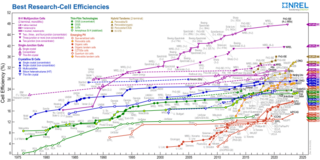
There are currently many research groups active in the field of photovoltaics in universities and research institutions around the world. This research can be categorized into three areas: making current technology solar cells cheaper and/or more efficient to effectively compete with other energy sources; developing new technologies based on new solar cell architectural designs; and developing new materials to serve as more efficient energy converters from light energy into electric current or light absorbers and charge carriers.
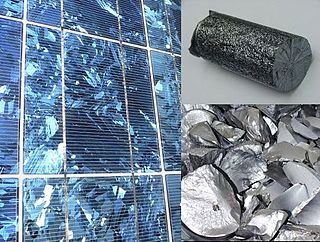
Polycrystalline silicon, or multicrystalline silicon, also called polysilicon, poly-Si, or mc-Si, is a high purity, polycrystalline form of silicon, used as a raw material by the solar photovoltaic and electronics industry.
Inkjet solar cells are solar cells manufactured by low-cost, high tech methods that use an inkjet printer to lay down the semiconductor material and the electrodes onto a solar cell substrate.

LONGi Green Energy Technology Co. Ltd. or LONGi Group (隆基股份), formerly Xi'an Longi Silicon Materials Corporation, is a Chinese photovoltaics company, a major manufacturer of solar modules and a developer of solar power projects.

Olga Malinkiewicz is a Polish physicist, inventor of a method of producing solar cells based on perovskites using inkjet printing. She is a co-founder and the Chief Technology Officer at Saule Technologies.
References
- ↑ "1366 Technologies and Hunt Perovskite Technologies Announce Merger". cubicpv.com. 28 June 2021. Archived from the original on 28 June 2021. Retrieved 11 July 2021.
- 1 2 3 4 Wald, Matthew L. "A Cheaper Route to Solar Cells", The New York Times , October 19, 2010. Accessed October 19, 2010.
- ↑ Staff. "1366 Technologies to offer its texturing and fine-line metallization through RENA, plans production of lower cost silicon" Archived 2011-07-12 at the Wayback Machine , i-micronews, October 15, 2010. Accessed October 19, 2010.
- ↑ Biello, David. "Sunshine is free, so can photovoltaics be cheap?", Scientific American , March 10, 2010. Accessed October 19, 2010.
- ↑ "1366 Technologies Aims To Slash Solar Wafer Costs 50% And Make Solar Cheaper Than Coal". Forbes. Retrieved 2015-12-01.
- ↑ Kelly-Detwiler, Peter. "1366 Technologies Aims to Slash Wafer Costs 50% and Make Solar Cheaper than Coal" November 23, 2015.