Related Research Articles

The president of the United States (POTUS) is the head of state and head of government of the United States. The president directs the executive branch of the federal government and is the commander-in-chief of the United States Armed Forces.

Theodore Roosevelt Jr., also known as Teddy or T. R., was the 26th president of the United States, serving from 1901 to 1909. He previously was involved in New York politics, including serving as the state's 33rd governor for two years. He was the vice president under President William McKinley for six months in 1901, assuming the presidency after McKinley's assassination. As president, Roosevelt emerged as a leader of the Republican Party and became a driving force for anti-trust and Progressive policies.

William Howard Taft was the 27th president of the United States and the tenth chief justice of the United States, the only person to have held both offices. Taft was elected president in 1908 as a Republican and defeated for reelection in 1912 by Democratic nominee Woodrow Wilson in a three-way race that included former president Theodore Roosevelt. In 1921, President Warren G. Harding appointed Taft to be chief justice, a position he held until 1930.

The State of the Union Address is an annual message delivered by the president of the United States to a joint session of the United States Congress near the beginning of most calendar years on the current condition of the nation. The State of the Union Address generally includes reports on the nation's budget, economy, news, agenda, progress, achievements and the president's priorities and legislative proposals.
The Pendleton Civil Service Reform Act is a United States federal law passed by the 47th United States Congress and signed into law by President Chester A. Arthur on January 16, 1883. The act mandates that most positions within the federal government should be awarded on the basis of merit instead of political patronage.
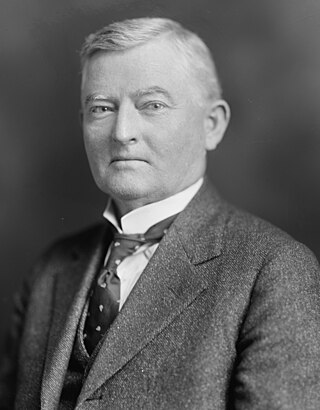
John Nance Garner III, known among his contemporaries as "Cactus Jack", was an American politician and lawyer who served as the 32nd vice president of the United States from 1933 to 1941 under President Franklin D. Roosevelt. A member of the Democratic Party, Garner served as the 39th speaker of the United States House of Representatives from 1931 to 1933, having been a United States representative from Texas from 1903 to 1933. Garner and Schuyler Colfax are the only politicians to have served as presiding officers of both chambers of the United States Congress — as speaker of the House and vice president of the United States.

The White House chief of staff is the head of the Executive Office of the President of the United States, a cabinet position in the federal government of the United States.
The Emergency Banking Act (EBA) (the official title of which was the Emergency Banking Relief Act), Public Law 73-1, 48 Stat. 1 (March 9, 1933), was an act passed by the United States Congress in March 1933 in an attempt to stabilize the banking system.

The Second Bill of Rights or Bill of Economic Rights was proposed by United States President Franklin D. Roosevelt during his State of the Union Address on Tuesday, January 11, 1944. In his address, Roosevelt suggested that the nation had come to recognise and should now implement a "Second bill of rights". Roosevelt argued that the "political rights" guaranteed by the Constitution and the Bill of Rights had "proved inadequate to assure us equality in the pursuit of happiness". His remedy was to declare an "economic bill of rights" to guarantee these specific rights:
The powers of the president of the United States include those explicitly granted by Article II of the United States Constitution as well as those granted by Acts of Congress, implied powers, and also a great deal of soft power that is attached to the presidency.
The presidency of Theodore Roosevelt started on September 14, 1901, when Theodore Roosevelt became the 26th president of the United States upon the assassination of President William McKinley, and ended on March 4, 1909. Roosevelt had been the vice president for only 194 days when he succeeded to the presidency. A Republican, he ran for and won by a landslide a four-year term in 1904. He was succeeded by his protégé and chosen successor, William Howard Taft.

The first inauguration of Franklin D. Roosevelt as the 32nd president of the United States was held on Saturday, March 4, 1933, at the East Portico of the United States Capitol in Washington, D.C. This was the 37th inauguration, and marked the commencement of the first term of Franklin D. Roosevelt as president and John Nance Garner as vice president.

The Secretary to the President is a long-standing position in the United States government, known by many different titles during its history.

The first 100 days of the Franklin D. Roosevelt presidency began on March 4, 1933, the day Franklin D. Roosevelt was inaugurated as the 32nd president of the United States. He had signaled his intention to move with unprecedented speed to address the problems facing the nation in his inaugural address, declaring: "I am prepared under my constitutional duty to recommend the measures that a stricken nation in the midst of a stricken world may require." Roosevelt's specific priorities at the outset of his presidency were getting Americans back to work, protecting their savings and creating prosperity, providing relief for the sick and elderly, and getting industry and agriculture back on their feet.
The 1939 State of the Union Address was given to the 76th United States Congress, on Wednesday, January 4, 1939, by Franklin D. Roosevelt, the 32nd United States president. Foreseeing World War II, he said, "In Reporting on the state of the nation, I have felt it necessary on previous occasions to advise the Congress of disturbance abroad and of the need of putting our own house in order in the face of storm signals from across the seas. As this Seventy-sixth Congress opens there is need for further warning. A war which threatened to envelop the world in flames has been averted; but it has become increasingly clear that world peace is not assured." On September 1, 1939, the War in Europe began.
The 1829 State of the Union Address was delivered by the 7th President of the United States, Andrew Jackson, on December 8, 1829, to the 21st United States Congress. This was Jackson's first address to Congress after his election, and it set the tone for his presidency, emphasizing limited government, states’ rights, and the removal of Native Americans from their lands.
The presidency of Theodore Roosevelt began on September 14, 1901, when Theodore Roosevelt was inaugurated as the 26th president of the United States following the assassination of William McKinley, and it ended on March 4, 1909.
The 1903 State of the Union Address was submitted on Monday, December 7, 1903, by the 26th president of the United States, Theodore Roosevelt, to both houses of the 58th United States Congress.
The 1870 State of the Union address was delivered by the 18th President of the United States Ulysses S. Grant on December 5, 1870, to the 41st United States Congress. This was Grant’s second annual message, emphasizing Reconstruction, foreign relations, and domestic reforms.
The 1879 State of the Union address was delivered by the 19th president of the United States, Rutherford B. Hayes, to the 46th United States Congress on December 1, 1879, in the House Chamber of the United States Capitol in Washington, D.C. Speaker of the House, Samuel J. Randall, and Vice President William A. Wheeler presided over the joint session.
References
- ↑ "Joint Meetings, Joint Sessions, & Inaugurations | US House of Representatives: History, Art & Archives". history.house.gov. Retrieved 21 October 2024.
- ↑ "Second Annual Message | The American Presidency Project". www.presidency.ucsb.edu. Retrieved 2024-12-02.