Related Research Articles
The Communications Assistance for Law Enforcement Act (CALEA), also known as the "Digital Telephony Act," is a United States wiretapping law passed in 1994, during the presidency of Bill Clinton.
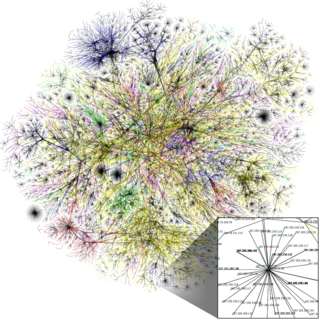
The Internet has a long history of turbulent relations, major maliciously designed disruptions, and other conflicts. This is a list of known and documented Internet, Usenet, virtual community and World Wide Web related conflicts, and of conflicts that touch on both offline and online worlds with possibly wider reaching implications.
Cyberwarfare by Russia includes denial of service attacks, hacker attacks, dissemination of disinformation and propaganda, participation of state-sponsored teams in political blogs, internet surveillance using SORM technology, persecution of cyber-dissidents and other active measures. According to investigative journalist Andrei Soldatov, some of these activities were coordinated by the Russian signals intelligence, which was part of the FSB and formerly a part of the 16th KGB department. An analysis by the Defense Intelligence Agency in 2017 outlines Russia's view of "Information Countermeasures" or IPb as "strategically decisive and critically important to control its domestic populace and influence adversary states", dividing 'Information Countermeasures' into two categories of "Informational-Technical" and "Informational-Psychological" groups. The former encompasses network operations relating to defense, attack, and exploitation and the latter to "attempts to change people's behavior or beliefs in favor of Russian governmental objectives."
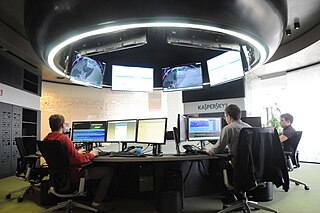
Kaspersky Lab is a Russian multinational cybersecurity and anti-virus provider headquartered in Moscow, Russia, and operated by a holding company in the United Kingdom. It was founded in 1997 by Eugene Kaspersky, Natalya Kaspersky and Alexey De-Monderik. Kaspersky Lab develops and sells antivirus, internet security, password management, endpoint security, and other cybersecurity products and services.
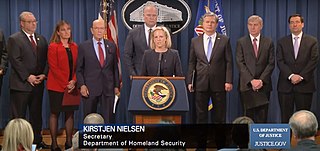
The United States has often accused the People's Republic of China of attempting to unlawfully acquire U.S. military technology and classified information as well as trade secrets of U.S. companies in order to support China's long-term military and commercial development. Chinese government agencies and affiliated personnel have been accused of using a number of methods to obtain U.S. technology, including espionage, exploitation of commercial entities, and a network of scientific, academic and business contacts. Prominent espionage cases include Larry Wu-tai Chin, Katrina Leung, Gwo-Bao Min, Chi Mak, Peter Lee, and Shujun Wang. The Ministry of State Security (MSS) maintains a bureau dedicated to espionage against the United States, the United States Bureau.
Cyberwarfare is the use of computer technology to disrupt the activities of a state or organization, especially the deliberate attacking of information systems for strategic or military purposes. As a major developed economy, the United States is highly dependent on the Internet and therefore greatly exposed to cyber attacks. At the same time, the United States has substantial capabilities in both defense and offensive power projection thanks to comparatively advanced technology and a large military budget. Cyberwarfare presents a growing threat to physical systems and infrastructures that are linked to the internet. Malicious hacking from domestic or foreign enemies remains a constant threat to the United States. In response to these growing threats, the United States has developed significant cyber capabilities.
Cyberwarfare by China is the aggregate of cyberattacks attributed to the organs of the People's Republic of China and various related advanced persistent threat (APT) groups.

Censorship of Twitter refers to Internet censorship by governments that block access to Twitter. Twitter censorship also includes governmental notice and take down requests to Twitter, which it enforces in accordance with its Terms of Service when a government or authority submits a valid removal request to Twitter indicating that specific content published on the platform is illegal in their jurisdiction.

The Office of Tailored Access Operations (TAO), now Computer Network Operations, and structured as S32, is a cyber-warfare intelligence-gathering unit of the National Security Agency (NSA). It has been active since at least 1998, possibly 1997, but was not named or structured as TAO until "the last days of 2000," according to General Michael Hayden.

During the 2010s, international media reports revealed new operational details about the Anglophone cryptographic agencies' global surveillance of both foreign and domestic nationals. The reports mostly relate to top secret documents leaked by ex-NSA contractor Edward Snowden. The documents consist of intelligence files relating to the U.S. and other Five Eyes countries. In June 2013, the first of Snowden's documents were published, with further selected documents released to various news outlets through the year.
Cozy Bear is a Russian advanced persistent threat hacker group believed to be associated with Russian foreign intelligence by United States intelligence agencies and those of allied countries. Dutch signals intelligence (AIVD) and American intelligence had been monitoring the group since 2014 and was able to link the hacker group to the Russian foreign intelligence agency (SVR) after compromising security cameras in their office. CrowdStrike and Estonian intelligence reported a tentative link to the Russian domestic/foreign intelligence agency (FSB). Various groups designate it CozyCar, CozyDuke, Dark Halo, The Dukes, Midnight Blizzard, NOBELIUM, Office Monkeys, StellarParticle, UNC2452 with a tentative connection to Russian hacker group YTTRIUM. Symantec reported that Cozy Bear had been compromising diplomatic organizations and national governments since at least 2010. Der Spiegel published documents in 2023 purporting to link Russian IT firm NTC Vulkan to Cozy Bear operations.
CrowdStrike Holdings, Inc. is an American cybersecurity technology company based in Austin, Texas. It provides endpoint security, threat intelligence, and cyberattack response services.
Pegasus is a spyware developed by the Israeli cyber-arms company NSO Group that is designed to be covertly and remotely installed on mobile phones running iOS and Android. While NSO Group markets Pegasus as a product for fighting crime and terrorism, governments around the world have routinely used the spyware to surveil journalists, lawyers, political dissidents, and human rights activists. The sale of Pegasus licenses to foreign governments must be approved by the Israeli Ministry of Defense.

The Russian government conducted foreign electoral interference in the 2016 United States elections with the goals of sabotaging the presidential campaign of Hillary Clinton, boosting the presidential campaign of Donald Trump, and increasing political and social discord in the United States. According to the U.S. intelligence community, the operation—code named Project Lakhta—was ordered directly by Russian president Vladimir Putin. The "hacking and disinformation campaign" to damage Clinton and help Trump became the "core of the scandal known as Russiagate". The 448-page Mueller Report, made public in April 2019, examined over 200 contacts between the Trump campaign and Russian officials but concluded that there was insufficient evidence to bring any conspiracy or coordination charges against Trump or his associates.
Russian interference in the 2020 United States elections was a matter of concern at the highest level of national security within the United States government, in addition to the computer and social media industries. In 2020, the RAND Corporation was one of the first to release research describing Russia's playbook for interfering in U.S. elections, developed machine-learning tools to detect the interference, and tested strategies to counter Russian interference. In February and August 2020, United States Intelligence Community (USIC) experts warned members of Congress that Russia was interfering in the 2020 presidential election in then-President Donald Trump's favor. USIC analysis released by the Office of the Director of National Intelligence (DNI) in March 2021 found that proxies of Russian intelligence promoted and laundered misleading or unsubstantiated narratives about Joe Biden "to US media organizations, US officials, and prominent US individuals, including some close to former President Trump and his administration." The New York Times reported in May 2021 that federal investigators in Brooklyn began a criminal investigation late in the Trump administration into possible efforts by several current and former Ukrainian officials to spread unsubstantiated allegations about corruption by Joe Biden, including whether they had used Trump personal attorney Rudy Giuliani as a channel.
Charming Kitten, also called APT35, Phosphorus or Mint Sandstorm, Ajax Security, and NewsBeef, is an Iranian government cyberwarfare group, described by several companies and government officials as an advanced persistent threat.
The Iranian government has interfered in the 2024 United States elections through social media efforts and hacking operations. Iranian interference has come amidst larger foreign interference in the 2024 United States elections. The efforts were identified as an effort to tip the race against former president Donald Trump through propaganda and disinformation campaigns. However, Iranian efforts have also targeted Joe Biden and Kamala Harris with similar attacks, which The New York Times stated suggested "a wider goal of sowing internal discord and discrediting the democratic system in the United States more broadly in the eyes of the world."
China has interfered in the 2024 United States elections through propaganda and disinformation campaigns linked to its Spamouflage influence operation. The efforts come amidst larger foreign interference in the 2024 United States elections.
Salt Typhoon, is an advanced persistent threat actor operated by the Chinese government which conducts cyberespionage campaigns against targets in North America and Southeast Asia. Active since 2020, the group engages in widespread data theft, particularly capturing network traffic. Former NSA analyst Terry Dunlap has called the group "another component of China's 100-Year Strategy." According to former CISA director Chris Krebs and other U.S. officials, the group may be affiliated with China's Ministry of State Security.
References
- ↑ Menn, Joseph (August 27, 2024). "Chinese government hackers penetrate U.S. internet providers to spy". The Washington Post . Retrieved August 27, 2024.
- ↑ Krouse, Sarah; Volz, Dustin; Viswanatha, Aruna; McMillan, Robert (October 5, 2024). "U.S. Wiretap Systems Targeted in China-Linked Hack" . The Wall Street Journal . Archived from the original on October 5, 2024. Retrieved October 5, 2024.
- ↑ Devlin Barrett; Jonathan Swan; Maggie Haberman (October 25, 2024). "Chinese Hackers Are Said to Have Targeted Phones Used by Trump and Vance". The New York Times.
- ↑ Nakashima, Ellen (October 11, 2024). "White House forms emergency team to deal with China espionage hack". The Washington Post . Retrieved October 12, 2024.