
The 1966 FIFA World Cup final was a football match played at Wembley Stadium in London on 30 July 1966 to determine the winner of the 1966 FIFA World Cup, the eighth FIFA World Cup. The match was contested by England and West Germany, with England winning 4–2 after extra time to claim the Jules Rimet Trophy. It was the first – and to date only – occasion that England has hosted or won the World Cup.

Showgirls is a 1995 erotic drama film directed by Paul Verhoeven, written by Joe Eszterhas, starring Elizabeth Berkley, Kyle MacLachlan, Gina Gershon, Glenn Plummer, Robert Davi, Alan Rachins, and Gina Ravera. An ambitious young woman hitches a ride to Vegas to pursue her dreams of being a professional dancer and showgirl.
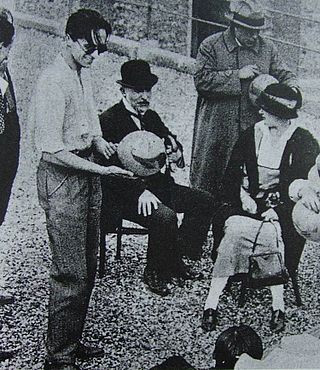
René Clair, born René-Lucien Chomette, was a French filmmaker and writer. He first established his reputation in the 1920s as a director of silent films in which comedy was often mingled with fantasy. He went on to make some of the most innovative early sound films in France, before going abroad to work in the UK and USA for more than a decade. Returning to France after World War II, he continued to make films that were characterised by their elegance and wit, often presenting a nostalgic view of French life in earlier years. He was elected to the Académie Française in 1960. Clair's best known films include Un chapeau de paille d'Italie, Sous les toits de Paris, Le Million (1931), À nous la liberté (1931), I Married a Witch (1942), and And Then There Were None (1945).

Rosie the Riveter is an allegorical cultural icon in the United States who represents the women who worked in factories and shipyards during World War II, many of whom produced munitions and war supplies. These women sometimes took entirely new jobs replacing the male workers who joined the military. She is widely recognized in the "We Can Do It!" poster as a symbol of American feminism and women's economic advantage. Similar images of women war workers appeared in other countries such as Britain and Australia. The idea of Rosie the Riveter originated in a song written in 1942 by Redd Evans and John Jacob Loeb. Images of women workers were widespread in the media in formats such as government posters, and commercial advertising was heavily used by the government to encourage women to volunteer for wartime service in factories. Rosie the Riveter became the subject and title of a Hollywood film in 1944.

Stewart Terence Herbert Young was a British film director and screenwriter who worked in the United Kingdom, Europe and Hollywood. He is best known for directing three James Bond films: the first two films in the series, Dr. No (1962) and From Russia with Love (1963), and Thunderball (1965). His other films include the Audrey Hepburn thrillers Wait Until Dark (1967) and Bloodline (1979), the historical drama Mayerling (1968), the infamous Korean War epic Inchon (1981), and the Charles Bronson films Cold Sweat (1970), Red Sun (1971), and The Valachi Papers (1972).

Richard Quine was an American director, actor, and singer.

The United Kingdom was a leading Allied Power during the First World War of 1914–1918. They fought against the Central Powers, mainly Germany. The armed forces were greatly expanded and reorganised—the war marked the founding of the Royal Air Force. The highly controversial introduction, in January 1916, of conscription for the first time in British history followed the raising of one of the largest all-volunteer armies in history, known as Kitchener's Army, of more than 2,000,000 men. The outbreak of war was a socially unifying event. Enthusiasm was widespread in 1914, and was similar to that across Europe.

Jean Marie Maurice Schérer or Maurice Henri Joseph Schérer, known as Éric Rohmer, was a French film director, film critic, journalist, novelist, screenwriter, and teacher. Rohmer was the last of the post-World War II French New Wave directors to become established. He edited the influential film journal Cahiers du cinéma from 1957 to 1963, while most of his colleagues—among them Jean-Luc Godard and François Truffaut—were making the transition from critics to filmmakers and gaining international attention.

Hearts of the World is a 1918 American silent World War I propaganda film written, produced and directed by D. W. Griffith. In an effort to change the American public's neutral stance regarding the war, the British government contacted Griffith due to his stature and reputation for dramatic filmmaking.

Irene Lilian Brodrick, Countess of Midleton was a British stage and screen actress of the 1930s, 1940s and 1950s and also a novelist.

The Lion Has Wings is a 1939 British, black-and-white, documentary-style, propaganda war film that was directed by Adrian Brunel, Brian Desmond Hurst, Alexander Korda and Michael Powell. The film was produced by London Film Productions and Alexander Korda Film Productions and 'was preparing the nation [for war] and shining a light on the power of the RAF'.

Münchhausen is a 1943 fantasy comedy film directed by Josef von Báky. Science fiction author David Wingrove has commented that this work "sidesteps immediate political issues whilst conjuring up marvellous visual images of an ageless pastoral Germany."
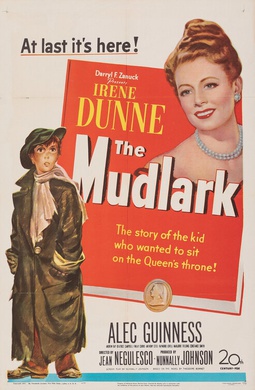
The Mudlark is a 1950 film made in Britain by 20th Century Fox. It is a fictional account of how Queen Victoria was eventually brought out of her mourning for her dead husband, Prince Albert. It was directed by Jean Negulesco, written and produced by Nunnally Johnson and based on the 1949 novel of the same name by American artillery sergeant and San Francisco newspaperman Theodore Bonnet (1908–1983). It stars Irene Dunne, Alec Guinness and Andrew Ray.
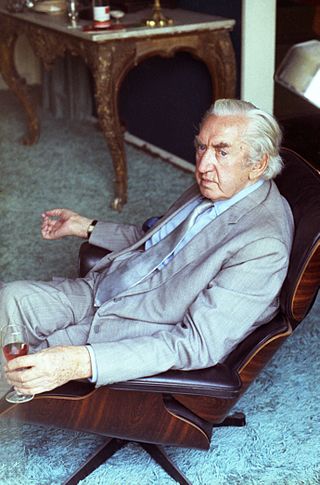
Brian Desmond Hurst was an Irish film director. With over thirty films in his filmography, Hurst was hailed as Northern Ireland's best film director by BBC film critic Mike Catto. He is perhaps best known for the 1951 A Christmas Carol adaptation Scrooge.

A Letter from Ulster is a 1942 documentary by Ulster-born movie director Brian Desmond Hurst who, along with his lifelong friend Terence Young (scriptwriter) and fellow Ulsterman and Assistant Director William (Bill) MacQuitty, created this film promoting a sense of community between the people of Northern Ireland and over one hundred thousand troops from the US based in Northern Ireland at the time. William Alwyn provided music.
Flight from Folly is a 1945 British musical comedy film directed and produced by Herbert Mason, in his last directorial credit before moving onto production, for Warner Bros. The cast includes Pat Kirkwood, Hugh Sinclair and Tamara Desni and with music from Edmundo Ros and the Rumba Band. An unemployed showgirl impersonates a nurse and undertakes the job of looking after a composer and playwright abandoned by his Russian wife. The story was written by Lesley Storm, Katherine Strueby and Edmund Goulding. The film was distributed by Warner Brothers and First National Pictures.

Jean Gillie was an English film actress of the 1930s and 1940s. Gillie appeared in 20 British and two American films before her career was cut short by her early death.
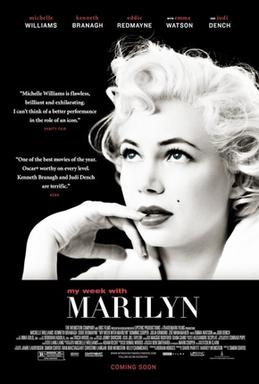
My Week with Marilyn is a 2011 biographical drama film directed by Simon Curtis and written by Adrian Hodges. It stars Michelle Williams, Kenneth Branagh, Eddie Redmayne, Dominic Cooper, Julia Ormond, Emma Watson, and Judi Dench. Based on two books by Colin Clark, it depicts the making of the 1957 film The Prince and the Showgirl, which starred Marilyn Monroe (Williams) and Laurence Olivier (Branagh). The film concerns the week during the shooting of the film when Monroe was escorted around London by Clark (Redmayne), after her husband Arthur Miller had returned to the United States.

Jennifer Hale is a 1937 British crime film directed by Bernard Mainwaring and starring René Ray, Ballard Berkeley and John Longden.

Women took on many different roles during World War II, including as combatants and workers on the home front. The war involved global conflict on an unprecedented scale; the absolute urgency of mobilizing the entire population made the expansion of the role of women inevitable, although the particular roles varied from country to country. Millions of women of various ages were injured or died as a result of the war.

