Related Research Articles
In physics, the fundamental interactions, also known as fundamental forces, are the interactions that do not appear to be reducible to more basic interactions. There are four fundamental interactions known to exist: the gravitational and electromagnetic interactions, which produce significant long-range forces whose effects can be seen directly in everyday life, and the strong and weak interactions, which produce forces at minuscule, subatomic distances and govern nuclear interactions. Some scientists hypothesize that a fifth force might exist, but these hypotheses remain speculative.
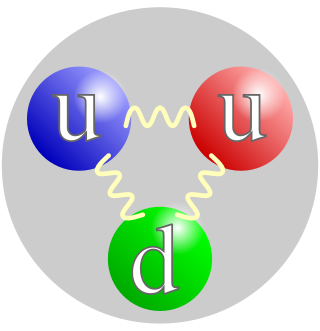
A quark is a type of elementary particle and a fundamental constituent of matter. Quarks combine to form composite particles called hadrons, the most stable of which are protons and neutrons, the components of atomic nuclei. All commonly observable matter is composed of up quarks, down quarks and electrons. Owing to a phenomenon known as color confinement, quarks are never found in isolation; they can be found only within hadrons, which include baryons and mesons, or in quark–gluon plasmas. For this reason, much of what is known about quarks has been drawn from observations of hadrons.

In theoretical physics, quantum chromodynamics (QCD) is the theory of the strong interaction between quarks and gluons, the fundamental particles that make up composite hadrons such as the proton, neutron and pion. QCD is a type of quantum field theory called a non-abelian gauge theory, with symmetry group SU(3). The QCD analog of electric charge is a property called color. Gluons are the force carrier of the theory, just as photons are for the electromagnetic force in quantum electrodynamics. The theory is an important part of the Standard Model of particle physics. A large body of experimental evidence for QCD has been gathered over the years.
In nuclear physics and particle physics, the strong interaction is one of the four known fundamental interactions, with the others being electromagnetism, the weak interaction, and gravitation. At the range of 10−15 m (1 femtometer), the strong force is approximately 137 times as strong as electromagnetism, 106 times as strong as the weak interaction, and 1038 times as strong as gravitation. The strong nuclear force confines quarks into hadron particles such as the proton and neutron. In addition, the strong force binds these neutrons and protons to create atomic nuclei, where it is called the nuclear force. Most of the mass of a common proton or neutron is the result of the strong force field energy; the individual quarks provide only about 1% of the mass of a proton.

In physics, a state of matter is one of the distinct forms in which matter can exist. Four states of matter are observable in everyday life: solid, liquid, gas, and plasma. Many intermediate states are known to exist, such as liquid crystal, and some states only exist under extreme conditions, such as Bose–Einstein condensates, neutron-degenerate matter, and quark–gluon plasma, which only occur, respectively, in situations of extreme cold, extreme density, and extremely high energy. For a complete list of all exotic states of matter, see the list of states of matter.

In quantum chromodynamics (QCD), color confinement, often simply called confinement, is the phenomenon that color-charged particles cannot be isolated, and therefore cannot be directly observed in normal conditions below the Hagedorn temperature of approximately 2 terakelvin. Quarks and gluons must clump together to form hadrons. The two main types of hadron are the mesons and the baryons. In addition, colorless glueballs formed only of gluons are also consistent with confinement, though difficult to identify experimentally. Quarks and gluons cannot be separated from their parent hadron without producing new hadrons.

In theoretical physics, the anti-de Sitter/conformal field theory correspondence, sometimes called Maldacena duality or gauge/gravity duality, is a conjectured relationship between two kinds of physical theories. On one side are anti-de Sitter spaces (AdS) which are used in theories of quantum gravity, formulated in terms of string theory or M-theory. On the other side of the correspondence are conformal field theories (CFT) which are quantum field theories, including theories similar to the Yang–Mills theories that describe elementary particles.
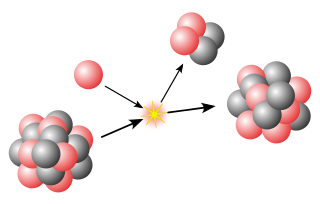
High-energy nuclear physics studies the behavior of nuclear matter in energy regimes typical of high-energy physics. The primary focus of this field is the study of heavy-ion collisions, as compared to lighter atoms in other particle accelerators. At sufficient collision energies, these types of collisions are theorized to produce the quark–gluon plasma. In peripheral nuclear collisions at high energies one expects to obtain information on the electromagnetic production of leptons and mesons that are not accessible in electron–positron colliders due to their much smaller luminosities.
Hadronization is the process of the formation of hadrons out of quarks and gluons. There are two main branches of hadronization: quark-gluon plasma (QGP) transformation and colour string decay into hadrons. The transformation of quark-gluon plasma into hadrons is studied in lattice QCD numerical simulations, which are explored in relativistic heavy-ion experiments. Quark-gluon plasma hadronization occurred shortly after the Big Bang when the quark–gluon plasma cooled down to the Hagedorn temperature when free quarks and gluons cannot exist. In string breaking new hadrons are forming out of quarks, antiquarks and some times gluons, spontaneously created from the vacuum.
Quark matter or QCD matter refers to any of a number of hypothetical phases of matter whose degrees of freedom include quarks and gluons, of which the prominent example is quark-gluon plasma. Several series of conferences in 2019, 2020, and 2021 are devoted to this topic.
The Hagedorn temperature,TH, is the temperature in theoretical physics where hadronic matter is no longer stable, and must either "evaporate" or convert into quark matter; as such, it can be thought of as the "boiling point" of hadronic matter. The Hagedorn temperature exists because the amount of energy available is high enough that matter particle (quark–antiquark) pairs can be spontaneously pulled from vacuum. Thus, naively considered, a system at Hagedorn temperature can accommodate as much energy as one can put in, because the formed quarks provide new degrees of freedom, and thus the Hagedorn temperature would be an impassable absolute hot. However, if this phase is viewed as quarks instead, it becomes apparent that the matter has transformed into quark matter, which can be further heated.
In theoretical physics, the anti-de Sitter/quantum chromodynamics correspondence is a goal to describe quantum chromodynamics (QCD) in terms of a dual gravitational theory, following the principles of the AdS/CFT correspondence in a setup where the quantum field theory is not a conformal field theory.
This timeline lists significant discoveries in physics and the laws of nature, including experimental discoveries, theoretical proposals that were confirmed experimentally, and theories that have significantly influenced current thinking in modern physics. Such discoveries are often a multi-step, multi-person process. Multiple discovery sometimes occurs when multiple research groups discover the same phenomenon at about the same time, and scientific priority is often disputed. The listings below include some of the most significant people and ideas by date of publication or experiment.

Rolf Hagedorn was a German theoretical physicist who worked at CERN. He is known for the idea that hadronic matter has a "melting point". The Hagedorn temperature is named in his honor.

Quark–gluon plasma or QGP is an interacting localized assembly of quarks and gluons at thermal and chemical (abundance) equilibrium. The word plasma signals that free color charges are allowed. In a 1987 summary, Léon van Hove pointed out the equivalence of the three terms: quark gluon plasma, quark matter and a new state of matter. Since the temperature is above the Hagedorn temperature—and thus above the scale of light u,d-quark mass—the pressure exhibits the relativistic Stefan-Boltzmann format governed by fourth power of temperature and many practically mass free quark and gluon constituents. We can say that QGP emerges to be the new phase of strongly interacting matter which manifests its physical properties in terms of nearly free dynamics of practically massless gluons and quarks. Both quarks and gluons must be present in conditions near chemical (yield) equilibrium with their colour charge open for a new state of matter to be referred to as QGP.
Quantum chromodynamic binding energy, gluon binding energy or chromodynamic binding energy is the energy binding quarks together into hadrons. It is the energy of the field of the strong force, which is mediated by gluons. Motion-energy and interaction-energy contribute most of the hadron's mass.

Johann Rafelski is a German-American theoretical physicist. He is professor of Physics at The University of Arizona in Tucson, guest scientist at CERN (Geneva), and has been LMU-Excellent Guest Professor at the Ludwig Maximilian University of Munich in Munich, Germany.
Strangeness production in relativistic heavy ion collisions is a signature and a diagnostic tool of quark–gluon plasma (QGP) formation and properties. Unlike up and down quarks, from which everyday matter is made, heavier quark flavors such as strangeness and charm typically approach chemical equilibrium in a dynamic evolution process. QGP is an interacting localized assembly of quarks and gluons at thermal (kinetic) and not necessarily chemical (abundance) equilibrium. The word plasma signals that color charged particles are able to move in the volume occupied by the plasma. The abundance of strange quarks is formed in pair-production processes in collisions between constituents of the plasma, creating the chemical abundance equilibrium. The dominant mechanism of production involves gluons only present when matter has become a quark–gluon plasma. When quark–gluon plasma disassembles into hadrons in a breakup process, the high availability of strange antiquarks helps to produce antimatter containing multiple strange quarks, which is otherwise rarely made. Similar considerations are at present made for the heavier charm flavor, which is made at the beginning of the collision process in the first interactions and is only abundant in the high-energy environments of CERN's Large Hadron Collider.
References
- ↑ "2018 CODATA Value: Planck temperature". The NIST Reference on Constants, Units, and Uncertainty. NIST. 20 May 2019. Retrieved 2019-05-20.
- 1 2 Tyson, Peter (2007). "Absolute Hot: Is there an opposite to absolute zero?". PBS.org. Archived from the original on 6 August 2009. Retrieved 2009-08-11.
- ↑ Hubert Reeves (1991). The Hour of Our Delight. W. H. Freeman Company. p. 117. ISBN 978-0-7167-2220-5.
The point at which our physical theories run into most serious difficulties is that where matter reaches a temperature of approximately 1032 degrees, also known as Planck's temperature. The extreme density of radiation emitted at this temperature creates a disproportionately intense field of gravity. To go even farther back, a quantum theory of gravity would be necessary, but such a theory has yet to be written.
- ↑ Absolute Hot. NOVA.
- ↑ Satz, Helmut (1981). Statistical mechanics of quarks and hadrons, International Symposium on Statistical Mechanics of Quarks and Hadrons, 24–31 Aug 1980, Bielefeld, Germany. Amsterdam: North-Holland. ISBN 0-444-86227-7.
- ↑ Atick, Joseph J.; Witten, Edward (1988). "The Hagedorn transition and the number of degrees of freedom of string theory". Nuclear Physics B. 310 (2): 291–334. Bibcode:1988NuPhB.310..291A. doi:10.1016/0550-3213(88)90151-4.