
Trichomes ; from Ancient Greek τρίχωμα (tríkhōma) 'hair') are fine outgrowths or appendages on plants, algae, lichens, and certain protists. They are of diverse structure and function. Examples are hairs, glandular hairs, scales, and papillae. A covering of any kind of hair on a plant is an indumentum, and the surface bearing them is said to be pubescent.
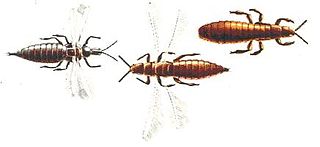
Thrips are minute, slender insects with fringed wings and unique asymmetrical mouthparts. Different thrips species feed mostly on plants by puncturing and sucking up the contents, although a few are predators. Entomologists have described approximately 6,000 species. They fly only weakly and their feathery wings are unsuitable for conventional flight; instead, thrips exploit an unusual mechanism, clap and fling, to create lift using an unsteady circulation pattern with transient vortices near the wings.
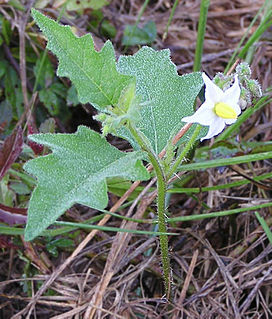
Solanum carolinense, the Carolina horsenettle, is not a true nettle, but a member of the Solanaceae, or nightshade family. It is a perennial herbaceous plant, native to the southeastern United States, though its range has expanded throughout much of temperate North America. The plant is an invasive in parts of Europe, Asia, and Australia. The stem and undersides of larger leaf veins are covered with prickles.
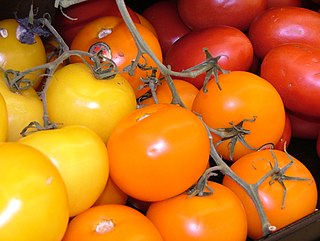
Lycopersicon was a genus in the flowering plant family Solanaceae. It contained about 13 species in the tomato group of nightshades. First removed from the genus Solanum by Philip Miller in 1754, its removal leaves the latter genus paraphyletic, so modern botanists generally accept the names in Solanum. The name Lycopersicon is still used by gardeners, farmers, and seed companies. Collectively, the species in this group apart from the common cultivated plant are called wild tomatoes.

Jasmonic acid (JA) is an organic compound found in several plants including jasmine. The molecule is a member of the jasmonate class of plant hormones. It is biosynthesized from linolenic acid by the octadecanoid pathway. It was first isolated in 1957 as the methyl ester of jasmonic acid by the Swiss chemist Edouard Demole and his colleagues.

Plant defense against herbivory or host-plant resistance (HPR) describes a range of adaptations evolved by plants which improve their survival and reproduction by reducing the impact of herbivores. Plants can sense being touched, and they can use several strategies to defend against damage caused by herbivores. Many plants produce secondary metabolites, known as allelochemicals, that influence the behavior, growth, or survival of herbivores. These chemical defenses can act as repellents or toxins to herbivores, or reduce plant digestibility. Another defensive strategy of plants is changing their attractiveness. To prevent overconsumption by large herbivores, plants alter their appearance by changing their size or quality, overall decreasing their consumption rate.

Systemin is a plant peptide hormone involved in the wound response in the family Solanaceae. It was the first plant hormone that was proven to be a peptide having been isolated from tomato leaves in 1991 by a group led by Clarence A. Ryan. Since then, other peptides with similar functions have been identified in tomato and outside of the Solanaceae. Hydroxyproline-rich glycopeptides were found in tobacco in 2001 and AtPeps were found in Arabidopsis thaliana in 2006. Their precursors are found both in the cytoplasm and cell walls of plant cells, upon insect damage, the precursors are processed to produce one or more mature peptides. The receptor for systemin was first thought to be the same as the brassinolide receptor but this is now uncertain. The signal transduction processes that occur after the peptides bind are similar to the cytokine-mediated inflammatory immune response in animals. Early experiments showed that systemin travelled around the plant after insects had damaged the plant, activating systemic acquired resistance, now it is thought that it increases the production of jasmonic acid causing the same result. The main function of systemins is to coordinate defensive responses against insect herbivores but they also affect plant development. Systemin induces the production of protease inhibitors which protect against insect herbivores, other peptides activate defensins and modify root growth. They have also been shown to affect plants' responses to salt stress and UV radiation. AtPEPs have been shown to affect resistance against oomycetes and may allow A. thaliana to distinguish between different pathogens. In Nicotiana attenuata, some of the peptides have stopped being involved in defensive roles and instead affect flower morphology.

Germacrenes are a class of volatile organic hydrocarbons, specifically, sesquiterpenes. Germacrenes are typically produced in a number of plant species for their antimicrobial and insecticidal properties, though they also play a role as insect pheromones. Two prominent molecules are germacrene A and germacrene D.

Myrosinase is a family of enzymes involved in plant defense against herbivores, specifically the mustard oil bomb. The three-dimensional structure has been elucidated and is available in the PDB.
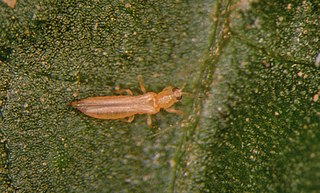
The western flower thrips [Frankliniella occidentalis (Pergande)] is an invasive pest insect in agriculture. This species of thrips is native to the Southwestern United States but has spread to other continents, including Europe, Australia, and South America via transport of infested plant material.

Orthotospovirus is a genus of negative-strand RNA viruses, in the family Tospoviridae of the order Bunyavirales, which infects plants. Tospoviruses take their name from the species Tomato spotted wilt orthotospovirus (TSWV) which was discovered in Australia in 1919. TSWV remained the only known member of the family until the early 1990s when genetic characterisation of plant viruses became more common. There are now at least twenty species in the genus with more being discovered on a regular basis. Member viruses infect over eight hundred plant species from 82 different families.

Sucrose-phosphate synthase is a plant enzyme involved in sucrose biosynthesis. Specifically, this enzyme catalyzes the transfer of a hexosyl group from uridine diphosphate glucose (UDP-glucose) to D-fructose 6-phosphate to form UDP and D-sucrose-6-phosphate. This reversible step acts as the key regulatory control point in sucrose biosynthesis, and is an excellent example of various key enzyme regulation strategies such as allosteric control and reversible phosphorylation.

Turanose is a reducing disaccharide. The d-isomer is naturally occurring. Its systematic name is α-d-glucopyranosyl-(1→3)-α-d-fructofuranose. It is an analog of sucrose not metabolized by higher plants, but rather acquired through the action of sucrose transporters for intracellular carbohydrate signaling. In addition to its involvement in signal transduction, d-(+)-turanose can also be used as a carbon source by many organisms including numerous species of bacteria and fungi.

Nicotiana attenuata is a species of wild tobacco known by the common name coyote tobacco. It is native to western North America from British Columbia to Texas and northern Mexico, where it grows in many types of habitat. It is a glandular and sparsely hairy annual herb exceeding a meter in maximum height. The leaf blades may be 10 centimetres (4 in) long, the lower ones oval and the upper narrower in shape, and are borne on petioles. The inflorescence bears several flowers with pinkish or greenish white tubular throats 2 to 3 centimetres long, their bases enclosed in pointed sepals. The flower face has five mostly white lobes. The fruit is a capsule about 1 centimetre long.
Solanum arcanum is a species of nightshade, commonly called the "wild tomato," endemic to Peru.

Cajanus scarabaeoides is a flowering plant in the genus Cajanus. Of the 32 different species within the genus Cajanus, only one, C. cajan (pigeonpea), is cultivated. Cajanus scarabaeoides is the closest wild relative to C. cajan, and is one of the easiest wild species to cross with pigeonpea cultivars. C. scarabaeoides is found naturally in both temperate and tropical zones around the globe. This species has higher levels of drought tolerance, is found to have greater protein content, and has higher levels of resistance to insect pests compared to cultivated types. These genetic traits can be crossed with C. cajan to improve the crop's productivity. For subsistence farmers, this can reduce economic losses and drastically improve overall crop yield.
Dicyphus hesperus is a species of true bug in the family Miridae. It is a generalist predator of other insects and also feeds on plant tissues. It is native to North America and has been used there in biological control of agricultural pests, especially whitefly on tomatoes.
Robert L. Last is a plant biochemical genomicist who studies metabolic processes that protect plants from the environment and produce products important for animal and human nutrition. His research has covered (1) production and breakdown of essential amino acids, (2) the synthesis and protective roles of Vitamin C and Vitamin E (tocopherols) as well as identification of mechanisms that protect photosystem II from damage, and (3) synthesis and biological functions of plant protective specialized metabolites. Four central questions are: (i) how are leaf and seed amino acids levels regulated, (ii.) what mechanisms protect and repair photosystem II from stress-induced damage, (iii.) how do plants produce protective metabolites in their glandular secreting trichomes (iv.) and what are the evolutionary mechanisms that contribute to the tremendous diversity of specialized metabolites that protect plants from insects and pathogens and are used as therapeutic agents.
Frankliniella schultzei, the common blossom thrips or cotton thrips, is a species of thrips in the family Thripidae. It is found in many parts of the world and is an important pest insect in agriculture.
