Related Research Articles
Purcell & Elmslie (P&E) was the most widely know iteration of a progressive American architectural practice. P&E was the second most commissioned firm of the Prairie School, after Frank Lloyd Wright. The firm in all iterations was active from 1907 to 1921, with their most famous work being done between 1913 and 1921.
Kimball House may refer to:

Joseph Warren Yost (1847–1923) was a prominent architect from Ohio whose works included many courthouses and other public buildings. Some of his most productive years were spent as a member of the Yost and Packard partnership with Frank Packard. Later in his career he joined Albert D'Oench at the New York City based firm D'Oench & Yost. A number of his works are listed for their architecture in the U.S. National Register of Historic Places (NRHP).

Ferry & Clas was an architectural firm in Wisconsin. It designed many buildings that are listed on the National Register of Historic Places. George Bowman Ferry and Alfred Charles Clas were partners.

Albert John Gibson was an architect in Missoula, Montana who designed a number of buildings that are listed on the National Register of Historic Places.
Oscar Cobb was an American architect of theaters and more. Several of his works are listed on the U.S. National Register of Historic Places.

Fisher & Fisher was an architectural firm based in Denver, Colorado named for partners William Ellsworth Fisher (1871–1937) and Arthur Addison Fisher (1878–1965).

James Wingfield Golucke (1865–1907), often known as J.W. Golucke, was an American architect based in Atlanta, Georgia.

Wing & Mahurin was an architectural firm of Fort Wayne, Indiana. Its principal partners were John F. Wing (1852-1947) and Marshall S. Mahurin (1857-1939), who were partners until 1907. Together with Guy M. Mahurin (1877-1941) they worked also as Mahurin & Mahurin.

Elmer E. Dunlap was an architect of Indianapolis, Indiana and a contractor from Columbus, Indiana, who worked often on projects designed by prolific architect William Ittner.
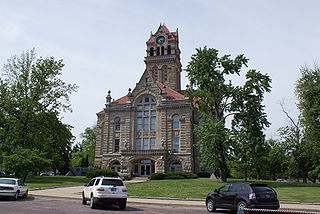
Caldwell & Drake was a construction firm based in Indiana. It included George W. Caldwell and Lester Drake.

Edward Oscar Fallis, often known as E.O. Fallis, was an American architect of Toledo, Ohio.
George M. Kerns was an architect in Iowa.
Edmond Jacques Eckel (1845–1934) was an architect in Missouri. One of his firms was Eckel & Mann. Eckel's name has been spelled with variations including Edmund rather than Edmond and with Jacques spelled as Jaques.

Barber & Kluttz, spelled often as Barber & Klutz, was an architectural firm that produced pattern books used across the United States. It was a partnership of George Franklin Barber of Tennessee and Thomas A. Kluttz of Georgia.
Wallace L. Dow, often known as W.L. Dow, was an architect of Sioux Falls, South Dakota.

Jacob M. Nachtigall was an American architect active in Omaha and eastern Nebraska. The surname is sometimes spelled Nachtigal. He designed numerous Catholic churches and other buildings in Nebraska. Nachtigall was born in Germany in about 1874 and came with his family to the U.S. in 1883. He apprenticed under Thomas Rogers Kimball during 1900–1908 and went independent in 1909. A number of his works survive and are listed on the U.S. National Register of Historic Places. Works include :
Addison G. Pulsifer was an American architect practicing in Lewiston, Maine.
Law, Law & Potter was an architect firm in Madison, Wisconsin; Potter Lawson, Inc. is its modern-day successor. Some of its buildings are listed on the U.S. National Register of Historic Places for their architecture. The firm was Madison's largest and "arguably most important" architectural firms in the 1920s and 1930s.
Louis F. Lockwood was an architect in Minnesota. Several of his works are listed on the National Register of Historic Places.
References
- ↑ "Madison Has Many Very Old Houses, But Little Interest Expressed In Proposed Markings" (PDF). Archived from the original (PDF) on 2012-04-26. Retrieved 2011-12-16.
- ↑ "National Register Information System". National Register of Historic Places . National Park Service. July 9, 2010.
- ↑ Madison MRA
 | This article about a United States architect or architectural firm is a stub. You can help Wikipedia by expanding it. |