
Hellenic Train S.A., formerly TrainOSE S.A., is a private railway company in Greece which currently operates passenger and freight trains on OSE lines. TrainOSE was acquired in September 2017 by the Italian national railway company, Ferrovie dello Stato Italiane. The company was a subsidiary of the Hellenic Railways Organisation (OSE) until 2008, when it became an independent state-owned company until its privatisation in 2017. Hellenic Train employs train crews, operators and manages the most of rail services throughout the Greek railway network, leasing rolling stock owned by GAIOSE except for ETR 470 trains. In 2022 the company rebranded as Hellenic Train.

Hellenic Train Class 120, also known as Hellas Sprinter, is a class of electric locomotives operated by Hellenic Train. It is part of OSE's rolling stock. They were manufactured by Siemens and Krauss-Maffei in Germany.

The New Thessaloniki railway station is the main central passenger railway station and terminal of Thessaloniki, Greece’s second-largest city. It is located in the central quarter of Xirokrini on Monastiriou Street and was inaugurated on 12 June 1961, the passenger station replaced the older and much smaller passenger station which now handles the city's cargo rail, hence the name "new railway station" which has been retained.

The railway from Piraeus to Platy is an electrified double-track railway line that connects Athens to northern Greece and the rest of Europe. It constitutes the longest section of the mostly completed higher-speed rail line known as P.A.Th.E./P., which includes Greece's most important rail connection, that between Athens and Thessaloniki. Its northern end is the station of Platy, on the Thessaloniki–Bitola railway. In the south, it connects to the Athens Airport–Patras railway at the Acharnes Railway Center. The line passes through Thebes, Katerini and Larissa, and offers connections to several other cities through branch lines.

Larissa railway station is the main station for Larissa in Thessaly, Greece. Located in a residential area, close to the city centre, it is served by InterCity trains between Athens and Thessaloniki, Express services to Kalambaka, Regional services to Volos and the southern terminus for Line 1 of Proastiakos services to Thessaloniki. Larissa railway station should not be confused with Larissa Station in Athens.

Platy railway station is the railway station of Platy in Imathia, Central Macedonia, Greece. Opened in 1894 in what was then the Ottoman Empire, it is located southwest of the residential area, at the junction of the Piraeus–Platy railway and Thessaloniki–Bitola railway 1.3 kilometres (0.81 mi) southwest of the town centre. The station is served by Intercity trains between Athens and Thessaloniki and since 9 September 2007 by Thessaloniki Suburban services or Proastiakos to Katerini and Larissa, Edessa, Florina and Thessaloniki.
P.A.Th.E./P, which stands for Patras–Athens–Thessaloniki–Idomeni/Promachonas is a higher-speed rail line in Greece which is partly completed and partly under construction. The section between Athens and Thessaloniki is completed and allows a travel time of 3 hours 20 minutes, a reduction of about three hours.
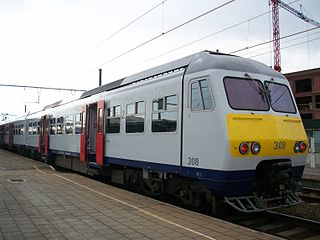
A derailment of a passenger train occurred on 18 February 2017 at Leuven, Belgium. One person was killed and 27 were injured. The cause of the derailment was excessive speed through a set of points.

Rapsani railway station is a railway station near the village of Rapsani, Thessaly, Greece. It is located about 5 kilometres (3.1 mi) from the center of Rapsani, the station sits in the shadow of Mount Ossa. Reopened on 7 September 2008. The station is served by both fast Regional trains and Proastiakos to Thessaloniki. Intercity services pass through the station, but do not call at it. The station was formerly called Pyrgetos station because of the small village close to the station.

Livadeia railway station is a railway station close to Livadeia, Boeotia, Greece. The station opened on 8 March 1904., along with the rest of the line. It is served by intercity trains between Athens and Thessaloniki and by regional trains to Kalampaka.

Adendro railway station is a railway station that serves the village of Adendro in the municipality of Chalkidona, Thessaloniki regional unit, Greece. Opened in 1894 in what was then the Ottoman Empire, it is located just north of the village centre. The station is served by Regional stopping services Florina, Kalambaka, Palaiofarsalos and Thessaloniki, and since 9 September 2007 by Proastiakos Thessaloniki services to Larissa, Edessa, and Thessaloniki. It was the site of a serious railway accident on 13 May 2017 in which three people were killed.

On 28 February 2023, a head-on collision occurred between two trains south of the Tempi Valley, near the village of Evangelismos in Thessaly, Greece. The collision, involving the InterCity 62 (IC62) passenger train and an intermodal freight train, killed at least 57 people, making it the deadliest rail disaster in Greek history, surpassing the death toll of the Corinth rail disaster in 1968. It was also the deadliest in Europe since the Santiago de Compostela derailment in 2013.
The Orfana rail disaster occurred on 16 January 1972 when, at around 16:45, a breakdown in communication between the corresponding stationmasters at Doxaras and Orfana caused an express train and a military relief train to collide in bad weather on the single track line. Twenty-one people died, and more than forty were injured in one of the deadliest rail accidents in Greece. Nikolaos Gekas The stationmaster at Orfana was later sentenced to 5 years for his part in the disaster.


