Kliment Yefremovich Voroshilov, popularly known as Klim Voroshilov, was a prominent Soviet military officer and politician during the Stalin-era. He was one of the original five Marshals of the Soviet Union, the second highest military rank of the Soviet Union, and served as Chairman of the Presidium of the Supreme Soviet, the nominal Soviet head of state, from 1953 to 1960.

Minsk is the capital and the largest city of Belarus, located on the Svislach and the now subterranean Niamiha rivers. As the capital, Minsk has a special administrative status in Belarus and is the administrative centre of Minsk Region and Minsk District. As of 2024, it has a population of about two million, making Minsk the 11th-most populous city in Europe. Minsk is one of the administrative capitals of the Commonwealth of Independent States (CIS) and the Eurasian Economic Union (EAEU).

Vitebsk Region or Viciebsk Region, also known as Vitebsk Oblast or Vitsyebsk Voblasts, is one of the regions of Belarus. Its administrative center is Vitebsk. It is located in the north of the country, and borders on Russia.

Barysaw or Borisov is a city in Minsk Region, Belarus. It serves as the administrative center of Barysaw District. It is located on the Berezina River and 74 kilometres (46 mi) north-east from the capital Minsk. As of 2024, it has a population of 135,696.

Minsk Tractor Works is a Belarusian agricultural machinery manufacturer with headquarters in Minsk, Belarus. Minsk Tractor Works is one of the main tractor factories in the country. It is a part of the Minsk Tractor Works Industrial Association. In addition to the main plant in Minsk, the association includes a number of plants that produce parts and attachable tools for tractors and other vehicles produced by MTZ.

FC Traktor Minsk is a football team from Belarus.

Traktor Stadium is a multi-purpose stadium in Minsk, Belarus. It is currently used mostly for football matches and is the home ground of Traktor Minsk.
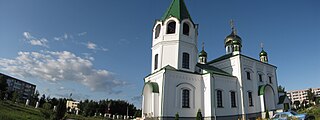
Fanipol or Fanipal is a town in Minsk Region, Belarus. Fanipol is located in Dzyarzhynsk District, 24 km (15 mi) southwest of Minsk and 13 km (8.1 mi) southwest of the Minsk Automobile Ring Road. As of 2024, it has a population of 18,252.

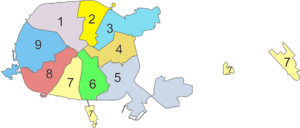
Kastrychnitski District or Kastryčnicki District is an administrative division of the city of Minsk, the capital of Belarus. It was named after the October Revolution. As of 2023, it has a population of 170,527.

Tsentralny District or Centraĺny District is an administrative division of the city of Minsk, the capital of Belarus. Its name means "Central District" due to its position partly in the centre of the city. As of 2023, it has a population of 128,151.

Pyershamayski District or Pieršamajski District is an administrative division of the city of Minsk, the capital of Belarus. It was named after May Day, also known as International Workers' Day. As of 2023, it has a population of 231,906.

Partyzanski District is an administrative division of the city of Minsk, the capital of Belarus. It was named after the Soviet partisans and is the least populated district of the city. As of 2023, it has a population of 94,143.

Frunzyenski District or Frunzienski District is an administrative division of the city of Minsk, the capital of Belarus. It was named after Mikhail Frunze and is the most populated district of the city. As of 2023, it has a population of 459,849.

Zavodski District is an administrative division of the city of Minsk, the capital of Belarus. As of 2023, it has a population of 230,701.

Lyeninski District or Lieninski District is an administrative division of the city of Minsk, the capital of Belarus. It was named after Vladimir Lenin. As of 2023, it has a population of 214,701.

Maskowski District or Maskoŭski District is an administrative division of the city of Minsk, the capital of Belarus. It was named after the city of Moscow. As of 2023, it has a population of 308,754.

Savyetski District or Saviecki District is an administrative division of the city of Minsk, the capital of Belarus. It was named after the Soviets. As of 2023, it has a population of 156,739.

Ganja Auto Plant is an auto assembly plant situated in the Ganja city in Azerbaijan. The factory was founded in 1986 as KiAZ for a production of run of 30,000 "GAZelle" vans according to the project brief. The commissioning was intended to end in 1989 but following a decision of Council of Ministers of the former USSR the construction of the factory was interrupted, and the technological project was given to the Bryansk Automobile Plant. The 256 hectares of overall territory, including the 50 hectares of the factory footprint itself, stayed without utilization for 15 years.

Belarus had third by volume part of automotive industry of the Soviet Union with near 40,000 annual production. Since that times Belarus specializes on production of own designed superheavy, heavy and middle trucks mainly plus post-Soviet developed buses, trolleybuses and trams. Auto manufacturers in Belarus include MAZ, BelAZ and Neman.
The Russification of Belarus denotes a historical process where the integration of Russian language and culture increasingly influenced Belarusian society, especially during the 20th century.