
Transport in Ethiopia is overseen by the Ministry of Transport and Communications. Over the last years, the Ethiopian federal authorities have significantly increased funding for rail and road construction to build an infrastructure, that allows better economic development.
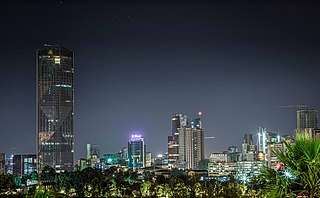
Addis Ababa is the capital and largest city of Ethiopia. In the 2007 census, the city's population was estimated to be 2,739,551 inhabitants. Addis Ababa is a highly developed and important cultural, artistic, financial and administrative centre of Ethiopia.

Addis Ababa Bole International Airport is an international airport in Addis Ababa, Ethiopia. It is in the Bole district, 6 km (3.7 mi) southeast of the city centre and 65 km (40 mi) north of Bishoftu. The airport was formerly known as Haile Selassie I International Airport. It is the main hub of Ethiopian Airlines, the national airline that serves destinations in Ethiopia and throughout the African continent, as well as connections to Asia, Europe, North America and South America. The airport is also the base of the Ethiopian Aviation Academy. As of June 2018, nearly 380 flights per day were using the airport.
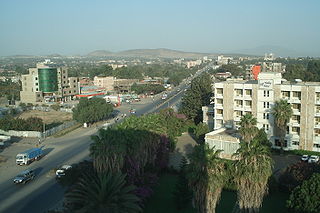
Adama, formerly Nazreth, is a one of the cities of Oromia Region of Ethiopia. Located in the East Shewa Zone 99 km (62 mi) southeast of the capital, Addis Ababa, the city sits between the base of an escarpment to the west, and the Great Rift Valley to the east.

The Tekezé or Täkkäze River, also spelled Takkaze, is a major river of Ethiopia. For part of its course it forms a section of the westernmost border of Ethiopia and Eritrea. The river is also known as the Setit as it joins the Nile tributary Atbarah River just over the border in Sudan. According to materials published by the Ethiopian Central Statistical Agency, the Tekezé River is 608 kilometers (378 mi) long. The canyon which it has created is the deepest in Africa and one of the deepest in the world, at some points having a depth of over 2000 meters.
Rail transport in Ethiopia is done within the National Railway Network of Ethiopia, which currently consists of three electrified standard gauge railway lines: the Addis Ababa–Djibouti Railway, the Awash–Weldiya Railway and the Weldiya–Mekelle Railway. Other lines are still in the planning phase. There is also an urban light rail system in the country's capital, the Addis Ababa Light Rail.
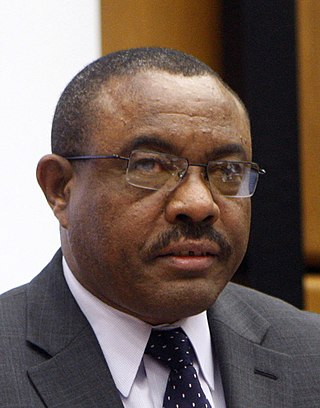
Hailemariam Desalegn Boshe is an Ethiopian politician who served as prime minister of Ethiopia from 2012 to 2018. He also previously served as deputy prime minister and Minister of Foreign Affairs under Prime Minister Meles Zenawi from 2010 to 2012. After Meles' death in August 2012, Hailemariam succeeded him as prime minister, initially in an acting capacity. He was then elected as the chair of the EPRDF, the ruling party, on 15 September 2012. Hailemariam also served as the chairperson of the African Union from 2013 to 2014.
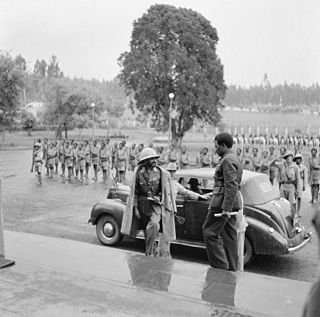
The history of Addis Ababa, capital of Ethiopia, formally begins with the founding of the city in the 19th century by Ethiopian Emperor Menelik II and his wife Empress Taytu Betul. In its first years the city was more like a military encampment than a town. The central focus was the emperor’s palace, which was surrounded by the dwellings of his troops and of his innumerable retainers. In the 1920s, Addis Ababa experienced a significant economic upturn, marked by a surge in the number of middle-class-owned buildings, including stone houses furnished with imported European furniture. The middle class also introduced newly manufactured automobiles and expanded banking institutions. Urbanization and modernization persisted during the Italian occupation, guided by a masterplan aimed at transforming Addis Ababa into a more "colonial" city, a trajectory that continued beyond the occupation. Subsequent master plans, formulated from the 1940s onward with the input of European consultants, focused on the development of monuments, civic structures, satellite cities, and the inner city.

Ethiopia is a landlocked sovereign country located in the Horn of Africa. Ethiopia is bordered by Eritrea to the north, Sudan to the west, South Sudan to the south-west, Kenya to the south, Somalia to the east and Djibouti to the north-east. Ethiopia is one of the oldest countries in the world and Africa's second-most populous nation. Ethiopia has yielded some of humanity's oldest traces, making the area important in the history of human evolution. Recent studies claim that the vicinity of present-day Addis Ababa was the point from which human beings migrated around the world. Ethiopian dynastic history traditionally began with the reign of Emperor Menelik I in 1000 BC. The roots of the Ethiopian state are similarly deep, dating with unbroken continuity to at least the Aksumite Empire and its predecessor state, D`mt. After a period of decentralized power in the 18th and early 19th centuries known as the Zemene Mesafint, the country was reunited in 1855 by Kassa Hailu, who became Emperor Tewodros II, beginning Ethiopia's modern history. Ethiopia's borders underwent significant territorial expansion to its modern borders for the rest of the century, especially by Emperor Menelik II and Ras Gobena, culminating in its victory over the Italians at the Battle of Adwa in 1896 with the military leadership of Ras Makonnen, and ensuring its sovereignty and freedom from colonization. It was occupied by Benito Mussolini's Fascist Italy from 1936 to 1941, ending with its liberation by British Empire and Ethiopian Patriot forces. Its eastern border also changed in 1950 from the former 1908 Convention Line to the subsequent provisional administrative line.

The Ethio-Djibouti Railway is a metre gauge railway in the Horn of Africa that once connected Addis Ababa to the port city of Djibouti. The operating company was also known as the Ethio-Djibouti Railways. The railway was built in 1894–1917 to connect the Ethiopian capital city to French Somaliland. During early operations, it provided landlocked Ethiopia with its only access to the sea. After World War II, the railway progressively fell into a state of disrepair due to competition from road transport.

People's Republic of China–Ethiopia relations were established in 1970. Ethiopia has an embassy in Beijing and the People's Republic of China has an embassy in Addis Ababa.
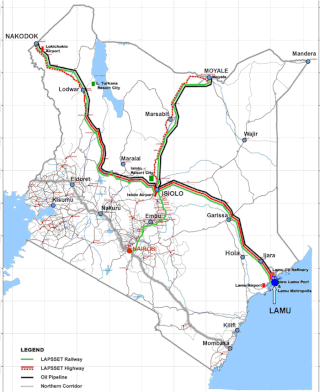
Lamu Port-South Sudan-Ethiopia-Transport (LAPSSET) Corridor project, also known as Lamu corridor is a transport and infrastructure project in Kenya that, when complete, will be the country's second transport corridor. Kenya's other transport corridor is the Northern Corridor, which links Mombasa to Uganda, passing through Nairobi and much of the Northern Rift. Some basic LAPSSET infrastructure has been built. The construction of LAPSSET's main components is currently ongoing with construction of the first berth at Lamu Port completed in October 2019.. Although the project is not formally stalled, its short to medium term success looks increasingly unlikely. Insecurity and political instability in Kenya are mostly to blame for this, as are more commercially viable alternative pipeline options through Tanzania or Ethiopia. The low oil prices since 2015 also affect LAPSSET's commercial prospects.

Yeka is a district of Addis Ababa, Ethiopia.

Arada is a district of Addis Ababa, Ethiopia. Arada got its name from the Oromo "Ardaa Gabaa," meaning "Market Venue." "Ardaa" is a term the Oromo commonly use for places where folks from different directions gather. Initially, they also called it "Birbirsa Gooroo". Over time, the name evolved to signify an urban and modern life style. As of 2011 Arada's population was of 226,000. Arada is one of 10 districts of Addis Ababa, the capital of Ethiopia. Arada is a center of culture and education, with a great number of schools, cultural establishments and annual cultural events. Arada is one of the oldest parts of Addis Ababa and early history is most apparent. Its narrow, sloping streets are dotted with beautiful old one- and two-storey buildings variously adorned with verandas, pillars, bay windows and other decorations in accordance with Indian, Middle-Eastern and European styles. Despite that, there are newer areas. The district's heart is Piazza, a bustling commercial area centered on De Gaulle Square; the imposing city hall, the seat of the city government, built in 1965, and the octagonal neoclassical St Georges Cathedral, built to commemorate Emperor Menelik's defeat of the Italians in the battle of Adwa in 1896 and named after Ethiopia's patron saint Its bustling streets are dotted with stores and boutiques offering European clothing, jewelry, and a variety of other things at relatively greater rates than in other sections of the city.

The Addis Ababa–Djibouti Railway is a standard gauge international railway that serves as the backbone of the new Ethiopian National Railway Network. The railway was inaugurated by Prime Minister Hailemariam Desalegn on January 1, 2018. It provides landlocked Ethiopia with access to the sea, linking Ethiopia's capital of Addis Ababa with Djibouti and its Port of Doraleh. More than 95% of Ethiopia's trade passes through Djibouti, accounting for 70% of the activity at the Port of Djibouti.

Jan Meda Sport Ground or Jan Meda, is a large field in Addis Ababa, Ethiopia. With an area of 25,000 square kilometers, the sport ground hosts Jan Meda International Cross Country as well as social and religious events, most notability, the Timkat celebration held there.
The Addis Ababa City Corridor Project, also known as Smart City Project, is an ongoing urban planning project in the city of Addis Ababa initiated by the Addis Ababa City Administration in December 2022 to upgrade key routes and improve connectivity among the corridors. Due in 2025, the project aims to expand metropolis that incorporates the construction of bicycle routes, spacious pedestrian walkways, better roads, parks, libraries, and additional housing.
Chaka Project is an ongoing urban planning project and part of Addis Ababa City Corridor Project, known as Smart City Project launched on 21 May 2022. The project encompasses the construction of National Palace, residencies, resorts, artificial lake and renovation of forest in Yeka sub-city of Addis Ababa, Ethiopia.
The Adwa 00KM Museum is a public historical museum located in Piasa, Arada district, Addis Ababa, Ethiopia. Inaugurated on 11 February 2024, the museum is dedicated to the Battle of Adwa, the battle of the First Italo-Ethiopian War where Italian forces defeated by the Ethiopian Army in 1896. Part of Adwa Zero KM Project, the museum lies on 1.5 hectares of land.
